Toho Co., Ltd. (TSE:9602) reported H1 FY2027/2 results on October 15: operating revenue down 3.4% to JPY 185.2bn, operating profit down 24.8% to JPY 30.9bn, and net profit down 40.2% to JPY 20.0bn. For Japan’s dominant film and entertainment conglomerate — the company behind Godzilla, the distributor of Detective Conan and Demon Slayer, and the operator of the country’s largest cinema chain — the net profit figure looks like the headline number. It mostly isn’t, once you read into the financial statements. The segment data also splits into three businesses moving in different directions, and the full-year guidance implies a sharp second-half reversal worth checking against as results come in.
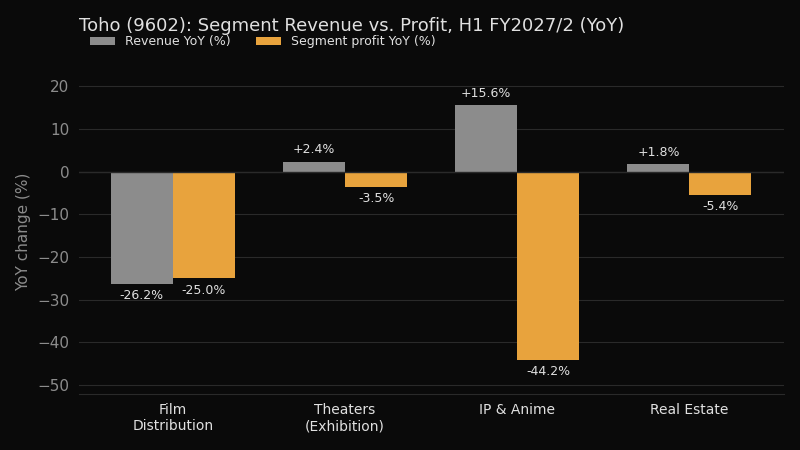 Figure 1: Revenue and segment profit, year-over-year, by business line.
Why net profit fell almost twice as fast as operating profit
Operating profit fell 24.8%, and ordinary income (経常利益, operating profit plus net interest, dividends and FX gains) fell a similar 21.5%, to JPY 33.1bn. Net profit then fell much further, down 40.2% to JPY 20.0bn — and Toho’s financial statements show why. H1 FY2026/2 (last year) included a JPY 8.9bn gain on the sale of investment securities, booked as an extraordinary item, against only JPY 0.7bn of extraordinary losses — a net extraordinary gain of roughly JPY 8.2bn that flattered last year’s base. This H1 had no extraordinary gains at all, and JPY 1.3bn of extraordinary losses, made up of an impairment charge and a fixed-asset demolition cost. Toho’s filing does not state what those relate to; the most plausible connection, though we could not confirm it directly, is the closure of the TOHO Cinemas Yojiro multiplex in Kagoshima noted below, which would naturally generate both kinds of charge. That swing of close to JPY 9.5bn in extraordinary items, not a higher tax rate or a charge against the core business, accounts for most of the gap between a 21.5% decline in ordinary income and a 40.2% decline in net profit. Strip the extraordinary items out — applying each period’s own effective tax rate to ordinary income, and adjusting for the minority-interest share of profit — and the resulting “core” net profit decline comes out to roughly 25%, in the same range as the 24.8% decline in operating profit and the 21.5% decline in ordinary income, not twice as large. That figure is necessarily an approximation rather than something Toho discloses directly, since it depends on assumptions about how the extraordinary items and minority interest split between periods. But however it’s estimated, once last year’s one-time gain is excluded, net profit fell at roughly the same pace as the core business, not nearly twice as fast.
Distribution: a brutal comp, not a demand problem
Toho’s film distribution business (映画営業) reported revenue down 26.2% and segment profit down 25.0%. That looks alarming until you remember what it’s being compared against: the full fiscal year through February 2026 was a record year for Toho, driven by Demon Slayer and Kokuho (国宝) — two of the biggest Japanese box-office hits in years. This half still had real hits of its own — Detective Conan: Highway Fallen Angel, Chiikawa the Movie, Kingdom, a new Doraemon film, and SAKAMOTO DAYS all performed well, and Toho co-developed its first Netflix original film, Gas Human. The lineup did not fail to deliver; it simply isn’t being measured against a normal year.
Theaters: ticket prices are doing the work attendance used to do
This is the segment worth watching more closely. TOHO Cinemas and its affiliates sold 26.23 million admissions in the half, down 4.2% year-over-year. Revenue nonetheless rose 2.4%, because Toho raised ticket prices starting July 1, 2026. Segment profit still fell 3.5% — the price increase covered the revenue gap but not quite the profit gap.
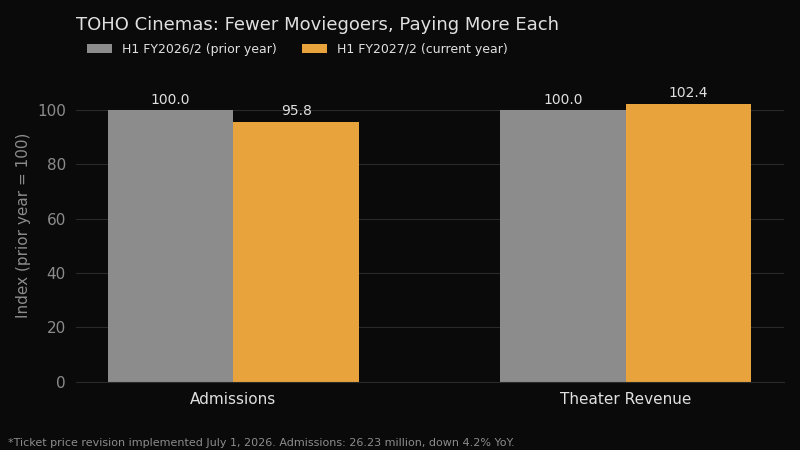 Figure 2: TOHO Cinemas admissions and revenue, indexed to the prior-year period.
This is the generic problem every theater chain in the world is navigating — streaming competition, a post-pandemic shift in moviegoing habits, and a cost base (real estate, staffing) that doesn’t shrink when attendance does — expressed in Toho’s specific numbers. Price increases can offset falling attendance for a while. They cannot do it indefinitely without accelerating the attendance decline they’re meant to paper over. Toho did open two new multiplexes this half (Oimachi in Tokyo, Sakae in Nagoya) and closed one (Yojiro in Kagoshima), a net gain of 8 screens to 725 — so the company is still expanding footprint even as same-store traffic softens.
IP and Anime: real growth, real costs, and a familiar accounting wrinkle
This is where the story gets most interesting, because the segment with the strongest demand story also posted the worst profit decline. Toho’s IP & Anime business — which monetizes streaming and licensing rights to titles it has invested in (Jujutsu Kaisen, Frieren, My Hero Academia, Haikyu!!) plus Godzilla merchandising — grew revenue 15.6% to JPY 43.1bn. Streaming and licensing revenue rose 22.7%; merchandise sales rose 33.8%. There is no sign here of a drying pipeline or of Netflix pulling back — if anything, the opposite: Toho is actively building out a newly acquired UK anime distributor, AnimeLimited, consolidated into the group this period.
Segment profit, though, fell 44.2% to JPY 6.0bn. Toho’s own tanshin does not break down why in yen terms; the most detailed account we found is trade-press reporting on the filing from gamebusiness.jp, which attributes the decline to three factors: upfront investment in overseas expansion, roughly JPY 1.4bn in one-time integration costs tied to the AnimeLimited acquisition, and a timing mismatch in overseas revenue recognition stemming from Toho’s March 2026 corporate split, which transferred its international licensing business to the newly formed TOHO Global. That last item is not new — Toho flagged the identical mechanism in its own Q1 results in July, explaining that overseas revenue booked by TOHO Global lands a quarter later than the associated distribution costs recognized by Toho, and stating that, excluding the accounting effect, the segment would show both higher revenue and higher profit. Full-year guidance for the company was left unchanged at the time.
What we could not independently verify is the exact yen-for-yen split between those three factors for this specific half. Toho’s own filing does not itemize it, and the detailed investor presentation that would typically break it out was not available at the time of writing — so treat the JPY 1.4bn figure as sourced to gamebusiness.jp’s reporting, not to Toho’s own disclosure.
Why the company can absorb all three stories at once
Toho’s real estate segment — rental buildings running at a 0.3% vacancy rate, plus a road-maintenance subsidiary — generated JPY 9.9bn of segment profit in H1, down a modest 5.4% even as distribution and IP & Anime posted much steeper declines. That is roughly a third of Toho’s total operating profit, earned by a business with no exposure to box-office hits, anime licensing cycles or cinema ticket pricing. Real estate and a 73.1% equity ratio, both built up over Toho’s long history as Japan’s dominant studio, are what let a company facing a tough distribution comp, a theater chain leaning on price increases, and an anime business absorbing acquisition costs all at once still leave full-year profit guidance largely intact. A pure-play theater chain facing the same attendance trend Toho is seeing would have nowhere to hide. Toho has real estate, and an IP & Anime business still growing revenue at 15.6%, to lean on instead.
What to watch
Whether H2 can deliver the roughly 16% operating profit growth the full-year guidance implies. Toho’s full-year FY2026/2 operating profit was JPY 67.9bn, of which JPY 41.1bn came in H1 and JPY 26.7bn in H2. This year’s full-year guidance of JPY 62.0bn, against an H1 actual of JPY 30.9bn, implies H2 operating profit of about JPY 31.1bn — up roughly 16% from the JPY 26.7bn Toho posted in H2 last year, a sharp reversal from H1’s 24.8% decline. Whether that reversal is realistic is not obvious either way: Toho’s own reporting credited Q3 FY2026/2 (September–November 2025) specifically for pushing the full year to a record, driven by Demon Slayer and Kokuho, which suggests last year’s H2 — not only H1 — carried the benefit of those hits. If so, this year’s H2 comp may not be meaningfully easier than H1’s was, which would make the guided 16% rebound harder to hit than it looks. Either way, this is the single number in this filing most worth checking against Q3 results in January — if H2 is tracking meaningfully below that pace, the full-year guidance, not the H1 headline, is what should be getting revised in investors’ models.
Q3 results (expected around January 2027) are also the test of the IP & Anime story. If the accounting timing mismatch Toho described in Q1 is genuinely temporary, segment profit growth should partially normalize as TOHO Global’s deferred overseas revenue gets recognized. A segment that keeps posting double-digit revenue growth alongside persistent profit declines, quarter after quarter, would undercut the “temporary” framing.
Theater ticket prices versus attendance, going forward. A second price increase without a recovery in admissions would be a clearer signal that Toho is managing decline rather than navigating a temporary post-pandemic dip.
AnimeLimited’s integration. The one-time costs tied to this acquisition should taper off; whether the UK distributor starts contributing net-positive revenue and profit, rather than just cost, is the clearest test of whether Toho’s overseas anime push is working.
Source: Toho H1 FY2027/2 earnings filing (TDnet) | Toho Q1 FY2027/2 earnings filing (TDnet, July 2026) | gamebusiness.jp: IP & Anime segment detail | Matsui Securities: Toho FY2026/2 full-year and H1/H2 results data | Toho IR: financial highlights | 日本語版
Disclaimer | This article is for informational purposes only and does not constitute investment advice.