On paper, Nextage (TSE:3186) has just delivered one of the strongest results in Japanese retail. For the nine months to August 2026, revenue rose 26.0% to JPY 600.4 billion, operating profit jumped 66.7% to JPY 21.6 billion, and net profit climbed 74.9% to JPY 13.8 billion. The company is now Japan’s largest used-car retailer by sales.
The share price tells a different story. Nextage closed at JPY 2,839 on October 5, the day of the results, roughly a third below its June peak close of JPY 4,235. The gap between those two facts says less about Nextage’s execution than about where the money in Japanese used cars actually goes.
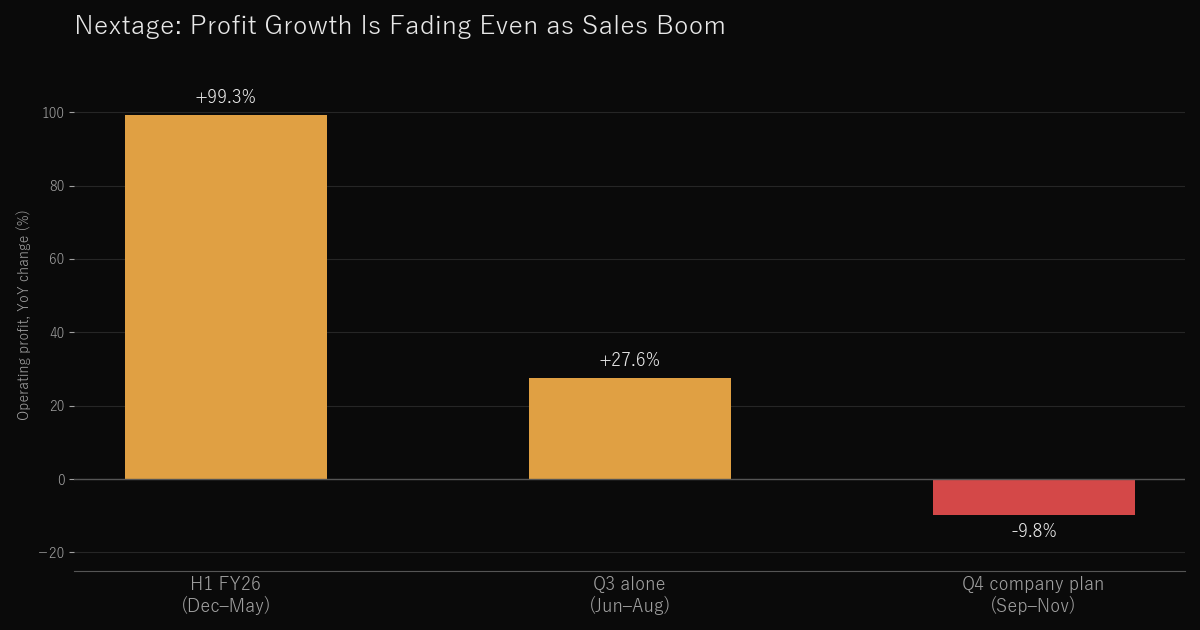 Figure 1: Operating profit, year-on-year change. H1 and Q3 are actuals; Q4 is the change implied by the company’s unchanged full-year plan.
It didn’t miss the opening
Japan’s domestic used-car market is barely growing. National used-vehicle registrations for December 2025 to August 2026 were 4.57 million, up 0.8%. Over the same nine months Nextage sold 390,074 vehicles, up 17.7%, while its store count rose only about 4% (353 to 367). Measured crudely against registrations, its footprint rose from roughly 7.3% to 8.5%. Registrations include dealer-to-dealer transfers, and Nextage’s count includes wholesale, so this is a rough guide rather than a true share figure. The direction, though, is clear.
Much of that volume came from Big Motor. Before its 2023 insurance-fraud scandal, the privately held chain had estimated annual sales of about JPY 580 billion, around 15% of the industry and first place. Its business passed in May 2024 to Itochu-backed WECARS. WECARS reported JPY 258.4 billion in sales for the year to March 2026, a net loss of JPY 11.2 billion, and 242 stores. It kept most of the store network but lost more than half the revenue.
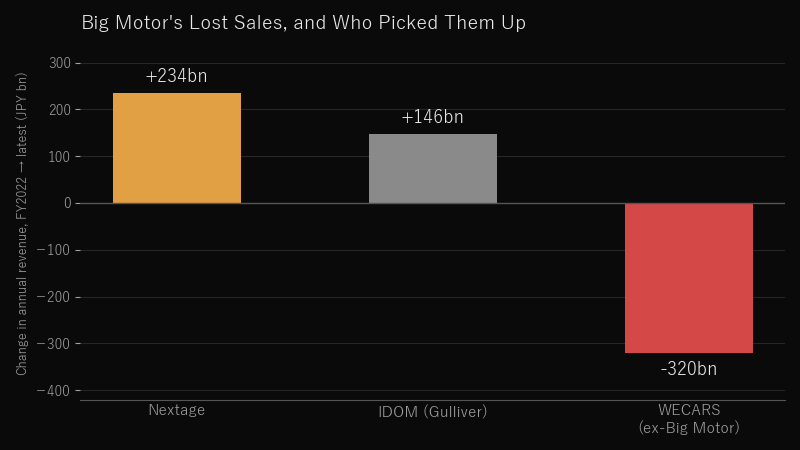 Figure 2: Approximate change in annual revenue. Nextage: about FY2022 to FY2025/11. IDOM: FY2023/2 to FY2026/2 (the base year includes about four months of the Australian business IDOM later sold). Big Motor’s FY2022 figure is a private-company estimate.
Nextage’s sales rose by about JPY 234 billion, to JPY 652 billion in FY2025. IDOM, operator of the Gulliver chain, grew from JPY 416.5 billion to JPY 562.8 billion. Its domestic gain is somewhat understated because the base year includes overseas sales. Revenue is an imperfect proxy, since it is inflated by rising used-car prices and by acquisitions. Even so, the two listed leaders between them absorbed roughly what Big Motor lost. Nextage did not miss the chance created by the market leader’s collapse, but it has not pulled decisively ahead of its main rival either.
The per-car economics did not change
Divide Nextage’s nine-month income statement by the number of cars sold, and the source of the profit surge becomes clear.
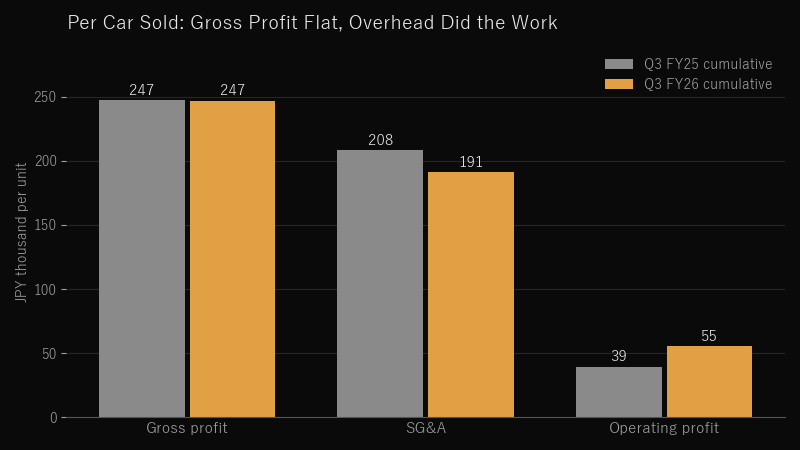 Figure 3: Gross profit, SG&A and operating profit per vehicle sold, nine months to August (JPY thousand).
Average revenue per vehicle rose about 7%, to JPY 1.54 million. Gross profit per vehicle did not move: JPY 247,000 in both years, so gross margin fell from 17.2% to 16.0%. What changed was overhead. Revenue grew 26% while SG&A grew only 8%, so SG&A per car fell from JPY 208,000 to JPY 191,000. That JPY 17,000 saving is almost exactly the rise in operating profit per car, from JPY 39,000 to JPY 55,000. Nextage is not earning more on each car. It is spreading fixed costs over more cars.
This is not just Nextage. IDOM’s FY2026/2 operating margin was also 3.6%, the same as Nextage’s, after IDOM grew sales 35% over three years with operating profit almost flat. Two of the best-run large operators in the country are converging on the same ceiling: about JPY 55,000 of operating profit on a JPY 1.5 million car.
Part of the reason is the product itself. Japanese cars are reliable, so there is little reconditioning work that would let a dealer add value. Japan’s strict inspection regime also pushes a steady supply of young, well-kept cars into the market. Prices are set transparently at dealer auctions, where any licensed buyer can bid. When the product needs little work and the price is public, a retailer has little room to charge a premium. The higher-margin pockets around the sale, such as insurance commissions and repairs, are exactly where Big Motor’s misconduct happened. Nextage itself went through an insurance-related governance problem and a leadership change in 2023–2024.
The value of Japanese cars goes overseas
The quality that makes Japanese used cars hard to profit from at home makes them highly valued abroad. Japan exported a record 1.71 million used vehicles in 2025, up 9.1% and the third straight annual record. The UAE was the largest destination at 253,000 units, followed by Russia, and Africa was the largest region at 370,000. That export flow is equivalent to nearly 30% of domestic registrations, and it is growing while the home market stands still.
Very little of that value stays with Japanese retailers. Research by Kyoto University’s Hiroshi Shioji found that exporters win around 30–35% of all cars sold at Japanese auctions, and that 70–80% of export firms are foreign-run. Those firms’ edge is knowing destination-market pricing, tariffs and local buyers. The dominant model is order-first: the exporter translates the next day’s auction list for overseas dealers, the dealers set maximum bids, and the exporter bids on their behalf. Every car is pre-sold, and the intermediary earns roughly JPY 30,000–50,000 a unit, effectively a commission. Pricing power sits with the overseas buyer.
That has two consequences for domestic retailers. First, a weaker yen strengthens foreign bidders at the same auctions where Nextage buys stock, which raises its purchase costs without raising what Japanese consumers will pay. This is consistent with a 7% higher selling price producing zero extra gross profit per car. Nextage’s push into stand-alone buying stores, which purchase directly from consumers, reads partly as a way to avoid bidding against exporters. Second, the yen tailwind lands with overseas importers and a handful of export specialists, not with listed retailers. The exception proves the rule. BE FORWARD, an export e-commerce firm that sells directly to buyers in more than 200 countries and territories, has reached a unit volume the Nikkei describes as comparable to Nextage’s. It owns the overseas customer, so it captures the margin.
Why the market is selling a beat
Overhead leverage is powerful while volume outpaces costs, but it diminishes as the base grows. Operating profit rose 99.3% in the first half against a weak prior-year base, then only 27.6% in the June–August quarter. On July 6 Nextage raised its full-year operating profit forecast from JPY 24.0 billion to JPY 27.6 billion, but the increase exactly matched the first-half beat, and the company stated that its second-half plan was unchanged. The stock fell from JPY 4,055 to JPY 3,805 on volume five to seven times normal, and has kept falling. The Q3 filing again left the forecast unchanged. It implies September–November operating profit about 10% below last year.
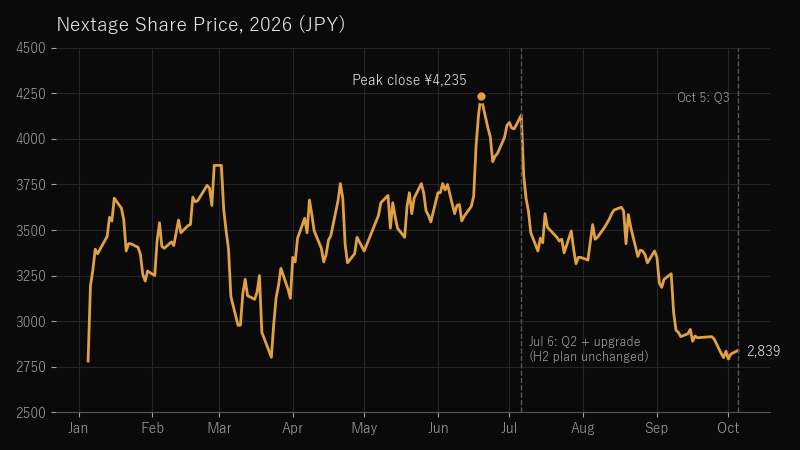 Figure 4: Nextage daily closing price, January–October 2026.
At JPY 2,839 the shares trade at about 13 times the company’s own FY2026 EPS forecast of JPY 218. The market is pricing a domestic retailer whose post-Big Motor share gains are largely behind it and which must now grow inside a flat, thin-margin market.
What to watch
The full-year result in January 2027 will show whether the Q4 plan was simply cautious, and FY2027 guidance will show where growth is meant to come from. The figure that would change the story is gross profit per vehicle. If it rises, Nextage has found pricing power. If it slips as WECARS rebuilds, the overhead leverage will run out quickly. The larger question is strategic. IDOM did go abroad, buying an Australian new-car dealer group in 2015 that reached a 3.5% operating margin. It sold the business in 2022 to concentrate capital on large domestic stores, which it said offered higher returns. Neither listed leader has seriously tried the business where Japanese cars earn their premium: selling them to overseas buyers. Until one does, the market is likely to keep valuing them as what they are today, efficient domestic retailers with a margin ceiling.
Source: Nextage Q3 FY2026/11 filing (TDnet) | Nextage H1 results vs forecast and full-year upgrade, July 6, 2026 (TDnet) | IDOM: Notice of share transfer of Australian subsidiaries (2022) | WECARS company profile | Nikkei: Former Big Motor still mid-rebuild as WECARS | ABA-J: 2025 used-car exports reach record 1.71 million | Shioji, H. “Business Models of Used Car Exports” (J-STAGE) | Nikkei: BE FORWARD, Japan’s little-known used-car export giant | 日本語版
Disclaimer | This article is for informational purposes only and does not constitute investment advice.