Nihon Kokudo Kaihatsu (TSE:1887), a mid-tier general contractor whose civil engineering segment builds dams, rivers, tunnels, roads and water infrastructure at home and in Southeast Asia, reported Q1 FY2027/5 results on October 15: revenue down 7.1%, operating profit essentially flat, net profit up 21.9%. Unremarkable on its own. What makes this company, and others like it, worth a second look is a piece of Japanese bureaucratic plumbing most international readers have never heard of — and that is moving toward a change this year.
A number fixed in 2004, still governing 2026
Every public-works project Japan’s government funds — a bridge, a tunnel, a dam, a river levee — has to clear a cost-benefit test before it gets built. The benefits (reduced flood damage, shorter commute times, avoided accidents) are projected decades into the future and then discounted back to present value, exactly like a corporate NPV calculation. The discount rate used for that calculation is called the social discount rate (社会的割引率), and Japan has used the same figure, 4%, since 2004.
Four percent was a reasonable reference rate in 2004. It has not been a reasonable reference rate for most of the two decades since — a period that included negative policy rates, a decade-plus of near-zero bond yields, and only a recent return to a policy rate around 1.25%. A discount rate meaningfully higher than the actual cost of capital does one specific thing: it penalizes exactly the kind of project — long-lived infrastructure with benefits that accrue over 30, 50, or 80 years — that Japan has the most of still to build or rebuild. A project that would clearly be worth building at a realistic discount rate can fail the official cost-benefit test at 4% and simply never get proposed, let alone funded.
MLIT’s own numbers show how much this matters
The Ministry of Land, Infrastructure, Transport and Tourism has acknowledged the mismatch for several years without fully acting on it. In 2023, a technical-guideline revision kept 4% as the official rate — for continuity with decades of past project evaluations — but allowed project reviewers to additionally cite reference comparison values: 1%, based on the 20-year average real yield on Japanese government bonds (2003–2022, averaging 0.96%), and 2%, based on the 30-year average (1993–2022, averaging 1.58%).
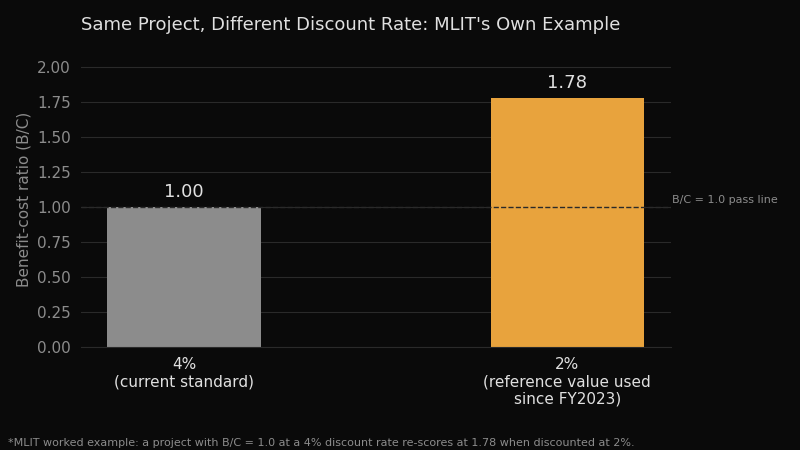 Figure 1: MLIT’s own worked example — the same project’s benefit-cost ratio at two different discount rates.
MLIT’s own illustrative example from that review makes the stakes concrete: a project calculated to have a benefit-cost ratio of exactly 1.0 — the bare minimum to pass — at a 4% discount rate re-scores at 1.78 when the same future benefits are discounted at 2%. That is not a rounding difference. It is the difference between a project that technically fails and gets shelved, and one that clears the bar with room to spare.
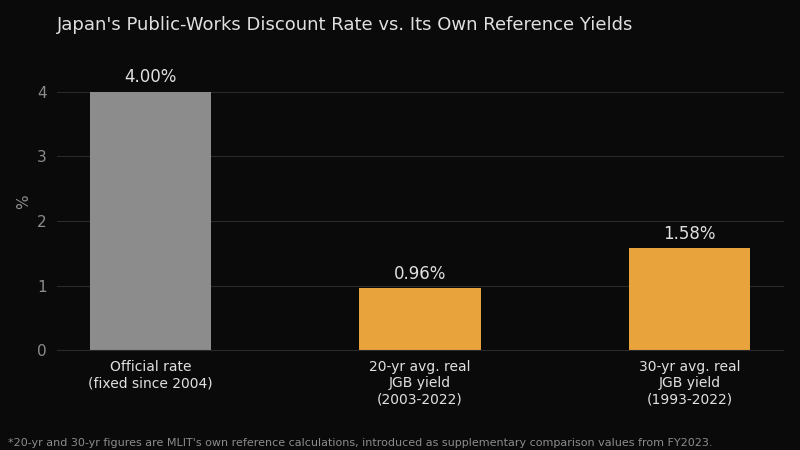 Figure 2: The 4% official rate against MLIT’s own 20-year and 30-year average real bond yield calculations.
2026 is when this goes from footnote to live policy
The 2023 revision left 4% as the binding standard and 1%/2% as supplementary color — reviewers could cite the lower figures, but a project still had to clear the 4% bar to be funded. That is the part now under real review. Basic Policy 2026 (骨太の方針2026), Japan’s annual cabinet-level fiscal and economic policy framework, decided on July 21, 2026 under the Takaichi administration, explicitly calls for revisiting the social discount rate “reflecting recent interest rate conditions,” alongside a broader shift away from pure benefit-cost-ratio screening toward more comprehensive project evaluation.
Following that mandate, MLIT’s Public Works Evaluation Methods Research Committee began meeting this fiscal year on three specific questions: how to improve comprehensive evaluation methodology, how to revisit the social discount rate itself (including which reference indicators — EIRR, real JGB yields, among others — should anchor it going forward), and how to evaluate projects that upgrade or extend the life of existing infrastructure rather than building new. The committee plans three total meetings and aims to finalize its conclusions around winter 2026.
No final replacement rate has been decided as of this writing — readers should treat any specific number as provisional until MLIT publishes its revised technical guideline. But the direction of travel, and the timeline, are now concrete in a way they were not in the 2023 review.
Why this matters more for international readers than it looks
This is the kind of structural detail that is invisible from outside Japan and easy to miss even for domestic investors who don’t follow public-works administrative process closely. It does not show up in any company’s earnings release. It will not generate a press release of its own when the committee concludes its work. The mechanism by which it eventually reaches a construction company’s order book is indirect and slow: a revised technical guideline changes which projects pass evaluation, local governments and ministries then include newly-viable projects in their budget requests for the following fiscal year (April 2027 at the earliest, more realistically FY2028 given Japan’s budget cycle), and from there a project moves through design and tender before any contractor recognizes revenue. This is a multi-year tailwind, not a near-term catalyst — nothing about Nihon Kokudo Kaihatsu’s October 15 results reflects it yet, and nothing will for some time.
What it does represent is a widening of the addressable pipeline for exactly the kind of civil engineering Nihon Kokudo Kaihatsu specializes in: dams, rivers, tunnels, roads, and disaster-prevention and recovery work — long-duration infrastructure that was disproportionately penalized by an above-market discount rate for over two decades. Twenty-two years of inflated hurdle rates likely left a real backlog of projects that were technically rejected, or never formally proposed because they were expected to fail, despite having genuine economic merit once properly discounted. If the review concludes with a materially lower official rate, that backlog becomes addressable in a way it has not been since 2004.
What to watch
The committee’s winter 2026 conclusions. Whether MLIT formally lowers the 4% standard, or simply expands how reference values can be used, determines whether this is a modest refinement or a genuine unlock.
FY2027 and FY2028 budget requests from MLIT and local governments. A visible jump in the number of newly-proposed river, dam, road and disaster-prevention projects citing the revised evaluation framework would be the first concrete sign the policy shift is translating into actual project pipeline, well before it shows up in any contractor’s order backlog.
Order backlogs at civil-engineering-focused contractors. Nihon Kokudo Kaihatsu’s own FY2027/5 full-year guidance already calls for an 11.9% decline in operating profit despite roughly flat revenue — a cautious outlook set before this policy shift could plausibly affect order flow. Whether subsequent quarters, and subsequent fiscal years, show order momentum building as the new evaluation framework filters through to actual budget requests is the real test of this thesis.
Source: Nihon Kokudo Kaihatsu Q1 FY2027/5 earnings filing (TDnet) | MLIT: Report on the Review of the Social Discount Rate (River Project Evaluation Committee, 9th meeting) | MLIT: Technical Guideline on Cost-Benefit Analysis for Public Works Evaluation (September 2023) | 日本語版
Disclaimer | This article is for informational purposes only and does not constitute investment advice.