Seven Japanese software and IT-services companies reported earnings on October 15, 2026, within hours of each other: Baudroie (TSE:4413), OPEN Group (TSE:6572), SHIFT (TSE:3697), TerraSky (TSE:3915), Money Forward (TSE:3994), BayCurrent (TSE:6532) and Globing (TSE:277A). All seven posted double-digit revenue growth. Profit growth was more mixed: only three of the seven grew operating profit faster than revenue, while the rest saw margins compress even as the business kept expanding. None of them builds its own foundation model.
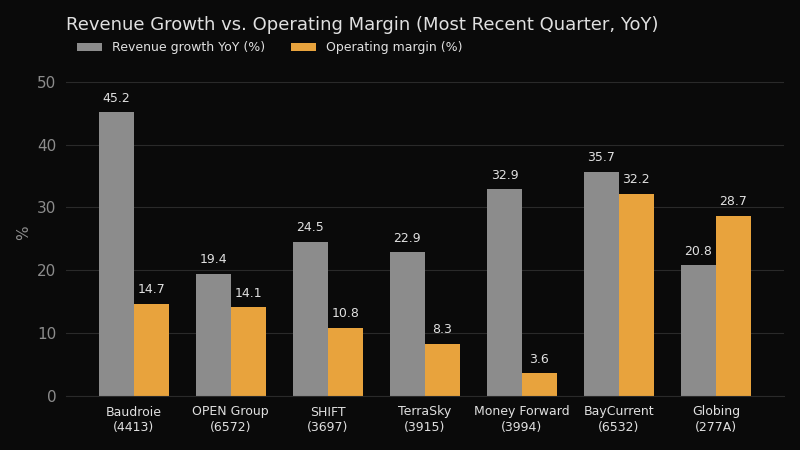 Figure 1: Revenue growth and operating margin, most recent reported quarter (YoY).
The numbers, side by side
| Company | Business | Revenue YoY | Operating profit YoY | Operating margin |
|---|---|---|---|---|
| Baudroie (4413) | IT infrastructure engineering (SoftBank, NTT, KDDI as clients) | +45.2% | +16.5% | 14.7% |
| OPEN Group (6572) | RPA + AI automation (BizRobo!, AUTORO, RoboRobo) | +19.4% | +55.6% | 14.1% |
| SHIFT (3697) | Software testing / QA outsourcing | +24.5% | +11.6% | 10.8% |
| TerraSky (3915) | Salesforce / AWS cloud implementation | +22.9% | +117.3% | 8.3% |
| Money Forward (3994) | SaaS accounting / back-office | +32.9% | loss → profit | 3.6% |
| BayCurrent (6532) | DX / generative-AI strategy consulting | +35.7% | +28.5% | 32.2% |
| Globing (277A) | Joint-initiative consulting + AI agent products | +20.8% | -3.1% | 28.7% |
Only three of the seven — OPEN Group, TerraSky and Money Forward — grew operating profit faster than revenue. TerraSky’s operating profit more than doubled on 22.9% revenue growth, and Money Forward turned a ¥2.0 billion operating loss into a ¥1.7 billion profit. The other four grew profit more slowly than revenue: Baudroie, SHIFT and BayCurrent all posted solid, real profit growth — in BayCurrent’s case, +28.5% — but not fast enough to keep pace with an even faster top line. Globing is the clearest outlier: operating profit actually fell 3.1% even as revenue grew 20.8%, on upfront investment behind a full-year growth plan (+39.8% revenue guidance) — a reminder that “AI-themed growth” doesn’t automatically mean margin expansion every quarter, even at a company running a 28.7% operating margin. The common thread in management commentary across all seven filings is the same phrase, in different words: demand for IT and DX investment remains robust, and AI adoption is accelerating it further.
Nobody here owns the model
None of these seven companies discloses a proprietary large language model. OPEN Group’s newly launched “BizRobo! AI Apps” and “AI Puncher” document-processing tool, TerraSky’s “AI-driven development” push around Salesforce, and Globing’s AI agent products built alongside its consulting practice, all sit on top of third-party model APIs — the kind of infrastructure OpenAI, Google and Anthropic sell by the token. That is the normal pattern for application-layer software in Japan: the model is rented, not built.
This matters for how to read the “AI theme” in this sector. It is not semiconductor-style capital expenditure on training infrastructure. It is usage-based consumption of someone else’s model, wrapped in a product that handles the parts a model alone cannot: who is allowed to approve an invoice, which record a given employee can see, what happens when a workflow step fails, and what the system did six months ago when an auditor asks. That wrapper is the software company’s actual product. The AI call is a feature inside it, not a replacement for it.
Why “SaaS is dead” didn’t happen — to this group, which is mostly not SaaS
Starting in late 2024 and building through 2025 and into 2026, a recurring argument — loud enough that commentators started calling it the “SaaSpocalypse” — held that AI agents would eventually call backend systems directly, cutting out the software interface layer the way middlemen get disintermediated elsewhere. Today’s results argue the opposite happened here, at least so far, but it’s worth being precise about what “here” actually is. Only two of these seven, OPEN Group and Money Forward, are SaaS products in the strict sense of software sold on a recurring subscription. The rest are a mix of IT staffing (Baudroie), outsourced testing (SHIFT), cloud implementation services (TerraSky), and strategy consulting (BayCurrent, Globing). That mix is itself the more interesting finding: it isn’t only subscription software holding up in the AI era. It’s the entire layer of applied software work — staffing, implementation, testing and the consulting wrapped around all of it — that sits between a raw model and a paying enterprise customer, and that layer is growing across every business model represented here.
The reason is structural, not sentimental. A large language model is probabilistic — it is very good at producing a plausible next step, and it has no native concept of “this user is authorized to approve payments up to ¥500,000, that one isn’t.” Permissions, audit trails, approval chains and task state are deterministic problems. Getting them wrong has a cost (a leaked record, an unauthorized transfer, a compliance failure) that a “usually correct” system cannot be trusted to bound. So the model gets slotted in as a component — drafting the email, extracting the line items, flagging the anomaly — inside an application that still enforces who can do what. That application layer is where Baudroie, OPEN Group, SHIFT, TerraSky, Money Forward, BayCurrent and Globing all sit, in different forms: engineering talent, implementation services, testing, consulting, or the software itself.
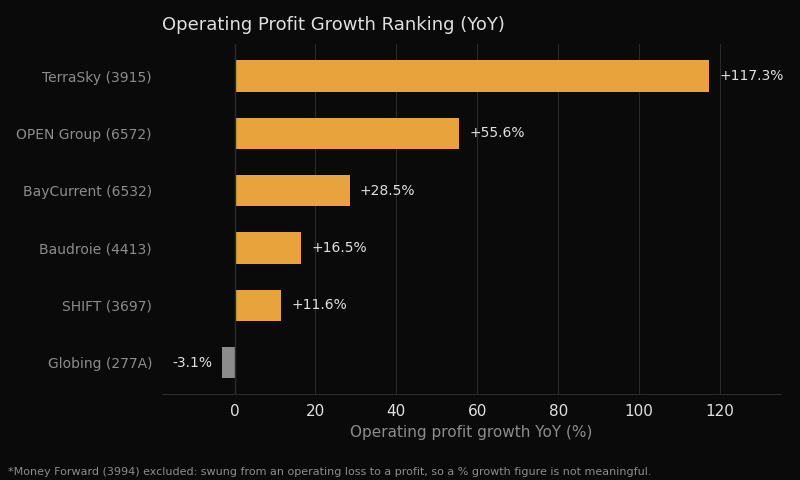 Figure 2: Operating profit growth, YoY, ranked. Globing’s -3.1% shows that even inside this AI-themed cohort, growth and margin don’t move in lockstep every quarter.
What the margin spread is actually showing
The margin gap in the table above — BayCurrent at 32.2% and Globing at 28.7%, against Money Forward at 3.6% — is not a ranking of “who is better at AI.” It mostly reflects business-model structure. BayCurrent and Globing both sell senior consulting hours at high day rates and carry limited direct API cost exposure; Globing’s slight profit dip this quarter came from upfront investment, not margin erosion in the underlying business. Money Forward is scaling a subscription product and is still in the phase of prioritizing annual recurring revenue over margin, which is the normal trade-off for SaaS still building market share. OPEN Group and TerraSky sit in between — implementation and RPA businesses where API consumption is a real cost line, and where the margin trajectory from here is worth tracking.
That trajectory is the thing to watch next. As AI engineering practice matures, routing cheap, routine tasks to smaller and cheaper models — rather than running every request through a frontier model regardless of complexity — is the standard playbook for controlling inference cost. If that discipline shows up in these companies’ numbers, expect operating margins at OPEN Group and TerraSky to keep climbing even as revenue growth moderates. If margins stay flat or compress while revenue keeps growing, it suggests the AI feature set is still in the “ship it first, optimize later” phase. Either way, this cohort’s results over the next two to three quarters are a reasonable proxy for how AI-cost discipline is progressing across Japanese enterprise software generally.
Software adoption is what ends up justifying the infrastructure bet
There is one more thing these results suggest. AI investment is often discussed as two separate stories — infrastructure capex (chips, data centers) and software monetization — as if they competed for the same dollars. It is more accurate to treat them as a loop that reinforces itself: the more deeply AI features get used inside day-to-day software, the more compute demand they generate, and that usage is what eventually justifies the infrastructure spend upstream. What distinguishes this kind of usage from an individual occasionally querying a chatbot is that it runs inside back-office systems continuously and largely out of sight — checking input data, drafting documents, flagging anomalies — which makes it closer to infrastructure that, once embedded in a workflow, keeps getting used, than to a discrete feature subject to a normal adoption-and-replacement cycle. This batch of seven earnings reports is one of the more concrete signs yet that the software side of that loop — AI adoption inside real business workflows — is moving faster than the “infrastructure is ahead of monetization” narrative assumes, and that the justification for the infrastructure bet is starting to show up in actual Japanese corporate earnings, not just in projections.
Source: Baudroie Q2 FY2027/2 earnings filing (TDnet) | OPEN Group Q2 FY2027/2 earnings filing (TDnet) | SHIFT FY2026/8 full-year earnings filing (TDnet) | TerraSky Q2 FY2027/2 earnings filing (TDnet) | Money Forward Q3 FY2026/11 earnings filing (TDnet) | BayCurrent Q2 FY2027/2 earnings filing (TDnet) | Globing Q1 FY2027/5 earnings filing (TDnet) | 日本語版
Disclaimer | This article is for informational purposes only and does not constitute investment advice.