In September, we wrote about two of Japan’s most prominent multi-carrier insurance agencies hit by governance failures within the same year: Advance Create (TSE:8798) technically insolvent after an accounting scandal, and FP Partner (TSE:7388) under a formal Financial Services Agency improvement order for steering customers toward insurers that paid the agency better, rather than toward the product that actually suited the customer.
FP Partner’s results for the nine months through August 2026, filed October 15, update that story, and the direction is not reassuring for the company. Operating profit fell 27.1% year-over-year through the first half (to May). Through nine months it is down 30.8%. Isolating just the third quarter (June–August) — the period furthest removed from the August 2025 order — profit fell 37.8% against the same quarter a year earlier. Fourteen months after the order, the financial hit is not fading. It is getting worse.
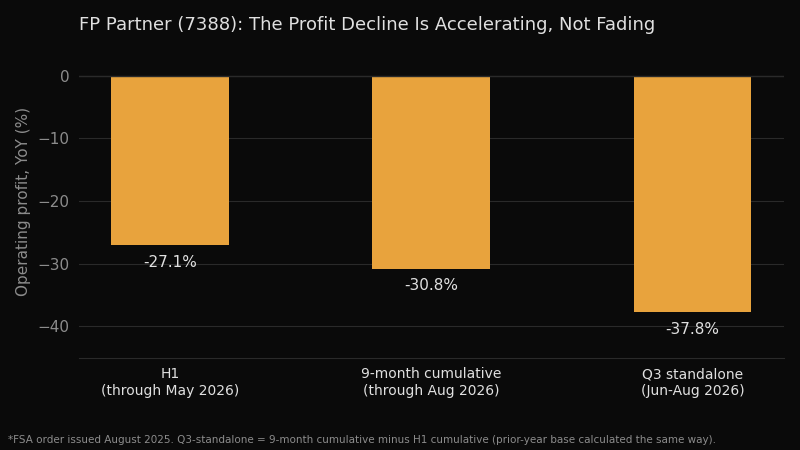 Figure 1: FP Partner operating profit, YoY change, cumulative and isolated by period.
The question worth asking
That raises a sharper version of the question the September piece left open. Is what’s happening to Japan’s multi-carrier insurance agencies consolidation — a shakeout where weaker players get absorbed and stronger ones keep running the same playbook, just with more market share — or is it something closer to the business model itself being regulated out of existence, the way it played out for a comparable industry in the UK over a decade ago?
Japan hasn’t run this experiment before. The UK has.
What the UK did, and what actually happened
The UK’s Retail Distribution Review (RDR), which took effect in January 2013, targeted the same structural conflict FP Partner was cited for: financial advisers earning commission from product providers, with the size of that commission varying by which product got recommended. RDR did not ban multi-provider advice — it banned the undisclosed commission that made it profitable to steer. Advisers had to switch to explicit, disclosed fees charged to the client, and the regulator required a formal minimum qualification level across the industry.
The forecasts beforehand were dramatic. Ernst & Young projected the number of independent financial adviser (IFA) firms could fall by up to 40%, from roughly 16,000 toward 10,000. What actually happened, per the UK regulator’s own adviser-count data from the year after implementation, was narrower and more specific than the doomsday forecasts: independent advisers were essentially flat, 21,684 before RDR to 21,881 a year later. Advisers tied to banks and building societies — the channel that most resembled high-volume, incentive-driven product push — fell 22.8%, from 4,604 to 3,556.
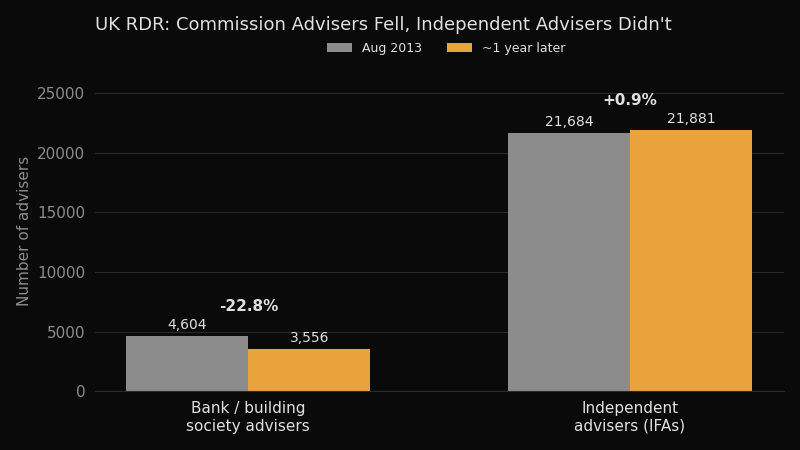 Figure 2: UK adviser headcount, bank/building-society channel vs. independent advisers, before and roughly one year after RDR took effect (FCA data).
RDR did not kill retail financial advice in Britain. It killed one specific distribution channel — commission-subsidized, volume-driven, bank-branch advice — while a different channel, built around an ongoing paid relationship with a client willing to pay directly for advice, mostly survived.
Where the Japan parallel holds, and where it doesn’t
The mapping to Japan is not exact, and it is worth being precise about where it breaks down. FP Partner and Advance Create both run outbound, appointment-driven sales forces — the Japanese analogue of the UK’s bank-branch channel in spirit, if not in ownership structure: a model where an employed or contracted salesperson’s income depends on closing a scheduled meeting, and where the agency, not the customer, is the one paying attention to which insurer’s commission schedule is most generous. iRIC (TSE:7325), which runs walk-in “Hoken Clinic” shops rather than outbound sales, is structurally closer to the UK’s surviving channel — a customer who walks in has sought out the comparison on their own terms, in a less persuadable frame of mind than one who just answered a phone call.
But iRIC is not the UK’s fee-based IFA model either. It is still commission-funded, not fee-funded by the client. Japan has no meaningful mass-market tradition of paying a financial adviser directly, the way post-RDR Britain’s surviving IFA channel does. That is the gap in the analogy, and it matters: if Japan’s regulatory tightening keeps pushing in the RDR direction — and the June 2026 Insurance Business Act revision, which adds compliance-officer and complaint-handling requirements for large multi-carrier agencies, is a step in that direction even though its proximate trigger was an unrelated auto-insurance scandal — there is no obvious Japanese equivalent of the UK’s fee-based IFA sitting ready to absorb the demand that an outbound, commission-driven sales force currently serves.
The part of the UK story that gets left out
The cleaner, more comfortable version of the RDR story is “commission-driven advisers mostly survived, so don’t worry.” The part of the UK outcome that gets dropped from that version is the “advice gap.” Industry and academic research after RDR — including Bayes Business School’s “Guidance Gap” study — found that only a minority of UK consumers, concentrated among wealthier households, were willing to pay an explicit fee for advice. Households with smaller amounts to invest or insure, who had previously received advice bundled “for free” inside a commission-paid sale, were the ones most likely to lose easy access once that bundling was banned. The industry consolidated toward serving people who could pay; it did not scale a cheap alternative fast enough to fully replace what the mass market lost. Some of that gap in Britain has since been filled by lower-cost robo-advice and execution-only platforms, but that took years, and the gap was real in the meantime.
If Japan’s multi-carrier agency channel contracts the way the UK’s bank-advice channel did, the open question is not just “what happens to FP Partner’s stock.” It is whether Japanese households who relied on a free, in-person agent visit to compare life and medical insurance products lose that access before any cheaper, structurally-cleaner alternative — direct online comparison, insurer-run digital channels, or a Japanese equivalent of fee-based advice — is mature enough to take its place.
What to watch
FP Partner’s next quarter. A fourth consecutive quarter of worsening year-over-year profit decline, rather than stabilization, would be the strongest evidence yet that this is a structural repricing of the business, not a one-off compliance cost.
Whether the smaller-agency consolidation wave continues. FP Partner disclosed completing three acquisitions of smaller agencies in the quarter even as its own results worsened — smaller players finding the post-order economics unworkable and selling their books is itself a sign of the business model compressing, not just one company’s problem.
Whether a lower-cost advice channel gains ground in Japan. Direct-to-consumer digital insurance sales and any Japanese fee-based advice model are the closest domestic equivalents of what eventually, slowly, filled part of the UK’s advice gap. Their growth rate — or absence of growth — is the best available signal for whether Japan is heading toward a UK-style advice gap of its own.
Source: FP Partner Q3 FY2026/11 earnings filing (TDnet) | FP Partner H1 FY2026/11 earnings filing (TDnet) | Our September 2026 piece on the industry’s governance crisis | 日本語版
Disclaimer | This article is for informational purposes only and does not constitute investment advice.