For the first time in the euro era, French government bonds yield more than Italy’s. Five-year credit default swaps on France have widened to 72–81 basis points, the highest level since 2013, while the same contract on Italy has tightened to a multi-year low. The 10-year France–Germany spread has blown out past 110 basis points, a level last seen during the 2012 eurozone debt crisis, while Italy’s spread over Germany has fallen to 68 basis points, its narrowest since 2010. Italy — the country markets have spent three decades treating as the eurozone’s structural risk case — is now being priced as the safer bet of the two.
This isn’t a story about debt levels. Italy’s public debt is forecast at 137.4% of GDP in 2026, second only to Greece in the eurozone and well above France’s 119.3%. If markets priced sovereign risk mechanically off the debt ratio, this reversal couldn’t happen. It happened anyway, and the reasons point to three separate questions that matter more than the number everyone watches.
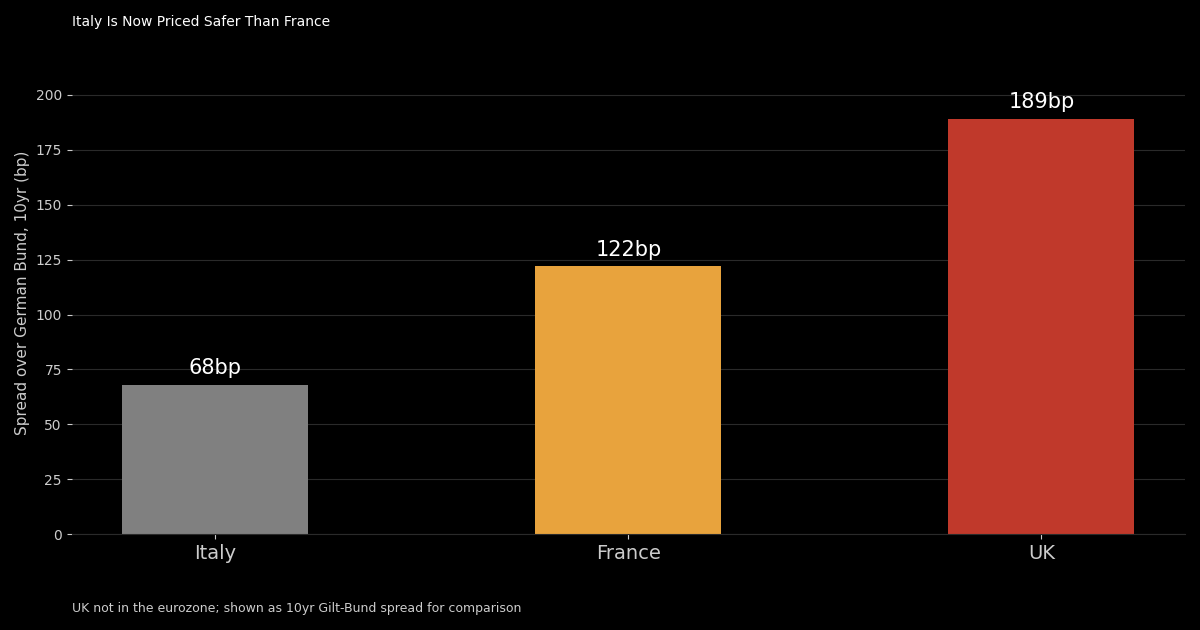 Figure 1: 10-year government bond spread over German Bunds (basis points).
Why sharing a currency makes default a real question
A sovereign that borrows in a currency it controls can always print more of it to meet a nominal obligation — that’s the baseline reason US, UK, and Japanese government bonds are not priced the way emerging-market or eurozone debt is. France and Italy don’t have that option. Neither controls the European Central Bank, so a French or Italian bond is, in a narrow technical sense, closer to foreign-currency debt than to a true sovereign-currency instrument: no national government can force the ECB to backstop its own paper. That structural fact is why CDS markets on eurozone sovereigns price something close to genuine default risk, in a way they don’t for Tokyo, London, or Washington.
It would be a mistake to conclude currency sovereignty is a free pass, though. The UK controls its own currency and its own central bank, and its 30-year gilt yield still hit 6.03% on October 1 — the highest since 1998 — while its 10-year spread over Bunds widened to 189 basis points, the most since the 2022 mini-budget crisis. Financial commentary has started calling it “the Italianisation of Britain’s finances.” The UK’s debt-to-GDP ratio is the highest since the early 1960s, the Office for Budget Responsibility has flagged shrinking fiscal headroom, and the Bank of England is projecting inflation near 4% into 2027 against a November 26 budget investors are treating as a genuine risk event. Owning your own printing press changes what “default” means; it does not exempt you from the market asking whether you can run a credible budget.
The real divide: can the government actually govern
This is where France and Italy diverge sharply, and where the explanation that fits the data is almost entirely political rather than fiscal.
France’s crisis traces to a specific decision: President Macron’s snap dissolution of the National Assembly in June 2024, called after a poor European election result. It produced a parliament split roughly three ways — the far-right National Rally, Macron’s centrist bloc, and the left-wing New Popular Front alliance — with no combination commanding a working majority. Since then, prime ministers have cycled through in rapid succession. The most recent, Sébastien Lecornu, was reappointed just four days after resigning and saw his first government collapse after 27 days, toppled by 364 votes that included the far-right National Rally (123), the far-left La France Insoumise (71), the Socialists (66), and the Greens (38) — opposite ends of the ideological spectrum voting together against the same budget, for entirely different reasons. The budget itself targeted a deficit cut from 5.8% to 4.6% of GDP through roughly EUR 43.8 billion in measures: eliminating two public holidays, freezing public-sector pay and benefits, cutting civil service headcount, and a new wealth tax.
Italy, under Giorgia Meloni’s government, has run the same fiscal playbook without the same collapse. Its medium-term plan laid out a declining deficit path — from 5.3% of GDP in 2023 to 4.3% in 2024, 3.6% in 2025, and a targeted 2.9% in 2026, clearing the EU’s 3% threshold — and has broadly delivered on it. Fitch upgraded Italy’s credit rating along the way. The distinguishing factor isn’t that Italian voters are more unified or that the country’s debt problem is smaller; it’s that Meloni’s government commands a working majority that can pass a budget and stick to a plan, while France’s cannot pass one at all.
Who bears the pain determines whether it passes
Look at what each government actually asked its population to accept, and the difference in outcome stops looking mysterious.
France’s package concentrated its costs on a small number of highly organized, highly visible constituencies: public-sector workers facing a pay freeze and headcount cuts, and the broader population losing two public holidays. The CGT union framed the pay-index freeze — unmoved since July 2023 — as an attack on “benefits won over half a century,” and followed through with roughly 170 planned demonstrations nationwide, more than 100,000 protesters, and strike participation above 40% among kindergarten and primary school staff. A concentrated, organized constituency with real mobilizing capacity was asked to absorb a visible, immediate loss, and it fought back hard enough to take the government down with it.
Italy’s 2025 budget took a different shape. It included an income tax cut for lower and middle earners — merging the bottom two brackets so someone earning EUR 28,000 a year pays 23% instead of 25% — funded by asset sales, an extension of the pension eligibility age, and a windfall contribution from banks that had benefited from high interest rates. Every one of those funding sources lands on a constituency that is either diffuse (future retirees, whose loss is abstract and years away), unsympathetic (banks that just posted record profits), or simply invisible (state asset sales). Meanwhile the median voter saw an immediate, visible tax cut. That’s a textbook application of a basic principle in political economy — concentrated, visible costs generate organized resistance; diffuse or unpopular costs generally don’t — and it is close to the whole explanation for why one government fell and the other didn’t.
The same pain logic shows up in foreign commitments too
This dynamic isn’t confined to domestic budget lines. NATO itself classifies both France and Italy as “stressed Allies” unlikely to meet the bloc’s new defense-spending target — 3.5% of GDP on core defense plus 1.5% on related investment by 2035 — with both expected to spend only just above 2% of GDP in 2026. On paper, the external pressure is roughly symmetric between the two countries. Germany, by contrast, amended its constitutional debt brake to fund a sharp defense buildup toward 3% of GDP by 2027, and has publicly criticized France for falling behind.
Where the two diverge is in what happens when that pressure meets a specific promise. In early 2024, under criticism for contributing less than Germany, Macron pledged EUR 3 billion in military aid to Ukraine for the year. France will fall roughly a third short of that figure, delivering just over EUR 2 billion, with the shortfall explicitly tied to the need to find EUR 10 billion in budget savings. The government collapse itself has openly raised the question of whether France can sustain even its reduced commitments going forward. Tellingly, France’s eventual 2026 budget still found an additional EUR 6.7 billion for the Defense Ministry’s own domestic spending — military modernization proved politically defensible in a way that aid to Ukraine, which has no organized domestic constituency lobbying for it, did not. It’s the same logic that explains the CGT’s strikes and Italy’s choice of who funds its tax cuts, applied one level up: costs with an organized domestic defender get protected; costs without one get cut first.
The stakes extend beyond this year’s aid figures. A country that positions itself as Europe’s leading military power and the most vocal advocate for continued Ukraine support, but then falls short of its own modest pledges because its parliament cannot pass a budget, pays a cost that doesn’t show up in any single spreadsheet: credibility with allies who are deciding how much to rely on French commitments going forward.
The tax-collection head start Italy had and France didn’t
One specific mechanism inside this story is worth isolating, because it shows up as a hard number rather than a political judgment call: digitizing tax collection to close the gap between taxes owed and taxes actually paid.
Italy made B2B e-invoicing mandatory nationwide in 2019, giving every transaction near-real-time visibility to tax authorities and making the classic fraud schemes — fake invoices, under-reporting, carousel VAT fraud — much harder to run. Italy’s VAT gap fell from 26.9% of theoretical liability in 2015 to 21.3% by 2019, and authorities recovered more than EUR 2 billion from evasion enforcement in 2022 alone.
France is only now catching up. Its own mandatory B2B e-invoicing regime doesn’t launch until September 1, 2026, with a “soft landing” grace period on enforcement running through the end of the year — seven years behind Italy’s equivalent system. The timing could not be worse: France is facing an estimated EUR 10 billion VAT shortfall for 2025 alone, with authorities citing organized fraud schemes and under-reporting as contributing causes, and officials have said e-invoicing alone will likely recover only a couple of billion euros of that hole, not close it.
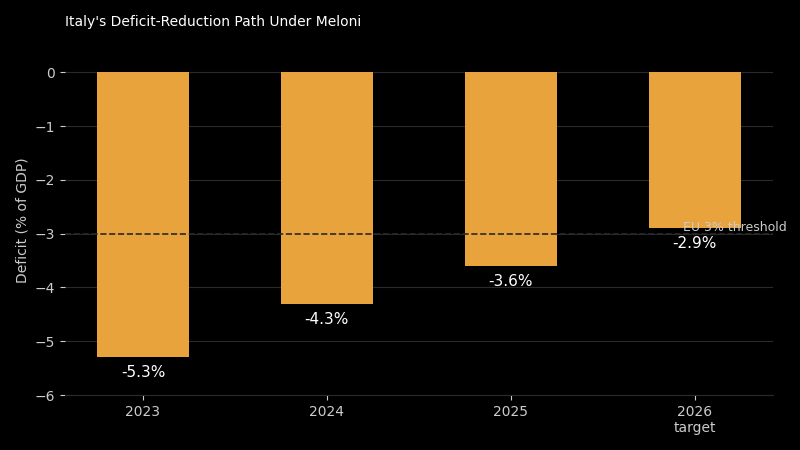 Figure 2: Italy’s deficit-to-GDP trajectory, 2023–2026 (government targets, delivered).
Japan offers a useful third data point here, not as part of this specific crisis but as a comparison on the same mechanism. The National Tax Agency began deploying AI-driven audit targeting in fiscal 2023, and additional income-tax assessments reached a record JPY 140 billion in the year through June 2024 — the highest since statistics began in 2009 — with the agency crediting AI explicitly. In July 2025 the same AI screening was extended to every inheritance tax filing since 2023, and a next-generation tax administration system is due to go live this September. None of that solves France’s specific hole, but it illustrates the same general point from the other direction: digitized, AI-assisted enforcement is a revenue lever most governments can pull with comparatively little of the organized political resistance that spending cuts provoke, because the people it targets — tax evaders — have no equivalent of a public-sector union.
Why this hasn’t hit the euro itself — yet
Given the scale of the French bond selloff, the obvious next question is what this does to the euro itself. The answer so far is: less than the bond market stress alone would suggest. Currency strategists estimate the euro is currently pricing in only about a 1% risk premium tied to French political and fiscal risk — well below the roughly 3% premium that has accompanied previous episodes of severe sovereign spread widening in the currency bloc. If that gap closes, the scenario analysts point to would take EUR/USD toward 1.110, a meaningfully weaker euro than current levels. For now, though, French political and fiscal developments are not being treated by currency markets as a major risk to the euro itself.
That distinction matters, and it’s the more interesting part of the story. In 2011–2012, eurozone stress was treated as existential risk to the currency bloc because it was multi-country and raised real questions about whether the euro would survive in its current form — Greece, Portugal, Ireland, Spain, and Italy were all under pressure simultaneously, and markets had to price the probability of a breakup. This time, the stress is concentrated almost entirely in France, while Germany remains stable and Italy — historically the eurozone’s other chronic risk case — is improving. Markets appear to be reading this as an idiosyncratic French governability problem rather than a currency-bloc-wide crisis, which is precisely why French CDS and OAT spreads have blown out while EUR/USD has moved only modestly. Whether that distinction holds is itself one of the things worth watching: a eurozone that can absorb one large member’s political dysfunction without currency contagion is a very different proposition from one that can’t.
Japan’s different protection
Japan sits outside this entire framework for a structural reason distinct from currency sovereignty or political stability: ownership. More than 90% of outstanding Japanese government bonds are held by domestic investors — the Bank of Japan itself, domestic banks, insurers, and pension funds — and Japanese market participants rarely trade the country’s own sovereign CDS at all. That ownership structure means Japan is far less exposed to the mechanism driving stress in France, Italy, and the UK: a wave of foreign investors reassessing risk and selling in size. It is also why CDS pricing on Japan and the actual JGB cash market can diverge meaningfully, something that doesn’t happen the same way in markets dominated by international holders.
That insulation is real, but it is not unlimited, and it is a separate story from the one here — we covered it in detail in a companion piece on why the Bank of Japan is now losing money on its own rate hikes and what that means for the yen. The short version: Japan’s protection comes from who holds the debt, not from the debt being small (at roughly 260% of GDP, it is the highest in this entire comparison) or from its government being unusually effective. France shows what happens when political governability breaks down inside a currency union; Italy shows that a credible, deliverable plan can offset even the eurozone’s second-highest debt load; the UK shows that controlling your own currency doesn’t buy immunity if investors doubt your budget math. Japan’s specific answer to all three pressures is the same one: a captive domestic buyer base that has, so far, been willing to keep holding bonds yielding far less than the risk-conscious money demands everywhere else in this comparison.
What to watch
France’s next flashpoint is the 2026 budget itself — whether Lecornu’s government, or whatever replaces it, can pass anything resembling the proposed deficit path before the political clock runs further down toward the 2027 presidential election. Italy’s is whether its 2.9% deficit target for 2026 actually lands, validating three years of a plan that markets have started to believe. The UK’s is the November 26 budget, the single event investors have identified as the next test of whether gilt yields keep climbing toward the levels markets are already pricing. And for all three, the tax-enforcement story is worth tracking on its own: whether France’s delayed e-invoicing system, once live, actually starts closing a gap that compounds annually, or whether — like much else in this story — it arrives too late to matter for the crisis that’s already here.
Source: French 5-year CDS widens to multi-year high | France-Germany bond spread hits 2012 levels | France now riskier than Italy by CDS pricing | Italy BTP-Bund spread narrows to multi-year low | Italy’s fiscal consolidation plan and Fitch upgrade | Italy’s 2025 budget: tax cuts funded by pension age and bank levy | UK 30-year gilt yield hits 1998 high | UK gilt-Bund spread widest since 2022 mini-budget | Italy’s e-invoicing and VAT gap reduction since 2019 | France’s EUR 10bn VAT shortfall and delayed e-invoicing | France e-invoicing mandate timeline | France government collapse vote breakdown | French public-sector strikes over austerity budget | Euro’s limited reaction to French fiscal risk, risk premium analysis | France and Italy classified as “stressed Allies” on NATO spending target | Germany criticizes France for lagging on defense spending | France set to fall short of EUR 3bn Ukraine aid pledge | France’s 2026 budget still raises Defense Ministry spending by EUR 6.7bn | Japan’s AI-driven tax enforcement, record assessments | Japan JGB domestic ownership share | Our companion analysis: why BOJ hikes aren’t strengthening the yen | 日本語版
Disclaimer | This article is for informational purposes only and does not constitute investment advice.