The Bank of Japan has raised its policy rate three times in 2026 — to 0.75% in June, then 1.0%, then 1.25% in September, the fastest pace of tightening since Kazuo Ueda became governor and the highest policy rate since 1995. Standard theory says higher rates should pull the yen stronger. Instead, Japan’s own exporters have spent the year revising their planning assumptions in the opposite direction: Toyota now assumes JPY 160 to the dollar, Honda JPY 155, and the average first-half assumption across 103 major manufacturers broke JPY 150 for the first time since the survey began in 2011. If the BOJ is trying to defend the currency, the currency does not seem to have gotten the memo.
It would be easy to write a version of this piece suggesting Governor Ueda has it in for life insurers, regional banks, and young households with variable-rate mortgages — the hikes are, after all, the direct cause of a 30 trillion yen hole in the insurance industry’s bond portfolio and a wave of still-rising mortgage payments. That would be the wrong story. What follows is the right one: a monetary authority raising rates it is visibly losing money on, ahead of inflation data that hasn’t yet validated the move, while the balance sheet damage lands first and hardest on the private institutions least equipped to absorb it.
Why ¥150 looks like the new floor, not a target
Japan’s own companies are the clearest signal here, because they have money on the line. A survey of 103 major listed manufacturers found their average dollar assumption for the fiscal year beginning this April at JPY 151.4 — the first time in the survey’s history it has cleared JPY 150. Toyota raised its full-year assumption to JPY 160 (and EUR 181) when it upgraded guidance in August. Honda moved from JPY 145 to JPY 155. ENEOS is planning FY2027/3 around JPY 155 and USD 85 per barrel of Dubai crude, against a market that has spent the past year swinging between USD 68 and over USD 120 on Middle East supply risk. Across every one of these companies, the pattern is the same: initial assumptions set more conservatively (stronger yen) than what the market actually delivered, followed by upward (weaker-yen) revisions once results come in. Companies keep betting on a stronger yen than they get.
Two theories of a currency, and only one fits 2026
The textbook explanation for a currency is the interest rate differential: raise your own rate, narrow the gap with other countries, attract capital, strengthen the currency. That theory explains why USD/JPY stayed in the JPY 150s–160s through 2026 even as the BOJ hiked three times — the Federal Reserve’s policy rate remains well above Japan’s even after this year’s moves, so the gap that funds yen-carry trades (borrow cheap yen, hold higher-yielding dollar assets) has narrowed only modestly. Forecasters expect the yen to firm only gradually, as US rate cuts — not Japanese hikes — close that gap from the other side.
It does not explain everything, though. The same zero-rate Japan produced a dramatically strong yen in 2011–2012, when the Tohoku earthquake and the European debt crisis triggered a global flight from risk and the unwinding of carry trades funded in yen — investors who had borrowed yen to buy higher-yielding assets abroad rushed to buy it back to repay those loans, regardless of what the Bank of Japan’s own policy rate happened to be. Japan’s rate level was not the driver; the direction of global risk appetite was.
The other candidate explanation is the stock of money itself. The Bank of Japan’s balance sheet expansion since 2013’s quantitative and qualitative easing dwarfs anything in Japan’s monetary history, and a currency’s long-run value is a function of how much of it exists relative to the economy behind it — a view closer to the quantity theory of money than to interest-rate parity. On this view, the BOJ’s hikes are tinkering with the flow (this month’s rate) while the stock (two and a half decades of balance sheet growth) has already set a much weaker structural floor underneath it. Both explanations likely hold simultaneously: the stock sets the level, the flow — rate differentials, carry trade positioning, risk sentiment — explains the swings around it.
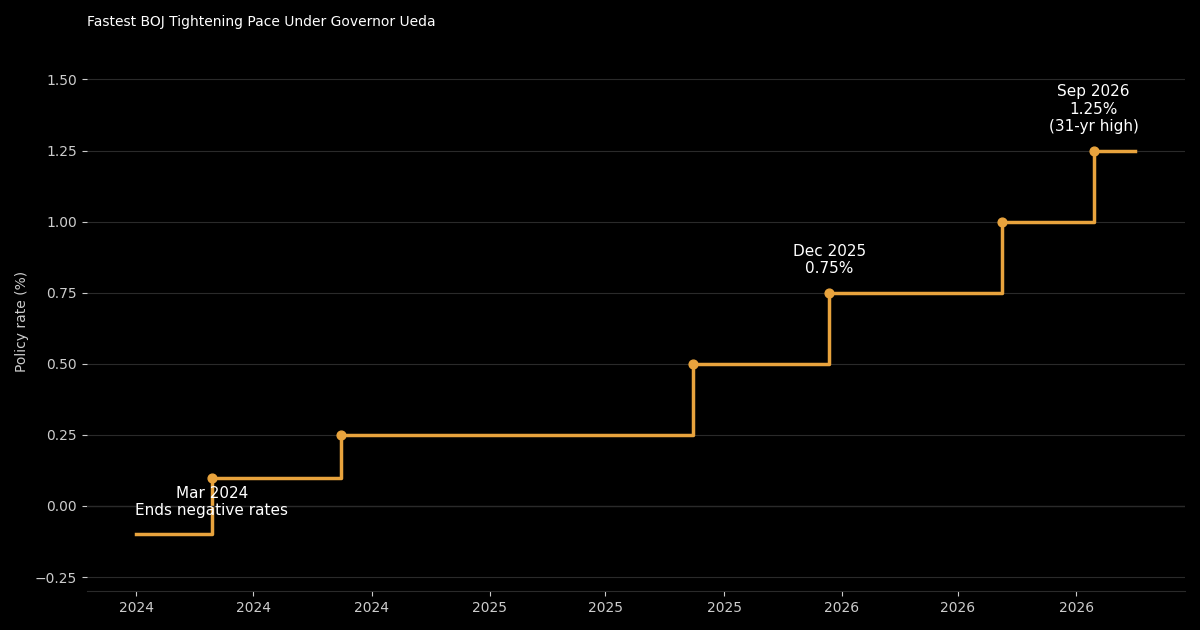 Figure 1: Bank of Japan policy rate, 2024–2026.
The BOJ is losing money on its own rate hikes
Here is the detail that makes this cycle unusual: the BOJ is not a disinterested party raising a number on a dashboard. It is now losing money every time it does it. In the first half of fiscal 2025, the BOJ earned about JPY 1.182 trillion in interest on its JGB holdings and paid out about JPY 1.268 trillion in interest on the reserves commercial banks hold with it — a net deficit of roughly JPY 86.3 billion, at a policy rate of just 0.75%. The mechanism is a mismatch: most of the BOJ’s JGB holdings are long-dated bonds bought at near-zero yields during the easing years, carried at amortized cost, so the interest they generate barely moves when the policy rate changes. The interest the BOJ pays on reserves, by contrast, moves immediately and in full with every hike. Every 0.25-point increase widens the gap.
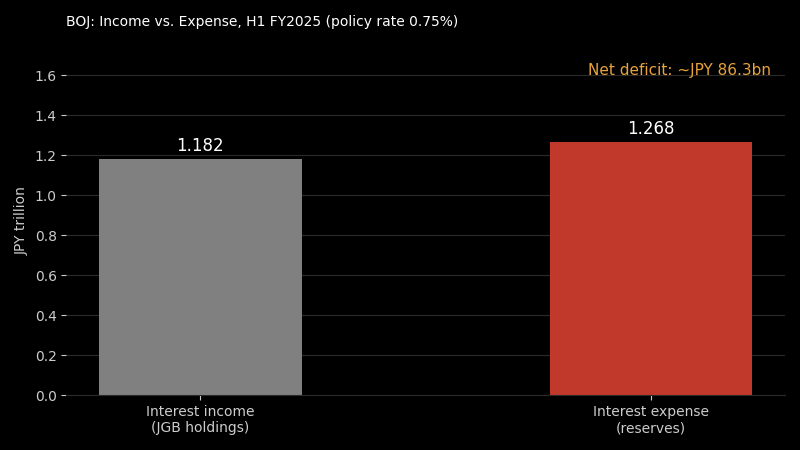 Figure 2: BOJ interest income vs. interest paid on reserves, H1 FY2025 (BOJ financial statements).
The scale compounds further out on the balance sheet. The BOJ’s unrealized losses on its JGB holdings reached JPY 45.4 trillion at the end of March 2026, up from JPY 28.6 trillion a year earlier — against a capital base of roughly JPY 5–14 trillion, depending on which measure is used. Because the BOJ carries these bonds at amortized cost rather than market value, and because its own quantitative tightening plan works by letting bonds run off at maturity rather than selling them into the market (long-term JGB purchases are being cut by roughly JPY 400 billion per quarter, from JPY 6 trillion a month toward JPY 3 trillion), most of that JPY 45.4 trillion will likely resolve itself at par as bonds mature rather than crystallizing as a realized loss. What it does not resolve is the flow problem: the BOJ’s own modeling, assuming short rates eventually reach 2% and the long-short spread compresses to 0.25 points, points to annual losses of up to JPY 2 trillion in fiscal 2027 and 2028. A roughly JPY 100 trillion unrealized gain on the BOJ’s ETF holdings offsets this on paper, but it is accounted for entirely separately — Japanese central bank accounting does not net bond losses against equity gains — and the BOJ’s own ETF sale policy explicitly prioritizes avoiding further losses and market disruption over monetizing that gain, with a stated disposal horizon measured in centuries, not years.
None of this makes the BOJ insolvent in the way a private bank would be. A central bank that issues the currency its liabilities are denominated in cannot be forced into bankruptcy by its creditors. But the channel through which a damaged BOJ balance sheet becomes a real-world problem is not insolvency — it is the credibility of the yen itself, the same mechanism behind the structural weakness described above. A central bank that keeps losing money defending its own hikes is, in a narrow sense, spending its credibility to buy inflation control it has not yet proven it needs.
Hiking into inflation that hasn’t arrived
That last qualifier matters. Japan’s core CPI has undershot the BOJ’s 2% target for eight consecutive months, running at 1.7% in August, down from 1.8% in July. The BOJ’s own policy board has been split on this point — some members have pushed for hikes every few months on concern about corporate price pass-through and the risk of inflation overshooting later, while others have warned explicitly that moving now risks curbing corporate investment and hurting production and employment. The board that is hiking fastest under Governor Ueda is doing so on a forward-looking, preemptive bet about future inflation risk, not in response to current data confirming it.
So far, that bet has not shown up as damage to the labor market. Japan’s unemployment rate fell to 2.4% in July 2026, a level last seen in mid-2025, and the job-openings-to-applicants ratio has held steady at 1.18. Real wages rose 1.9% year-on-year in April, the fourth straight month of gains, and the share of small and mid-sized companies implementing wage increases has risen to 82.3%, narrowing the gap with large companies to 11.5 points. On these numbers, the preemptive bet looks, for now, like it is not costing jobs. Whether it costs growth is a question next month’s interim earnings season should start to answer.
Where the pressure actually lands
If the BOJ’s own balance sheet can absorb this cycle — eventually, awkwardly, but without default — the parts of the financial system that cannot are where the real constraint on further hikes is likely to come from.
Japan’s 13 largest life insurers were sitting on JPY 30 trillion in unrealized losses on domestic bonds as of June 2026, up roughly 60% from a year earlier and now larger than the unrealized gains on domestic equities that have traditionally offset them. The mechanism is structural, not a choice any one insurer made badly: life insurers match multi-decade policy liabilities with multi-decade JGBs, so every insurer in the industry carries broadly the same exposure, differentiated mainly by capital buffer. Sony Financial Group has already shown what happens when that buffer is thin — its net profit fell 30% on bond losses at subsidiary Sony Life. The industry’s new economic-value-based solvency regulation (ESR), which took effect this fiscal year after two decades in development, will translate these mark-to-market losses into regulatory capital ratios for the first time, with first disclosures expected around this fiscal year’s securities filings. Japan’s life insurance surrender rate is already at a record high — the one trigger that forces insurers to sell bonds before maturity and convert paper losses into real ones, the exact mechanism that broke several mid-sized life insurers in Japan in the early 2000s.
Regional banks carry a smaller but directionally similar exposure, concentrated among banks that extended bond duration later and more aggressively than the megabanks, which had already repositioned ahead of the hiking cycle under Basel III interest-rate-risk discipline. The logic that drove regional banks into longer-dated JGBs in the first place was a reach for yield: with regional loan demand structurally weak, a small term premium on 10-year-plus bonds was one of the few ways to generate a positive spread, on a bet — like much of the industry’s — that normalization would be gradual. It has not been.
The distribution channel selling these products is simultaneously breaking down for unrelated reasons. Advance Create, one of Japan’s largest listed insurance agencies, disclosed on September 18 that it is in substantial capital deficiency after an accounting investigation, with its external auditors flagging material doubt about its ability to continue as a going concern. A larger rival, FP Partner, has been operating under a formal business improvement order from Japan’s Financial Services Agency since August 2025, after an inspection found it had been steering clients toward insurers offering the largest sales incentives rather than the products that best fit their needs. Two of Japan’s three major listed multi-carrier agencies are now in some form of governance crisis at the same time — a coincidence that looks less like bad luck and more like a business model (paid by insurers, not by the clients it claims to serve neutrally) finally being tested by tighter regulatory scrutiny that followed the Bigmotor auto-insurance fraud scandal.
The parallel worth keeping in mind is Silicon Valley Bank in March 2023: a bank whose long-dated bond losses were entirely survivable as paper losses until a surge of withdrawals forced it to sell those bonds and realize them, at which point a solvent-on-paper institution failed in days. Japan’s life insurers hold the same structural exposure, and the same trigger — a surge in early surrenders — would convert the same kind of unrealized loss into the same kind of real one. The BOJ’s own hikes raise the odds of that trigger by squeezing household finances broadly: variable-rate mortgages, which make up the majority of new Japanese home loans, are already repricing with the policy rate, with major banks’ floating rates rising from roughly 0.9–1.1% in May toward an estimated 1.5–2% by year-end if the BOJ follows through on signaled further hikes. Wage gains that look solid in aggregate get eaten by mortgage payments at the household level, and a household under that kind of pressure is a more likely candidate to cash out a life insurance policy than one that isn’t.
What this actually means, in two directions
It helps to separate two outcomes that get blurred together. They point to different places for money, not the same place.
If something breaks first — an insurer forced into realized losses, a regional bank under stress, a credit event that forces the BOJ to pause — the most likely near-term reaction probably isn’t a clean yen move. The Fed itself has faced the same “hiked too fast” critique this cycle, so the US side of the rate-differential equation is no more settled than Japan’s, which makes calling USD/JPY’s direction on a pause a low-conviction bet. The more tradeable, already-visible reaction is inside the capital markets, not the currency market: money continuing to rotate out of equities into bonds along the yield-gap channel described at the top of this piece (JGB yields above TOPIX dividend yields for the first time since 2005), and within equities, continuing to rotate from the high-PER, semiconductor-heavy names that drove the Nikkei to a record and toward financials, which benefit from a steeper curve even as growth names get re-rated on a higher discount rate. That rotation is not a forecast — it already showed up in the data: TOPIX rose 3.8% in the July–September quarter while the Nikkei fell 4.1%, a divergence driven almost entirely by bank stocks gaining as AI and semiconductor names fell.
If the BOJ’s bet is vindicated instead — core CPI reaccelerates toward 2% and the hikes get retroactively justified — that doesn’t automatically mean a healthier domestic economy. Real wage gains are already being eaten by rising mortgage payments at the household level, and nothing about a justified rate hike reverses that arithmetic; if anything, a confirmed inflation trend means rates keep rising, squeezing disposable income further. In that outcome, companies dependent on Japanese domestic consumption stay structurally disadvantaged relative to exporters, whose revenue depends on global demand and a currency that — per the differential and stock arguments above — isn’t likely to strengthen quickly even as the BOJ’s inflation case gets stronger.
Either way, the practical takeaway for anyone positioning around this isn’t a single directional call on the yen. It’s that the yield gap itself has made a previously uninteresting asset class newly competitive: JGBs are no longer just the thing life insurers are trapped holding — for an investor outside that trap, with no duration mismatch to manage and no surrender risk to fund, the same bonds that are breaking insurers’ balance sheets are now paying more than Japanese equities’ dividend yield, for the first time in two decades.
What to watch
The BOJ’s own scenario work points to fiscal 2027–2028 as the point its own losses peak, assuming a 2% terminal short rate. Well before that, three nearer-term signals will show whether the private side of this system or the BOJ’s own finances give out first: the life insurers’ interim results in mid-November, where any acceleration past the June’s JPY 30 trillion mark would be the clearest sign the industry’s buffer is thinning faster than expected; the first disclosures under the new ESR solvency framework, which will convert these paper losses into a regulatory metric for the first time; and whether core CPI reaccelerates toward 2% in the coming months, which would retroactively validate this year’s preemptive hikes, or stays stuck below target, which would not. Historically, tightening cycles tend to end not when a central bank judges its inflation fight complete, but when something in the financial system breaks badly enough to force its hand. On the evidence gathered this year, the most exposed candidates are already visible, and none of them is the Bank of Japan itself.
Source: BOJ rate decision, September 2026 | BOJ H1 FY2025 financial statements and interest income/expense | BOJ unrealized JGB losses, March 2026 | BOJ loss scenario modeling, FY2027-2028 | BOJ JGB purchase tapering plan | Japan core CPI, August 2026 | Japan unemployment and job-openings ratio, July 2026 | Real wage growth and SME wage spread, 2026 | 103-company average FX assumption breaks JPY 150 | Toyota and Honda FY2027/3 FX assumptions | ENEOS FY2027/3 crude and FX assumptions | Why yen strengthened despite zero rates in 2011-2012 | Japan’s net external assets, 2025 | Our life insurer bond-loss analysis (Sept 18, 2026) | Our insurance agency governance crisis analysis (Sept 18, 2026) | 日本語版
Disclaimer | This article is for informational purposes only and does not constitute investment advice.