In April, we wrote about Morito as a quiet roll-up story: the world’s top maker of metal hooks, buckles, and snap fasteners for the apparel industry, using its stable core business to acquire a fragmented apparel-accessories distribution sector. Six months and one more acquisition later, the growth is real. So is a margin problem in exactly the part of the business where the deals have landed.
What Morito Actually Makes
It is worth being concrete about this, because “apparel accessories trading house” undersells how varied the business is. Morito’s Apparel segment supplies the metal hooks, buckles, and fasteners sewn into garments worldwide, plus category extensions that range from silver jewelry to accessories for luxury bags, uniform hardware, and — genuinely — bear-repellent spray. Its Product segment sells healthcare goods, tools and stationery, merchandise for ¥100-style discount retailers, extreme-heat countermeasure products, and runs a kitchen-equipment rental, sales, and cleaning business. Its Transport segment supplies automotive interior components to Japanese carmakers across Japan, Asia, the US, and Europe. On the sustainability side, its “Rideeco” line turns discarded fishing nets into a yarn called MURON and sewing-factory offcuts into a paper called ASUKAMI. This is a conglomerate of small, unglamorous niches, operating through subsidiaries in the US, Europe, China, Hong Kong, Vietnam, Thailand, and Mexico — not a single-product company.
The Roll-Up, Now Three Deals Deep
The April thesis centered on two acquisitions: Ms.ID, a Fukuoka-based fashion-accessories EC brand bought in December 2024, and Mitsuboshi Corporation, a 75-year-old Hiroshima apparel-accessories distributor bought in April 2025 from an owner prioritizing succession over price. A third has since joined them: Hisanaga Seisakusho, a precision metal-hook and press-processing manufacturer acquired in April 2026 for JPY 200M, which the filing describes as holding some of the industry’s most advanced hook-manufacturing technology. The roll-up strategy is still active, not a one-time event.
Why Net Profit Fell 21.6% While Operating Profit Rose 22.7%
Q3 (9-month cumulative) results show Revenue of JPY 49.3bn (+21.5% YoY) and Operating Profit of JPY 2.92bn (+22.7% YoY) — core profitability genuinely improved. Net profit attributable to parent shareholders, however, fell 21.6% to JPY 2.37bn. The gap is M&A accounting, not operating weakness: the Mitsuboshi acquisition in the prior-year period generated a JPY 1.105bn bargain-purchase gain (negative goodwill) booked as an extraordinary item, inflating last year’s net profit. Hisanaga Seisakusho generated no equivalent gain this year. Extraordinary gains collapsed from JPY 1.355bn to JPY 0.37bn, pre-tax profit actually fell 12.6% despite higher ordinary income, and the effective tax rate jumped from 23.9% to 31.9% as the tax-free gain rolled off. Full-year guidance, revised upward alongside these results, calls for Revenue of JPY 66.0bn (+16.1%) and Net Profit of JPY 3.05bn (+4.6%), with EPS of JPY 121.38 — management clearly does not see this as a sign of underlying trouble.
The Real Tell: Segment Margins
The more interesting number is buried in the segment table, and it points the opposite direction from the April thesis’s base case that integration was proceeding cleanly.
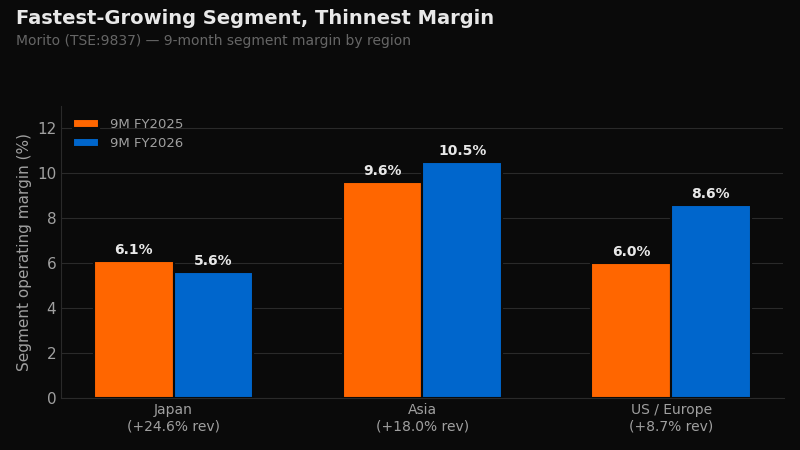 Figure 1: 9-month segment operating margin by region, Morito (TSE:9837)
Japan — where Ms.ID, Mitsuboshi, and now Hisanaga Seisakusho all sit — grew revenue the fastest of the three regions (+24.6%) but its segment margin fell, from 6.1% to 5.6%. Asia and the US/Europe regions, which reflect Morito’s legacy B2B hardware business with minimal M&A exposure, both expanded margin substantially (9.6% to 10.5%, and 6.0% to 8.6%, respectively). The acquired businesses — an EC brand and a regional wholesale distributor — plausibly carry structurally thinner margins than Morito’s core manufacturing franchise, and as they get folded into the Japan segment, they are diluting a margin profile that used to be the company’s calling card. This is the first hard evidence of the integration cost the April piece flagged as the key execution risk.
Secondary items worth tracking: the company’s own language on procurement risk is qualitative only — “heightened geopolitical risk including the situation in the Middle East” is flagged with no quantification of exposure. Foreign-exchange results swung from a JPY 88M gain to a JPY 15M loss year-over-year as the yen weakened further (the average USD rate moved to JPY 156.85 from JPY 149.78), with no sensitivity disclosure to size the risk going forward. Inventory grew 17.2% to JPY 8.36bn, a build the filing does not comment on. None of these are alarming in isolation, but they are all directional headwinds layered on top of the margin question.
Valuation Has Moved the Wrong Way
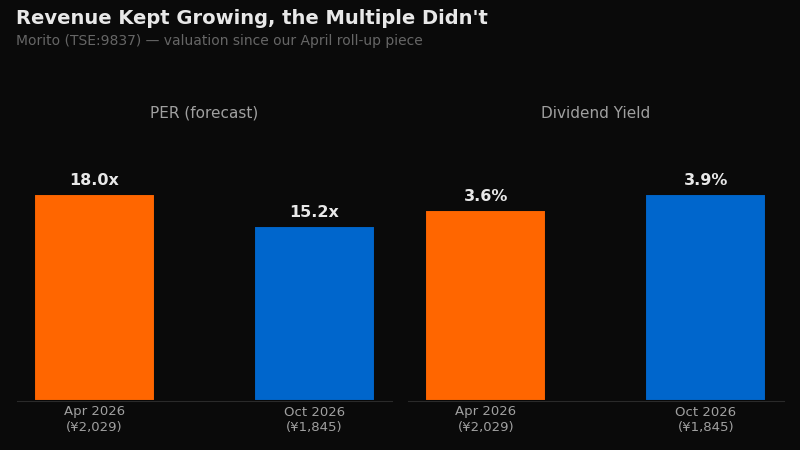 Figure 2: Valuation at the time of our April piece vs. today, Morito (TSE:9837)
When we profiled Morito in April, shares traded at JPY 2,029 — an 18x forecast PER and a 3.6% dividend yield. Today, despite revenue growing 21.5% and a third acquisition closing, shares trade at JPY 1,845: a 15.2x forecast PER and a 3.9% yield. The market has not rewarded the continued execution of the roll-up — if anything, the multiple has compressed even as the growth numbers improved, which is consistent with investors starting to discount exactly the margin dilution the segment data now shows.
What to Watch
Unchanged: Morito’s niche hardware franchise remains genuinely advantaged, and the roll-up logic — buy the EC channel, consolidate succession-driven regional distributors — still makes sense.
Not a concern: This quarter’s 21.6% net profit decline is accounting noise from a bargain-purchase gain rolling off, not an operating problem.
The one number that matters: the Japan segment margin. If it keeps slipping as more deals get folded in, that is the signal that integration costs are running higher than management is currently acknowledging — a more concrete concern than the extraordinary-items volatility that dominates the headline net profit figure.
Source: Original filing (TDnet) | 日本語版
Disclaimer | This article is for informational purposes only and does not constitute investment advice.