
On October 14, PR TIMES (TSE:3922) released three pieces of news at once: a downward revision to full-year revenue guidance, a formal admission that its second growth pillar had failed, and a dividend forecast raised 342% in a single announcement. The stock responded with a limit-up move in after-hours trading, from a same-day close of JPY 2,131 to roughly JPY 2,600. The question worth asking is whether that reaction is justified — or whether it is a thin-volume overreaction to a headline number.
The Second Pillar Is Gone
PR TIMES built its moat on a press-release distribution platform that, as our April profile argued, created Japan’s PR culture from nothing. For several years, the stated plan was to layer SaaS products — the task-management tool Jooto and the customer-support tool Tayori — on top of that platform to build a second revenue engine.
That plan is now half-abandoned. The filing confirms the company will shut down Jooto entirely by July 31, 2027:
“As announced on August 6, 2026, the company has decided to end general availability of the task and project management tool ‘Jooto’ and discontinue the Jooto business as of July 31, 2027.”
Consolidated subsidiary NAVICUS is also tracking below plan. Together, these two items explain the bulk of today’s guidance cut: full-year revenue was trimmed from JPY 10.8bn to JPY 10.3bn (-4.8%), while net profit attributable to parent shareholders falls from a prior forecast of JPY 2.20bn to JPY 2.10bn (-4.5%), taking forecast EPS down to JPY 154.98. Notably, operating profit guidance was held flat at JPY 3.25bn — cost cuts tied to the Jooto wind-down offset the revenue loss almost exactly.
What stands out more than the numbers is the company’s own diagnosis of what went wrong. The capital allocation policy released alongside the dividend hike states plainly that the delay in deciding to exit was itself the failure:
“We recognize that it took time to decide whether to continue or exit, and we will reflect this lesson in how we verify and judge future investments… For deals that do not meet our investment criteria, we will not invest even if budget remains.”
That is a tighter, more mechanical capital allocation framework than the one that let Jooto run for years without hitting its profitability targets — defined decision owners, explicit review deadlines, and pre-set continue/exit criteria for every future investment.
The ROE Math Behind the Dividend
The headline — a dividend raised from a previously guided JPY 16.80 to JPY 74.30 per share, a 342% increase in the forecast itself, and a 438% increase over last year’s actual JPY 13.80 payout — reads like a major strategic shift. The balance sheet tells a more mundane story.
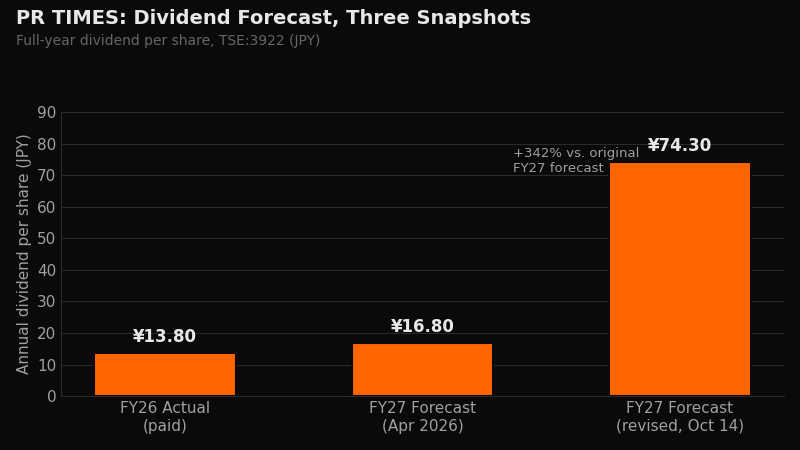 Figure 1: Full-year dividend per share forecast, three points in time (TSE:3922)
At the end of Q2 FY2027, PR TIMES held JPY 9.98bn of parent-shareholder equity (JPY 10.13bn total net assets) against an equity ratio of 82.6% — a balance sheet with almost no leverage and very little of that capital earning a return inside the business. Against a full-year net profit forecast of JPY 2.10bn, that works out to a forecast ROE of roughly 21%, comfortably above the 15% floor the new capital policy sets as a trigger for strategic review:
“If ROE falls below 15%, we will examine the causes and implement necessary measures, including the recovery of profit growth, continuation/reduction/exit of businesses and investments, and reallocation of capital.”
In other words, the 15% ROE floor is not currently binding — profit would need to fall by roughly 30% from today’s forecast before it would. The dividend increase is better read as management acknowledging it has no near-term use for excess capital following the Jooto exit, and choosing to return it rather than let it sit idle on an already over-capitalized balance sheet. At a roughly 48% payout ratio (JPY 74.30 against EPS of JPY 154.98), this is a step up toward a more conventional mature-company payout level — not a one-off cash dump, but also not evidence of a newly discovered growth opportunity.
Does the Stop-High Reaction Hold Up?
Here is where the math gets less flattering for the rally. Operating profit guidance was unchanged at JPY 3.25bn — the core business economics did not improve today. What changed is entirely a capital-return and capital-discipline announcement layered on top of a revenue cut.
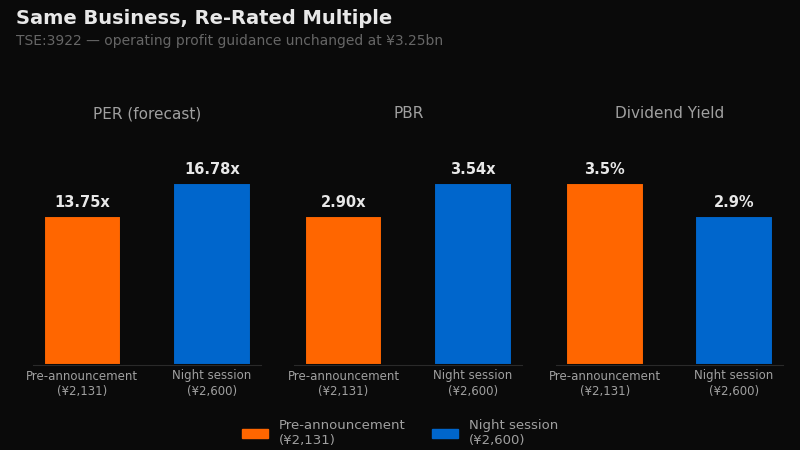 Figure 2: Valuation multiples before and after the after-hours move, same guidance (TSE:3922)
At the pre-announcement close of JPY 2,131, PR TIMES traded at a forecast PER of 13.75x, a PBR of 2.90x, and a dividend yield of 3.49% — already a reasonable valuation for a dominant platform business with a 34.7% operating margin but shrinking profit. At the reported night-session price of roughly JPY 2,600, those multiples jump to a PER of 16.78x, a PBR of 3.54x, with the dividend yield compressing to 2.86%, on a market capitalization that rises from roughly JPY 28.9bn to JPY 35.3bn.
That is a meaningful re-rating for a company whose earnings outlook, net of the Jooto write-off, did not change. Day-session volume on October 14 was a thin 45,900 shares; after-hours PTS liquidity is typically a fraction of that. A limit-up print on volume that light is a weak signal of where the stock actually clears once the broader market has had a full session to react — it is as consistent with a short squeeze on a surprising headline number as it is with a genuine fundamental re-rating.
What to Watch
The core press-release platform remains structurally advantaged and highly profitable, and nothing in today’s filing changes that thesis. But three things are worth tracking before treating the post-announcement price as a new fair value: whether the elevated payout ratio proves durable across future fiscal years rather than a one-time correction; whether NAVICUS stabilizes or becomes the next writedown candidate; and whether the stock holds the roughly JPY 2,600 level once day-session volume normalizes, or mean-reverts toward the pre-announcement range once the capital-return headline is priced in.
Source: Original filing (TDnet) | 日本語版
Disclaimer | This article is for informational purposes only and does not constitute investment advice.