Japan’s three listed property and casualty insurance groups operate in a sector that should, on paper, be telling one consistent story right now. All three invest heavily in Japanese Government Bonds and benefit from the same Bank of Japan rate hikes discussed elsewhere in this series. All three write business — auto, fire, and other short-tail coverage — built on large-numbers statistics and settled within months to a few years, not the multi-decade guaranteed-rate promises creating a JPY 30 trillion unrealized bond-loss problem for Japan’s life insurers. None of the three carries anything like that overhang.
And yet their own guidance for the fiscal year now underway points in three different directions. Tokio Marine Holdings is guiding FY2027 (ending March 2027) net profit up 56.2% to JPY 830.0 billion. MS&AD Insurance Group is guiding its own net profit down 16.8% to JPY 425.0 billion. SOMPO Holdings is guiding down 23.4% to JPY 490.0 billion. Same sector, same rate tailwind, same fiscal year — and each company telling investors to expect something different.
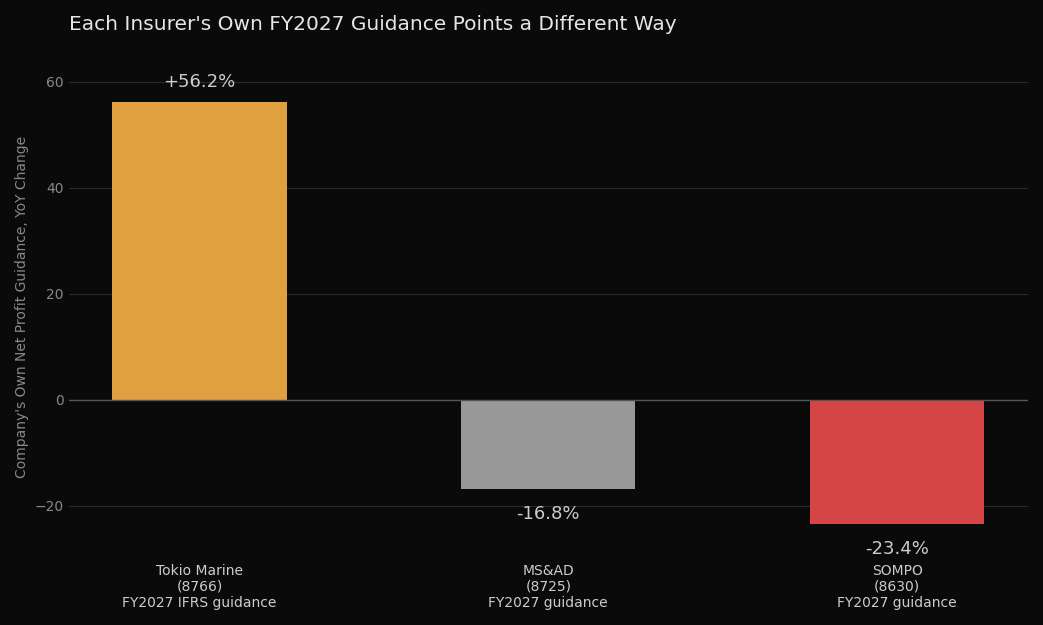 Figure 1: Each company’s own net profit guidance for the fiscal year ending March 2027, versus its own prior-year comparison.
Why P&C Skips the Life-Insurer Problem
The mechanism explained in our companion piece on life insurers — a widening spread between what companies earn on newly purchased JGBs and what they owe policyholders under decades-old guaranteed rates, offset by a mark-to-market hit on the existing bond portfolio — depends on holding bonds with duration long enough to match liabilities that will not be paid out for twenty or thirty years. P&C insurance does not work that way: an auto or fire claim is typically settled within months to a few years of the policy being written, so P&C insurers match those liabilities with correspondingly shorter-duration bonds. The same BOJ rate hikes inflicting trillions of yen in mark-to-market losses on life insurers’ ultra-long JGB holdings do comparatively little damage to a P&C insurer’s much shorter book — which is precisely why none of the three companies discussed here has shown up in the reporting on Japan’s escalating life-insurer bond-loss problem.
That structural advantage is real. It is not, however, a reason to assume the three companies’ results should move together — because outside of the shared bond-portfolio advantage, almost everything else about how each one makes money, and how each one now reports it, differs.
Tokio Marine’s +56.2% Is Mostly an Accounting Story
Tokio Marine’s guidance needs to be read alongside a complication the other two don’t share: the company transitioned its reporting to IFRS in mid-2026. Restated under IFRS, FY2026 net profit was JPY 572.2 billion, up 32.6% — a materially different picture from the JPY 980.4 billion, down 7.1%, that the company had reported under Japanese GAAP just weeks earlier for the same fiscal year. Comparing FY2027 guidance against the old Japanese GAAP base, or against the new IFRS base, produces two different stories about the same company; the 56.2% increase is the IFRS-to-IFRS comparison management itself is now guiding to.
Even on that basis, the jump is not primarily an underwriting story. Our own detailed review of the guidance found that roughly JPY 264 billion of the roughly JPY 258 billion increase in profit is explained by a single mechanical reversal: Tokio Marine’s domestic life insurance subsidiary booked a JPY 204.9 billion IFRS loss in FY2026 driven by foreign-currency hedging costs on US bonds that exceeded the bonds’ yield as the US-Japan rate differential peaked, plus IFRS 17 insurance-finance costs and deferred reinsurance gains that Japanese GAAP would have recognized immediately. As that rate differential normalizes, the loss is expected to reverse — mechanically, not through better underwriting. Layered on top is a roughly JPY 3.5 trillion cross-shareholding liquidation program running through FY2029, structured to deliver half of the company’s targeted “+16% or more” EPS growth from policy-stock sales rather than organic operations; domestic non-life profit, meanwhile, is guided down slightly as management normalizes for a fiscal year that happened to see relatively low earthquake- and typhoon-related claims — Japan’s major seismic and storm events recur on their own schedule, not the company’s, so a quiet year is not something to extrapolate.
None of this makes Tokio Marine a weak franchise — the overseas business, anchored by Philadelphia Consolidated in the US and Tokio Marine Kiln at Lloyd’s, remains the group’s genuine organic growth engine, and the company has continued to return capital aggressively, including a 15-for-1 stock split announced August 25 to broaden retail accessibility to the shares. In March 2026, Tokio Marine also announced a capital and business alliance with Berkshire Hathaway — a 2.5% stake purchase worth roughly JPY 287.4 billion, the first time Berkshire has invested in a Japanese financial institution rather than a trading company, and the first major deal under CEO Greg Abel since he succeeded Warren Buffett in December 2025. The substance of the deal is a Whole Account Quota Share reinsurance arrangement: Berkshire’s National Indemnity subsidiary joins Tokio Marine’s reinsurance panel and takes on a share of the group’s entire insurance portfolio, not one specific line of business, with the explicit aim of strengthening Tokio Marine’s resilience to natural-catastrophe losses and freeing up capital capacity the two companies plan to deploy into joint overseas M&A. Neither MS&AD nor SOMPO has announced anything structurally comparable — this is a genuine point of difference among the three insurers, not just a difference in guided growth rates. It is simply that the headline 56.2% profit guidance figure is doing far less work in explaining why the stock is worth owning than the accounting mechanics behind it would suggest on first read.
MS&AD and SOMPO: Strong Last Year, Cautious About This One
MS&AD and SOMPO both had strong FY2026/3 results by conventional measures, helped in SOMPO’s case by a sharp reduction in natural catastrophe losses compared with a difficult prior year. Both companies are now guiding their own FY2027 net profit down from that base — MS&AD to JPY 425.0 billion (-16.8%) and SOMPO to JPY 490.0 billion (-23.4%) — with both flagging intensifying competition in overseas insurance markets, historically their primary profit engine, as a source of the caution. A sector that looked uniformly strong looking backward is telling investors, in its own words, to expect uneven conditions looking forward.
The near-term guidance dip does not mean either company lacks its own structural case. MS&AD’s MSIG platform is among the largest non-life insurers in Southeast Asia, spanning 48 countries and territories, with management targeting 50% of group adjusted profit from overseas by 2030; its Lloyd’s specialty and reinsurance unit, MS Amlin, has been restructured toward higher-margin lines, improving its combined ratio from 92.6% to 87.7% year-on-year. SOMPO’s overseas arm, Sompo International, provides its own specialty-underwriting diversification, but the more distinctive piece of SOMPO’s strategy is domestic: its nursing-care subsidiary, Sompo Care, is a direct bet on Japan’s aging population that neither Tokio Marine nor MS&AD has replicated at scale, with management targeting roughly 20% of adjusted group profit from the broader “Wellbeing” segment by 2030. Each company, in other words, is pursuing a genuinely different growth thesis beneath the shared FY2027 guidance caution — not a single sector story with three sets of numbers attached to it.
The Same Reform, Funding Different Things
All three companies are also aggressively selling down cross-shareholdings (政策保有株): a combined roughly JPY 1.4 trillion planned for the current fiscal year alone, inside Tokio Marine’s own roughly JPY 3.5 trillion multi-year liquidation program, with the three companies’ leadership collectively earmarking roughly JPY 2.5 trillion for structural reform. The push accelerated after Japan’s 2023–2024 fraudulent auto-insurance-claims scandal — the same Bigmotor-linked episode discussed in our piece on insurance agencies, and the trigger for the revised Insurance Business Act that took effect in June 2026 — which forced all three insurers’ leadership to confront conflicts of interest embedded in decades of cross-shareholding relationships with corporate clients.
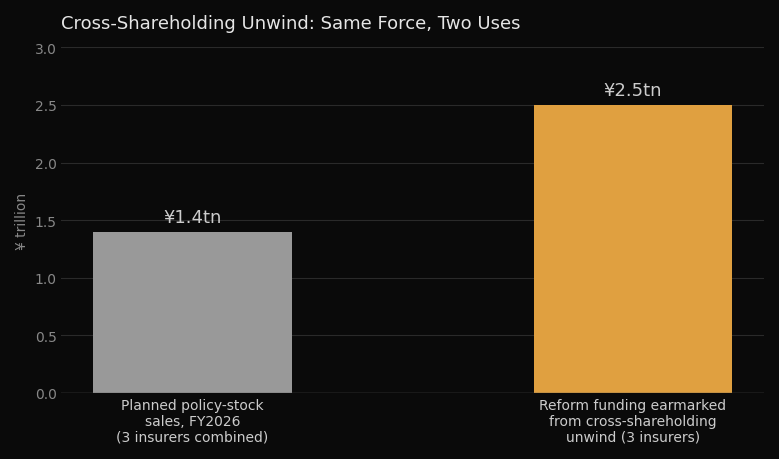 Figure 2: Planned FY2026 policy-stock sales versus total reform capital earmarked across the three insurers.
The irony is worth naming directly: the same cross-shareholding unwind that is one of the structural tailwinds behind Japan’s stock market strength this year is, for these three companies, simultaneously funding shareholder returns (buybacks and Tokio Marine’s EPS-growth targets) and the governance remediation a fraud scandal made necessary. The same pool of capital is doing different jobs at different companies for different reasons — one more reason a single “P&C insurers are having a good year” headline undersells how differently that capital, and that year, actually breaks down.
What to Watch
The nearest-term signal is simply whether MS&AD’s and SOMPO’s overseas competitive pressure shows up in results faster or slower than their own guidance assumes — a beat against a guided decline would say more about conservative guidance-setting than about the underlying business. For Tokio Marine, the signal to watch is how much of the FY2027 profit increase actually materializes as the guided life-insurance accounting reversal, versus how the Berkshire alliance’s first concrete joint transactions unfold over its ten-year term — the difference between a stock re-rating on an accounting normalization and one on a genuine new growth engine. And across all three, the pace of cross-shareholding sales is worth tracking both as a funding source for reform and buybacks, and as a live data point in Japan’s broader corporate-governance unwind — the same unwind that has been one of the tailwinds behind the Nikkei’s own strength this year.
Source: Tokio Marine Q1 FY2027 filing (TDnet) | Tokio Marine FY2026/3 results under IFRS (TDnet) | Tokio Marine dividend revision ahead of 15-for-1 split (TDnet) | MS&AD Q1 FY2027 filing (TDnet) | SOMPO Q1 FY2027 filing (TDnet) | Nikkei: Berkshire Hathaway invests JPY 287.4bn in Tokio Marine | Nikkei: Tokio Marine, MS&AD, SOMPO leadership on structural reform after insurance fraud scandal | 日本語版
Disclaimer | This article is for informational purposes only and does not constitute investment advice.