Japan Post Insurance’s ordinary profit rose 59.7% in the fiscal year ended March 2026. T&D Holdings’ rose 29.5%, with net profit up 10.0%. Dai-ichi Life Group’s ordinary revenue grew 14.5%. On the income statement, this looks like an industry firing on all cylinders, and the headline reason is simple: the Bank of Japan’s rate hikes let insurers earn more on new and reinvested government bond purchases than the rates they locked in during the era of near-zero interest rates.
Look at the balance sheet instead of the income statement, and the picture changes. Thirteen major Japanese life insurers were sitting on a combined JPY 30 trillion in unrealized losses on domestic bonds as of June 2026 — up roughly 60% from a year earlier, and now larger than the unrealized gains on their domestic equity holdings, which have traditionally served as an offsetting cushion. Sony Financial Group already knows what this looks like when it stops being theoretical: its net profit for the fiscal year fell 30%, weighed down by an expanding pile of unrealized bond losses at its Sony Life subsidiary, now JPY 3.25 trillion, up 45% year-over-year.
Same interest rate move, same asset class, two completely different outcomes depending on which side of the balance sheet you’re looking at — and Japan just adopted a new solvency regime, effective this fiscal year, that is specifically designed to stop letting companies look at only one side.
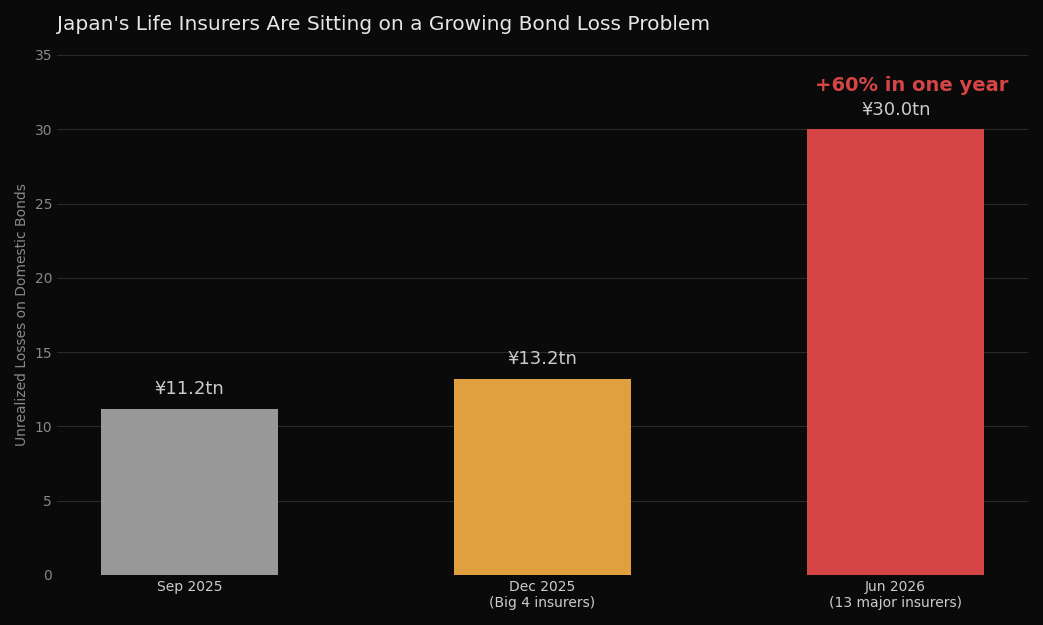 Figure 1: Combined unrealized losses on domestic bonds at major Japanese life insurers (company count and reporting scope differ slightly by period; directionally consistent across sources).
Why Rate Hikes Help the Income Statement
Japanese life insurers built their portfolios overwhelmingly around Japanese Government Bonds (JGBs) through three decades of near-zero rates, matching long-duration insurance liabilities with long-duration domestic bonds. Every new premium dollar and every maturing bond that gets reinvested today goes into JGBs yielding more than what the insurer locked in years ago. Because most of these companies’ in-force policies carry guaranteed rates (予定利率, the assumed rate baked into the policy’s pricing) fixed at issuance — often set during the depths of the zero-rate period — the spread between what insurers now earn on fresh money and what they owe existing policyholders is widening. That is the mechanical reason profit and ordinary income are rising across most of the sector.
It is worth being precise about the channel here, because it differs from how the rate hike benefits banks. Life insurers do not hold current accounts at the Bank of Japan — that privilege is reserved for banks, credit unions, securities firms, and money market brokers that settle funds or securities directly with the BOJ — so insurers earn no interest on reserve balances the way banks do under the BOJ’s tiered rate system. An insurer’s entire benefit from the rate hike flows through the yield on the bonds it actually buys and holds, not from any deposit-style interest income. That makes the widening 予定利率 spread described above the whole story on the income-statement side, not one channel among several.
There is a second tailwind working in the same direction, and it has nothing to do with interest rates: an August 2026 revision to Japan’s high-cost medical expense cap system (高額療養費制度) added a new annual out-of-pocket ceiling, strengthening the public safety net for long-term treatment. To the extent this reduces the claims insurers pay out on supplemental medical and hospitalization riders, it is a second, unrelated factor compressing costs at the same time investment income is rising.
The Same Bonds, Viewed the Other Way
The complication is that a JGB portfolio built for a near-zero-rate world does not just generate more income when rates rise — the existing stock of bonds purchased at those old, low yields falls in market value, exactly as bond math dictates. New money benefits from higher rates; the back-book built up over three decades does not. Both effects are happening inside the same portfolio, at the same insurer, at the same time.
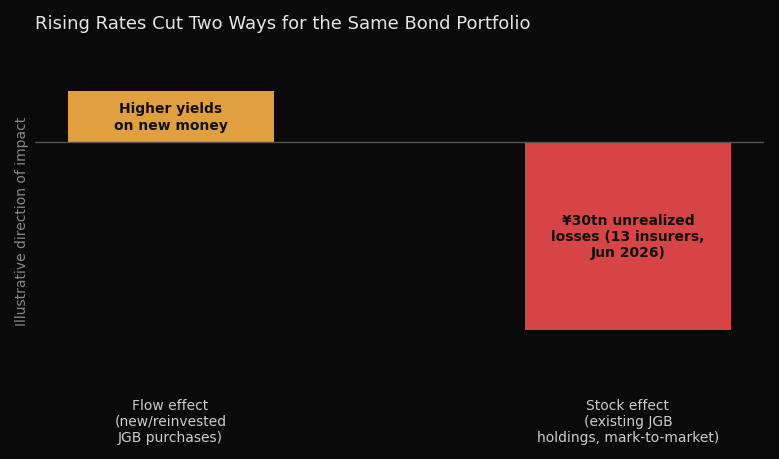 Figure 2: The flow effect (new investment) and stock effect (existing holdings) move in opposite directions for the same rate move.
The scale of the stock-side damage has been escalating quickly. The four largest insurers (Nippon Life, Dai-ichi Life, Meiji Yasuda Life, and Sumitomo Life) had combined unrealized domestic bond losses of roughly JPY 13.2 trillion as of December 2025 — up about JPY 2 trillion in a single quarter. By June 2026, a broader group of 13 major insurers had a combined JPY 30 trillion, up roughly 60% from a year earlier, driven in part by market concern over the fiscal policy of the administration formed in October 2025 and expectations of further BOJ tightening.
That JPY 30 trillion figure is already stale. On the same day this article was written, the Bank of Japan raised its policy rate to 1.25% — the highest level in 31 years — its third hike since the tightening cycle began, and the shortest interval yet between increases. Governor Ueda told reporters afterward that the BOJ would “continue to raise the policy rate” to secure its 2% inflation target and declined to rule out consecutive, large moves. None of that is priced into the June bond-loss figures. Every basis point of further tightening marks down the value of the JGBs insurers are still holding from the low-rate era, and the BOJ has just told the market to expect more of it, not less.
Nikkei’s reporting on the June figure noted a specific milestone: unrealized bond losses have now exceeded unrealized gains on these insurers’ domestic equity holdings — a cushion the industry has relied on for decades — for the group as a whole.
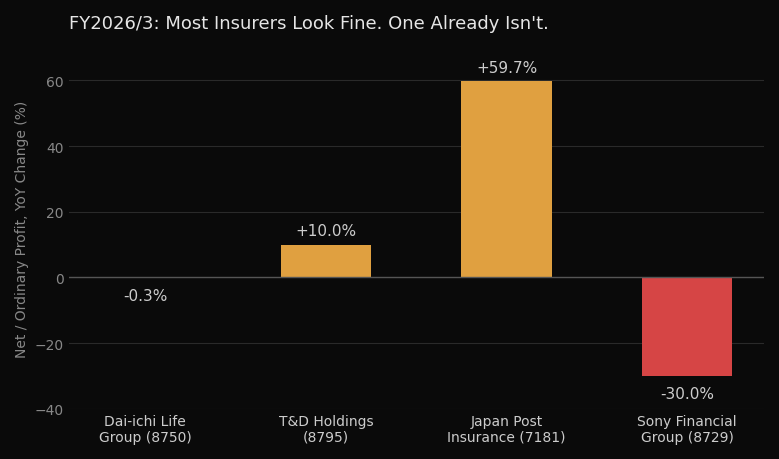 Figure 3: Net or ordinary profit, year-over-year change, FY2026/3.
Sony Financial Group is the clearest evidence that this is not a purely theoretical risk. Its net profit fell 30% for the fiscal year, a result explicitly attributed to expanding unrealized bond losses at Sony Life. The mechanism analysts are watching closely is policy surrenders: if policyholders cancel in large enough numbers, insurers may be forced to sell bonds to fund the payouts rather than holding them to maturity — converting a paper loss into a realized, cash one. Life insurance surrender payouts in Japan reached record levels earlier this year, which is precisely the trigger this risk depends on.
How much of a cushion the rest of the industry has before facing the same outcome comes down to capital. Dai-ichi Life Group carried consolidated net assets of roughly JPY 3.86 trillion against JPY 70.3 trillion in total assets as of its last mid-year report, with a Solvency Margin Ratio — the pre-ESR regulatory buffer metric — of 684.8%, more than three times the 200% regulatory floor. Sony Financial Group’s total capital, by contrast, was roughly JPY 1.12 trillion at the same point in time — smaller than the JPY 3.25 trillion of unrealized losses sitting in its life insurance subsidiary alone. That gap in capital cushion is the difference between an insurer that can absorb its share of the industry’s bond losses for now and one that already cannot.
It would be a mistake, though, to read that comparison as “the big insurers are fine and only the smaller ones are exposed.” Holding long-duration JGBs against long-duration liabilities is not a Sony-specific choice; it is the business model of Japanese life insurance itself, which means every major insurer carries the same underlying exposure — what differs is only how much capital stands between them and Sony Financial Group’s position, not whether the exposure exists. A Solvency Margin Ratio of 684.8% is a snapshot taken at a given interest rate; it says nothing about where that ratio lands after several more rate hikes of the kind the BOJ signaled today. Capital size buys time and absorbs shocks, but with the tightening cycle still open-ended, it is a matter of degree across the whole industry, not a line that separates insurers with this risk from insurers without it.
The Regulatory Timing Is Not a Coincidence
Japan’s new economic value-based solvency regulation (ESR, roughly Japan’s equivalent of the EU’s Solvency II) took effect on March 31, 2026, after roughly two decades of preparation. Where the prior Solvency Margin Ratio regime assessed capital adequacy on a basis closer to book value, ESR requires insurers to value both assets and liabilities on a market-consistent, economic basis and hold capital against the resulting risk — structured, like Solvency II, around three pillars: quantitative capital requirements, internal risk management review, and expanded public disclosure. Insurers have not yet finalized and published their first ESR ratios under the new regime, but the timing is notable: the regime that is best equipped to make unrealized bond losses visible in a company’s regulatory capital position arrived in the same fiscal year those losses reached their largest scale on record.
A note on why this is a life-insurer story more than a banking story. Banks hold JGBs too, and are exposed to the same rate move, but the scale is not comparable: Japan’s regional banks collectively held roughly JPY 2 trillion in unrealized domestic bond losses at the end of 2024, doubling year-over-year through 2025 toward a reported JPY 3–4 trillion range — real money, but an order of magnitude below the JPY 30 trillion sitting across 13 major life insurers. Megabanks are less affected still, having largely repositioned ahead of the rate move. The gap comes down to what each sector’s liabilities look like: bank deposits are short-duration and largely on demand, so banks hold correspondingly shorter-duration bonds, and Basel III capital rules constrain how much interest-rate risk a bank can carry in the first place. Life insurers match multi-decade policy liabilities with multi-decade JGBs, which is precisely what makes the mark-to-market swing so much larger when rates move. Within banking, the exposure is also uneven — regional banks, which were slower to reposition than the megabanks, are carrying most of the sector’s bond-loss burden, and any strain in regional-bank mortgage books tied to the same rate cycle is a related but separate risk worth tracking on its own.
The Ten-Year Question
Strip out both the interest-rate spread and the bond-loss overhang, and there is a slower-moving structural question underneath. Japanese life insurers built multi-decade organizational cultures around a single asset class — domestic government bonds — because for most of the last thirty years there was little reason to build anything else. Nippon Life, the largest, has publicly flagged plans to expand credit and alternative-asset investment as part of asset diversification, and industry-wide fiscal 2026 investment plans show insurers weighing private assets and infrastructure allocations alongside JGBs. Whether that shift can happen fast enough, and skillfully enough, to produce investment-linked products genuinely competitive with what a household can now access directly through Japan’s expanding NISA tax-free investment accounts, is a question that will not be answered by a single fiscal year of rate-driven profit growth. It is also a question sharpened by the same forces reshaping the insurance agency channel: as AI tools make it easier for consumers and advisors to evaluate whether a savings-type insurance product’s embedded assumed rate is actually competitive, products that depended on interest-rate complexity being hard to evaluate lose one more layer of protection from scrutiny.
What to Watch
The most immediate signal is simply the next round of interim disclosures under a policy rate that, as of today, just moved to 1.25% with the BOJ’s governor declining to rule out further large increases — each insurer’s September-quarter bond-loss figures will show whether the JPY 30 trillion figure above was a peak or a waypoint. Dai-ichi Life Group’s H1 results, based on last year’s reporting date, should land around mid-November; a revision notice ahead of that date, given how fast the rate backdrop has moved, would not be a surprise.
There is also a second cushion worth watching alongside the bond side of the balance sheet: domestic equity holdings, whose unrealized gains have traditionally offset bond losses, but which Japan’s own governance-reform push is shrinking at the same time. Dai-ichi Life Group’s own disclosed policy is to sell down roughly 30% of its domestic equity holdings — about JPY 1.2 trillion — between fiscal 2024 and 2026, continuing through 2030 toward a target of no more than JPY 1.5 trillion in domestic shares. That is the same TSE-driven cross-shareholding unwind that has been one of the tailwinds behind Japan’s stock market strength this year. It means the equity buffer is being reduced deliberately, on top of whatever a genuine equity market pullback would do to it involuntarily — a scenario in which bond losses keep growing from further rate hikes while the equity cushion shrinks from both directions at once is the more adverse case to have in mind, not just further bond losses in isolation.
The next signal to watch is each insurer’s first disclosed ESR ratio under the new regime, expected as 2026 annual securities reports are filed — a below-threshold or sharply lower ratio at any major insurer would be the clearest sign that the bond-loss overhang is becoming a capital problem rather than a paper one. The medium-term signal is the policy surrender rate: continued record-level cancellations would force more insurers into Sony Financial Group’s position of realizing losses rather than waiting them out. And the long-term signal, playing out over years rather than quarters, is whether Japan’s life insurers can build genuine multi-asset investment capability before the JGB-centric business model that has defined the industry for three decades becomes a genuine competitive liability rather than just a balance sheet headache.
Source: Dai-ichi Life Group FY2026/3 results | Dai-ichi Life Group domestic equity investment policy | Dai-ichi Life Group H1 FY2026/3 filing | T&D Holdings FY2026/3 filing (TDnet) | Sony Financial Group H1 FY2026/3 filing | Nikkei: 13 insurers’ bond losses reach JPY 30tn | Nikkei: Sony FG net profit down 30% | FSA: Economic Value-based Solvency Regulation overview | Nikkei: BOJ raises policy rate to 1.25%, Sep 18 2026 | 日本語版
Disclaimer | This article is for informational purposes only and does not constitute investment advice.