Advance Create Co., Ltd. (TSE:8798) disclosed on September 18 that it is technically insolvent — consolidated net assets of negative JPY 276.6 million — after a third-party investigation found improper accounting at the company and its wholly owned subsidiary, Hoken Ichiba Co., Ltd. Four straight years of operating losses, three straight years of negative operating cash flow, and a breach of financial covenants on its receivables-securitization contracts have combined into a formal “material doubt about the company’s ability to continue as a going concern” — one step short of insolvency proceedings, but a serious one.
That would be a notable story on its own. What makes it a story about the industry, rather than one company, is this: FP Partner Co., Ltd. (TSE:7388) — a larger, more prominent player in the same business — is currently operating under a formal administrative improvement order from Japan’s Financial Services Agency, issued in August 2025 after an on-site inspection by the Kanto Local Finance Bureau found the company’s sales process was inadequate at confirming customer needs, and that its product recommendations were skewed toward insurers offering better incentive payments rather than what actually suited the customer. FP Partner’s president and other executives took a voluntary 30% pay cut in response.
Two of Japan’s most prominent multi-carrier insurance agencies, hit by governance failures within roughly the same year. That is not a coincidence — it is a structural feature of the business model finally catching up with the companies that built it.
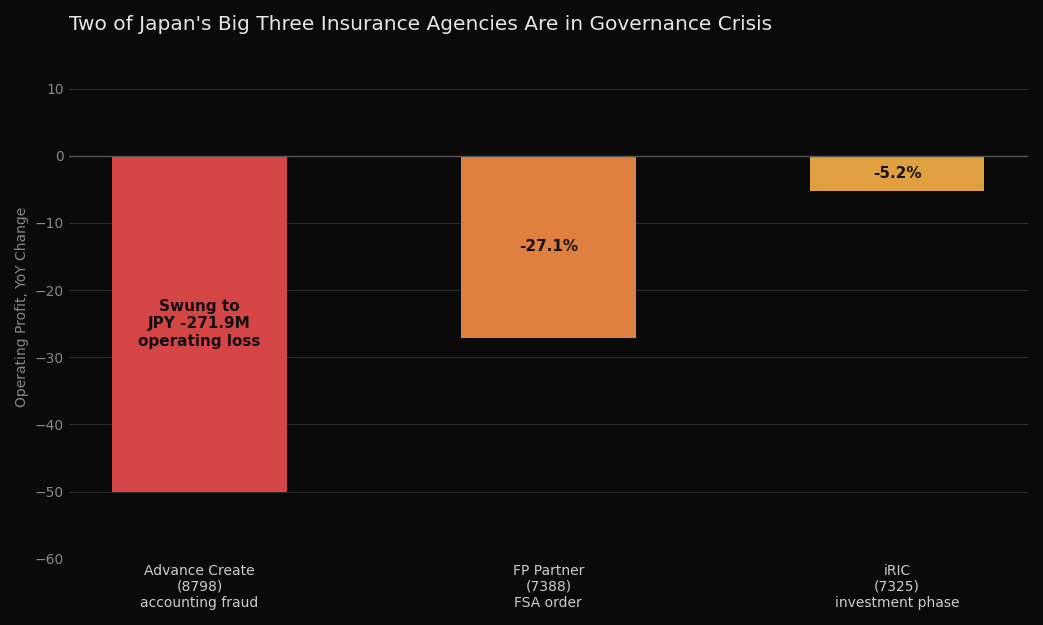 Figure 1: Operating profit, year-over-year change, at three listed Japanese insurance agencies.
The Business Model Contains Its Own Conflict of Interest
The “multi-carrier agency” (乗合代理店) model that Advance Create and FP Partner both operate emerged from Japan’s insurance deregulation in the mid-1990s. Advance Create itself was founded in 1995 and listed on Nasdaq Japan in 2002, squarely inside that liberalization wave; its pitch, like every agency of its type, was neutrality — an agent unaffiliated with any single insurer, free to recommend whichever product genuinely suited the customer.
The problem is that these agencies are not paid by the customer. They are paid by the insurer whose product gets sold, and insurers do not all pay agencies the same commission rate — some layer additional “support payments” (支援金) on top for volume or preferential placement. The FSA’s finding against FP Partner was precisely that its sales process let this asymmetry override customer interest: product selection favored insurers offering better terms to the agency, not better terms to the client. The very feature that made the multi-carrier model attractive at launch — an agent who can sell anyone’s product — is also what makes it structurally exposed to exactly this failure mode.
Advance Create’s problem is different in mechanism (improper accounting for advertising transactions and software capitalization at its media subsidiary, Hoken Ichiba) but sits inside the same weak spot: an asset-light, commission-driven business with essentially no hard collateral — total fixed assets of under JPY 1 million against total assets of JPY 8.2 billion — where the only real asset is the flow of new customer appointments the marketing budget can generate, and the only real governance safeguard is management’s own integrity.
A Regulatory Shift Is Compounding the Pressure
This is not happening in a vacuum. A revised Insurance Business Act took effect on June 1, 2026, reshaping how insurers structure agency support and commission arrangements industry-wide. The revision was prompted by an unrelated but high-profile scandal — fraudulent auto-repair insurance claims involving used-car dealer Bigmotor and its insurer partners — which pushed the FSA to tighten oversight of large multi-carrier agencies generally. The law now requires “designated large-scale multi-carrier property and casualty agencies” (those with annual insurance commission income of JPY 2 billion or more) to appoint a dedicated compliance officer and build a formal complaint-handling system, strengthens oversight of agencies that sell insurance as a side business alongside another trade, and expands the range of prohibited conduct in soliciting policies. In a supervisory guideline revision a year earlier, in May 2025, the FSA had already flagged agency commission structures directly, warning that commission design should not create improper incentives to solicit unsuitable policies, and that agencies should be evaluated on service quality rather than scale or growth rate. FP Partner’s FSA order sits squarely inside that policy shift, even though the trigger event (Bigmotor) was in auto insurance rather than the life and medical insurance products FP Partner and Advance Create primarily sell — the tightening has clearly spilled over across the whole multi-carrier agency channel.
FP Partner’s own disclosure notes that smaller agencies, worried about their business continuity under the new commission structure, are increasingly approaching FP Partner to sell their books of business — the company completed three such acquisitions in the quarter alone, even as its core operating results declined. The regulatory tightening that is punishing conflict-of-interest sales practices is simultaneously creating a consolidation opportunity for the larger players positioned to absorb smaller agencies that can no longer make the economics work.
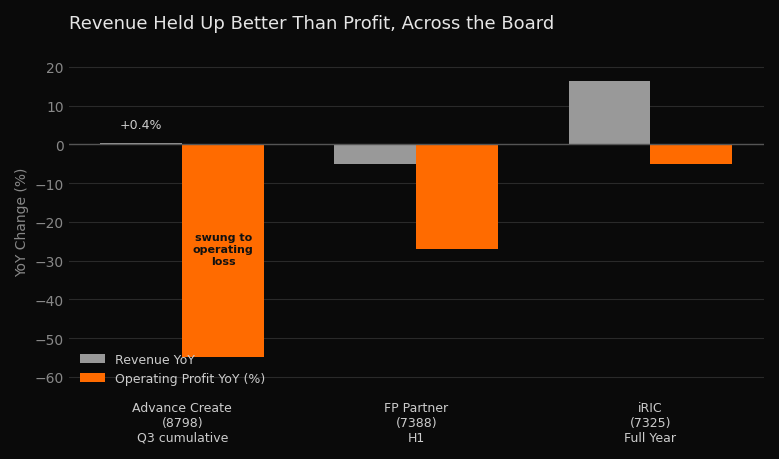 Figure 2: Revenue and operating profit, year-over-year, for the most recently reported period at each company (Advance Create: Q3 cumulative through June 2026; FP Partner: H1 through May 2026; iRIC: full year through June 2026).
The Exception: A Different Business Model, A Different Kind of Profit Decline
iRIC Corporation (TSE:7325), which operates the “Hoken Clinic” chain of walk-in insurance consultation shops, has not been touched by any governance finding. Its fiscal year ended June 2026 also produced a profit decline — operating profit down 5.2% to JPY 703 million, even as revenue grew 16.3% to JPY 10.96 billion — but the cause is unrelated to sales conduct. The company opened 16 new stores and completed three acquisitions during the year as part of a three-year expansion plan that targets 20 more store openings next year and 36 by the plan’s final year. Margin compression here is a company choosing to spend on growth, not a company caught misallocating trust. iRIC’s balance sheet remains healthy (60.8% equity ratio) and its dividend rose to JPY 32.00 per share from JPY 30.00 (guidance calls for a full-year profit rebound of 15.6% operating profit growth next year).
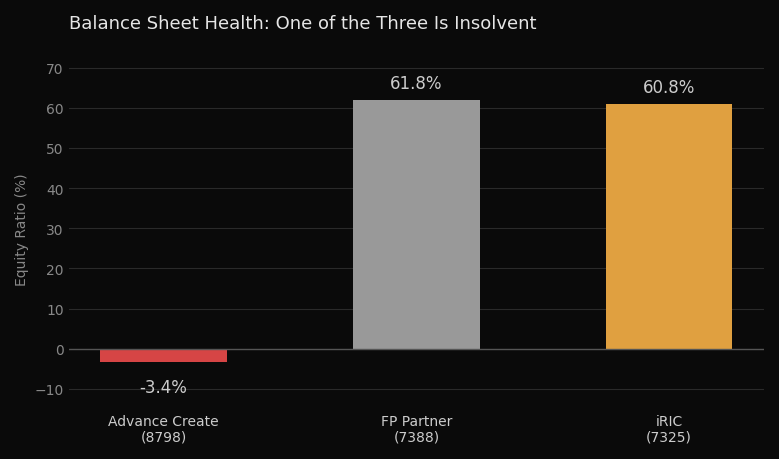 Figure 3: Equity ratio at each company’s most recently reported balance sheet date.
The distinction between iRIC’s model and its two struggling peers is worth being precise about, because the obvious explanation — “walk-in beats outbound sales” — understates what is actually different. Advance Create and FP Partner both depend on an employed or contracted sales force generating appointments and closing them, largely by phone or scheduled visit; the quality of that outcome rides heavily on individual salesperson skill, which is not a company-level asset — it walks out the door when the employee does, and it is exactly the kind of asymmetric, person-to-person interaction where a conflicted recommendation is hardest for a customer to detect in the moment. iRIC’s model instead depends on store locations: a shop in a shopping mall generates its own walk-in traffic based on where it is, independent of which specific staff member happens to be on duty. That is a scalable, ownable, balance-sheet asset in a way that sales talent is not — and it is also a channel where the customer, having walked in voluntarily, is arguably in a less persuadable, more skeptical frame of mind than one who has just taken a scheduled sales call.
What AI Changes, and What It Doesn’t
There is a reasonable case that generative AI erodes the core value proposition of the outbound agent model faster than it erodes the walk-in shop model. The informational advantage an agent holds over a customer — which insurer’s assumed interest rate, loading ratio, or payout terms are actually competitive — is precisely the kind of structured, comparable, machine-checkable information that AI tools already handle well, and every insurer’s own direct-to-consumer digital channel is getting more efficient at presenting it without an agency in between. If that informational edge disappears, what is left for a phone- or appointment-based agent to sell is closing skill and reassurance — a persuasive conversation, not a superior comparison. That is a much thinner, more commoditized value proposition, and it is also the exact lever the FSA just found FP Partner abusing.
A walk-in shop is not immune to this pressure either — a customer can, in principle, use an AI tool to check any recommendation made in-store before signing anything — but the shop’s traffic-generating asset (its location) is not made obsolete by AI the way an agent’s informational edge is. The more precise framing for international investors is not “technology versus human,” but which layer of value in this business — location, brand, or individual salesmanship — actually survives as AI commoditizes the comparison-shopping function these agencies were built to perform.
What to Watch
Advance Create’s near-term path depends on whether its stated remediation plan — improved marketing efficiency, fixed-cost reduction, and continued lender forbearance — can outrun its structural cash burn before the going-concern doubt forces a more drastic outcome such as a third-party capital injection or an acquisition. FP Partner’s path depends on whether its FSA-mandated governance overhaul restores the trust that its recommendation engine depended on, without also stripping out the very commission-sensitivity that made its sales force effective. And for iRIC, the test is simpler: whether the 16 stores opened this year, and the 20 planned for next year, generate the return the three-year plan assumes — because unlike its two peers, iRIC’s underperformance this year was a choice, not a symptom.
Source: Advance Create Q3 FY2026 filing (TDnet) | Advance Create revision notice (TDnet) | FP Partner H1 FY2026 filing | iRIC FY2026 filing | 日本語版
Disclaimer | This article is for informational purposes only and does not constitute investment advice.