params: ticker: “TSE:4369” reviewed: “edit” image: “/images/analysis/tri-chemical-china-taiwan-moat/thumb.png”
Tri Chemical Laboratories (4369), a niche supplier of high-purity chemicals for semiconductor manufacturing, just posted a first half so far ahead of its own forecast that it had to file a same-day guidance revision alongside the earnings themselves. H1 revenue came in at ¥14.7 billion (+18.8% YoY), but the more telling numbers are the gaps against the company’s own March guidance: operating profit beat by 29.7%, ordinary profit by 46.5%, net profit by 54.0%. Full-year guidance was raised in the same filing, by a similar magnitude. This isn’t a company that quietly exceeded a conservative plan — it’s one whose own forecast was overtaken by events within five months.
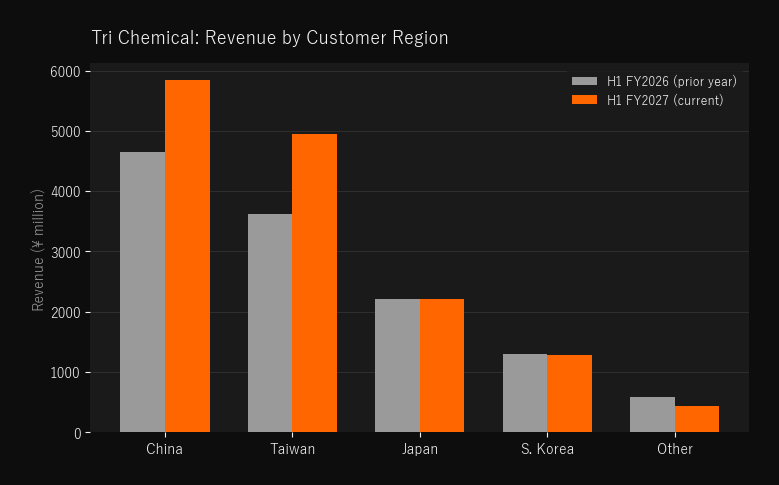 Figure 1: Tri Chemical revenue by customer region, current half vs. prior year
The beat is concentrated in two countries
Tri Chemical operates a single reporting segment — high-purity chemical compounds for semiconductor manufacturing, nothing else — so there’s no product-line diversification to point to. What the filing does break out is revenue by customer location, and that tells the real story. China and Taiwan together accounted for 73.4% of H1 revenue, up from 66.8% a year earlier. Regionally, the growth is lopsided: China revenue rose 25.5% YoY, Taiwan rose 36.9%, while Japan (-0.5%), South Korea (-2.1%) and everywhere else combined (-25.8%) were flat to down. Essentially all of this half’s growth came from two countries, and one of them is China.
By product use, roughly half of revenue (48.5%) is High-k dielectric material — the insulating film used in advanced logic chips, where the company holds a reportedly leading global share — with metal-film materials (21.7%) and etching materials (12.7%) filling out the rest. The company itself attributes the beat to generative-AI-driven data center buildouts keeping advanced logic and memory capex strong, plus an equity-method profit boost from its Korean affiliate SK Tri Chem.
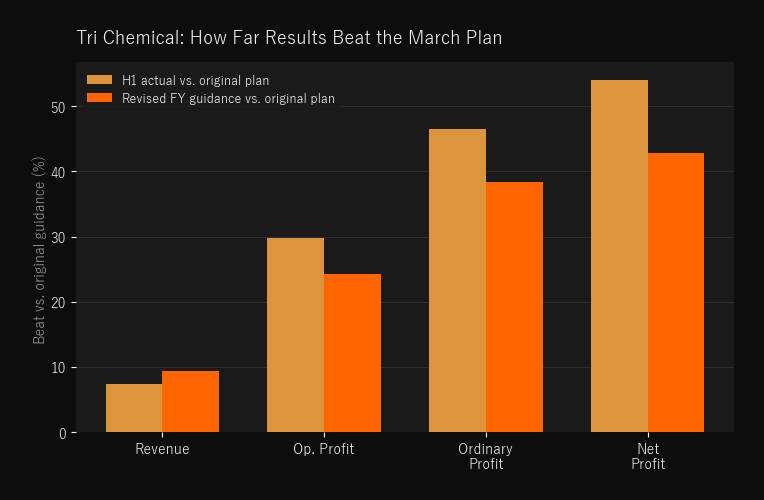 Figure 2: Beat magnitude vs. original guidance, H1 actual and revised full-year forecast
Why China exposure here isn’t the same risk as equipment exposure
A company earning 40% of revenue from China would normally raise an obvious question: what happens if China finishes localizing its supply chain? For semiconductor equipment, that’s a real and active threat — Chinese toolmakers are visibly working to replicate lithography, etch and deposition systems, and Beijing has made equipment self-sufficiency a stated national priority.
Materials are a different problem. Reverse-engineering a physical machine is one thing; replicating ppb/ppt-level purity control, proprietary synthesis chemistry, and the iterative qualification process each individual fab line requires before it will even accept a new supplier is another. There’s nothing to disassemble and copy. That’s the underlying reason a company like Tri Chemical can hold a “world-leading share” in a narrow material category in the first place — and it means Chinese equipment self-sufficiency, even if it succeeds on its own terms, doesn’t obviously threaten this business. If anything, more domestically-equipped Chinese fabs running at capacity means more customers for the specialty chemicals those fabs still need to buy from somewhere.
The risk that would actually change this picture
None of this makes the concentration risk-free — it just relocates it. The channel where this could genuinely break isn’t Chinese import substitution catching up technically; it’s export policy. Japan has progressively tightened controls on semiconductor manufacturing equipment exports to China since 2023, in step with the US and the Netherlands. Materials haven’t been swept into that regime the same way, and as of today there’s no broad restriction on semiconductor materials exports to China. But that’s a policy choice, not a technical barrier, and policy choices move faster than materials science does. If geopolitical pressure eventually extends export controls to materials the way it already has to equipment, a company this concentrated in Chinese customers would feel it immediately — and unlike the equipment-replication scenario, there’s no structural reason that outcome couldn’t happen.
Notably, there’s also close to no offsetting exposure elsewhere: the “other regions” bucket, which would catch the US and Europe, is just 2.9% of revenue and shrank 25.8% year-on-year. Whatever happens to China and Taiwan demand, there’s no meaningful third market cushioning it.
What to watch
- Whether the beat repeats or normalizes. A quarter this far ahead of guidance raises the question of how conservative the original plan was versus how sustainable this pace of Chinese and Taiwanese capex actually is.
- Export policy on materials, not just equipment. No such restriction exists today, but this is the one lever that would turn concentration risk from theoretical to immediate.
- SK Tri Chem’s contribution. Equity-method income from the Korean affiliate is growing faster than group operating profit, meaning a rising share of profit sits one step removed from direct operating control.
Source: Q2 earnings filing (TDnet) | Guidance revision (TDnet) | IR | 日本語版
Disclaimer | This article is for informational purposes only and does not constitute investment advice.