params: ticker: “TSE:2995, TSE:8921” reviewed: “edit” image: “/images/analysis/tokyo-prime-real-estate-demand-shift/thumb.png”
In August 2026, two Tokyo real estate companies’ earnings filings captured a contradiction sitting at the heart of Japan’s property market. J-REX Corporation (2995), a genuine developer, reported segment profit up 54.1% year-on-year on its self-developed urban apartment business. C’s Create (8921), which buys and resells existing condominium units, raised its full-year operating profit guidance by 10.4%, citing brisk resale demand for high-end central Tokyo units. Both companies’ own disclosures point to the same thing: demand for prime Tokyo property remains unusually strong.
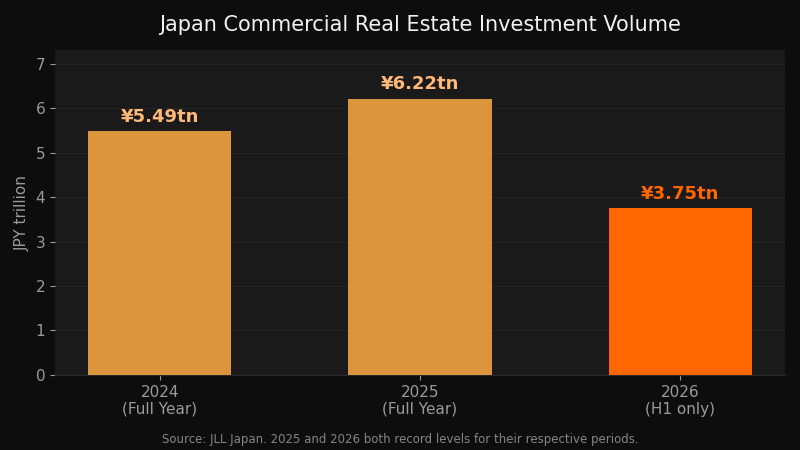 Figure 1: Japan’s commercial real estate investment volume (source: JLL)
At the same time, Japanese media have been reporting the retreat of wealthy Chinese buyers — often called “Run Ri” (润日), those who moved capital or residency to Japan — from the Tokyo condo market. Two forces are cited: Japan’s own October 2025 tightening of the business manager visa (the required capital was raised from ¥5 million to ¥30 million), and China’s domestic property slump forcing some wealthy individuals to cash out. Central Tokyo’s six wards saw used-condo prices fall for two consecutive months in February–March 2026 — the first such streak in over three years, a signal some read as an early turning point.
So why does investment into Tokyo property keep setting records? A weak yen alone doesn’t explain it. Japanese real estate loan rates sit at roughly 1–2%, structurally far below the US (~6%) or UK (~5%), which by itself creates an attractive spread between borrowing cost and yield. On an absolute basis, Tokyo also remains cheap: indexing luxury residential rents to Tokyo = 100, London comes in at 222, New York at 192, Hong Kong at 157, and Singapore at 113 — Tokyo is the cheapest of the major global cities. JLL further points to geopolitical capital reallocation amid US-China tension, flowing into Japan from sources that explicitly include Greater China — foreign investors’ share of Japan’s real estate investment jumped from 17% in 2023–2024 to 38% in 2025. In other words, individual wealthy Chinese buyers may be exiting even as Chinese-sphere institutional capital is arriving — two very different flows happening at once.
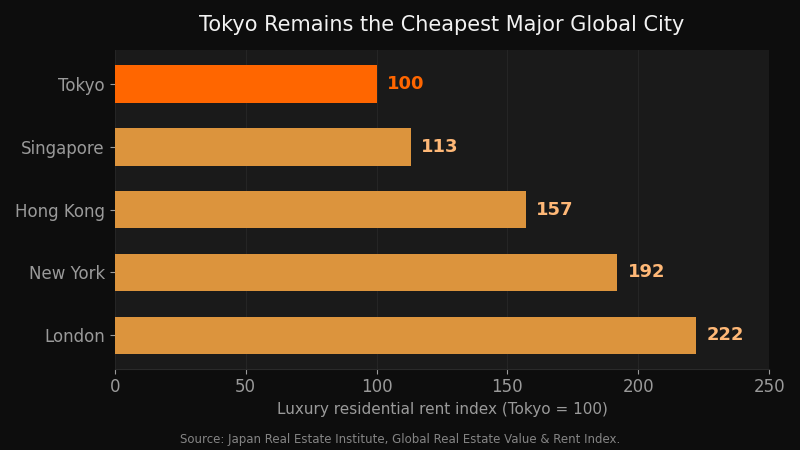 Figure 2: Luxury residential rent index, indexed to Tokyo = 100 (source: Japan Real Estate Institute)
Against that backdrop, the two companies profit through fundamentally different mechanisms. J-REX is a classic developer — it buys land, plans and builds urban rental and family apartments, then sells them; its 54.1% segment profit growth reflects that build-and-sell cycle. C’s Create, by contrast, runs on turnover: it profits from the spread between buying and reselling existing units, so what matters most is transaction velocity, not appreciation per se. Revenue grew from ¥11.8 billion to a guided ¥15.4 billion and operating profit from ¥0.7 billion to ¥1.2 billion year-on-year — growth that depends on active market churn, i.e., both sellers (some of them exiting Chinese owners) and buyers (institutional and other capital) staying engaged.
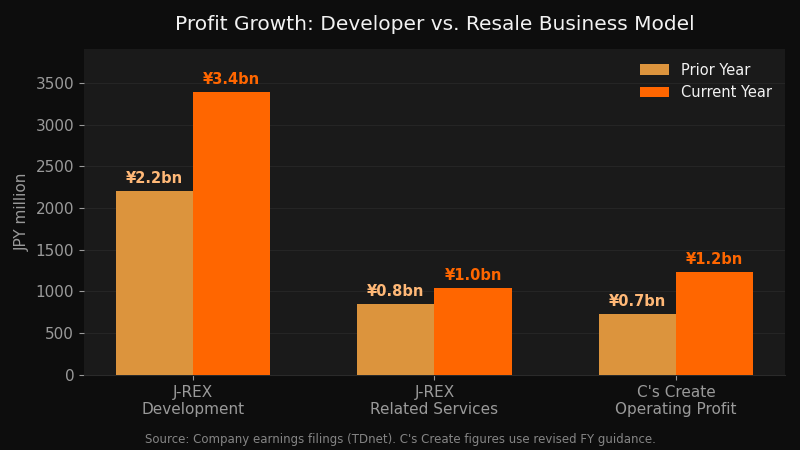 Figure 3: Year-on-year profit growth by segment/business — J-REX vs. C’s Create
The flip side is that neither business model works in a market without demand or liquidity — which describes most of regional Japan today. Central Tokyo’s outperformance isn’t a single story about the weak yen; it’s the product of at least five overlapping structural factors — the rate spread, the international valuation gap, geopolitical capital reallocation, diversifying domestic institutional investors, and continued population concentration in Tokyo. Individual Chinese buyer behavior is only one input among several. That said, the recent back-to-back decline in used-condo prices is worth watching closely as a possible early signal of a shifting balance.
What to Watch:
- Turning-point risk: Whether the two-month used-condo price decline in central Tokyo extends into a broader correction, or proves to be noise.
- Visa policy follow-through: Further tightening (or loosening) of Japan’s business manager visa could accelerate or reverse the pace of individual foreign buyer exits.
- Institutional vs. individual capital: Watch whether the 38% foreign-investor share of 2025 investment holds up — a pullback would remove one of the structural supports behind current pricing.
Source: Company earnings filings (TDnet), Japan Real Estate Institute “Global Real Estate Value & Rent Index,” JLL Japan real estate market reports | 日本語版
Disclaimer | This article is for informational purposes only and does not constitute investment advice.