params: ticker: “TSE:5726” reviewed: “edit” image: “/images/analysis/osaka-titanium-dilution-warning/thumb.png”
Osaka Titanium Technologies (5726) delivered a standout first quarter for fiscal year ending March 2027: revenue up 2.3%, operating profit up 82.7%, net profit up 302.8%. The world’s leading producer of high-purity metal titanium for aircraft is riding strong Boeing and Airbus demand alongside a weak yen tailwind.
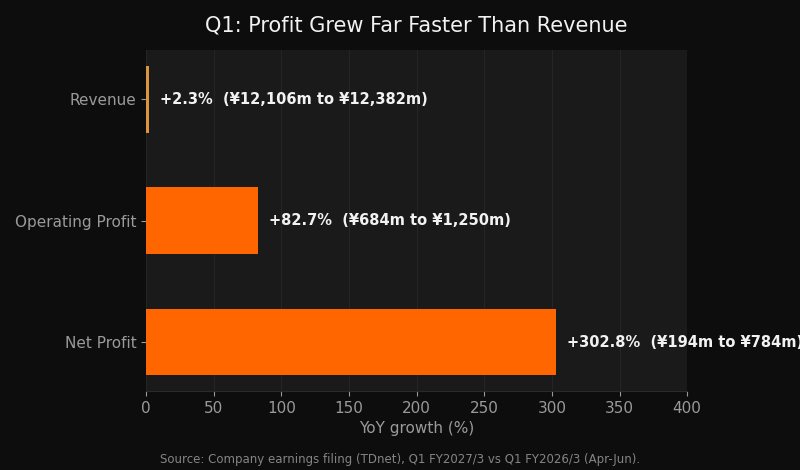 Figure 1: Key Q1 metrics, year-on-year, fiscal year ending March 2027
What’s actually behind that +2.3% headline
The nearly-flat revenue figure hides two offsetting stories. Within the Titanium segment (revenue ¥10.3bn, -1.6%), domestic sales for general industrial applications fell a sharp 24.9% — and the company names the reason itself, both in this filing and in its mid-term plan: intensifying price competition from Chinese producers. Export volumes (largely Boeing/Airbus-bound) actually grew, but revenue growth there was capped at just +2.0% because the formula-based export price is indexed to a titanium ore price benchmark that declined. Meanwhile the High-Function Materials segment — AI-server-related MLCC materials among its products — grew revenue 27.4% and profit 345.5%. In other words, “+2.3% revenue growth” is really the net of a retreating general-industrial business, price-capped exports, and a fast-growing AI-adjacent niche.
Not fighting China on price — the “OTC 2030” strategy
The company’s mid-term plan, “OTC 2030,” published in May 2026, names “intensifying price competition with China (general-industrial sponge titanium)” as an external challenge it faces head-on. Its answer isn’t to compete on price — it’s to change which market it competes in.
- General-industrial titanium (China’s stronghold) gets de-emphasized via “portfolio transformation through expansion of the High-Function Materials business and full-scale entry into new businesses.”
- Aircraft-grade titanium (a segment Chinese producers can’t easily enter, given certification and reliability requirements) gets fresh capital instead — a new plant in Amagasaki expanding sponge titanium capacity from 40,000 to 50,000 tons a year. The roughly ¥39 billion project was certified in August 2024 under Japan’s Economic Security Promotion Act as a supply-security plan for a critical material, carrying government subsidies of up to roughly ¥8 billion (partially already received).
- The High-Function Materials segment carries its own target: 30% return on sales.
- OTC 2030’s headline company-wide targets for fiscal 2030: ¥100 billion in revenue, 20% ROS, 20% ROE, and a ¥150 billion market capitalization goal.
This ¥39 billion investment isn’t a new idea prompted by this quarter — it’s a planned project that began with demolition of the old plant building in summer 2023, targeting completion in March 2028.
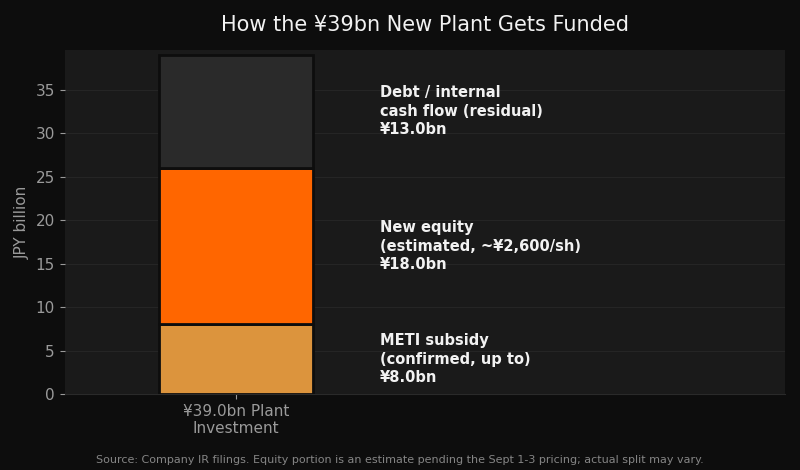 Figure 3: How the ¥39 billion new plant investment is being funded (the equity portion is an estimate)
And now, the new share offering — announced alongside the good news
Part of that ¥39 billion is being funded by a share offering decided on the same day, August 25, as the Q1 results. It comprises a public offering of 7 million new shares plus a third-party allotment (green shoe option) to Nomura Securities of up to 1.05 million additional shares. Against 36.8 million shares currently outstanding, full exercise would take the count to 44.85 million — dilution of up to roughly 22%.
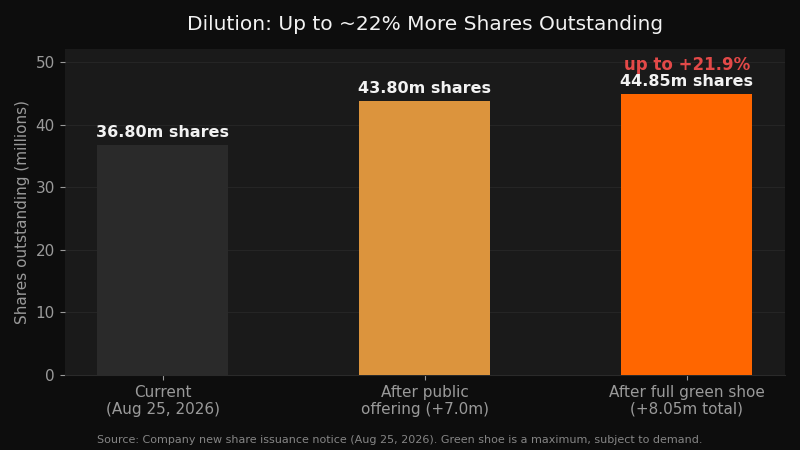 Figure 2: Shares outstanding before and after the offering (full exercise scenario)
The market reacted immediately: the stock closed down 4.65% on August 25, at ¥2,851.0. Under Japan Securities Dealers Association rules, the final offering price will be set around September 1–3, based on the market price near that date with a discount applied. This structure typically invites short-selling arbitrage ahead of Japanese public offerings, which tends to push the stock lower into the pricing date — a pattern that looks likely to repeat here.
Bottom line: a coherent strategy is not the same thing as good timing
Concentrating capacity where Chinese competitors can’t easily follow, while quietly stepping back from a general-industrial market it’s losing on price — that’s a coherent, deliberate strategic choice. But for investors, a strong earnings print and good investment timing are two different questions. Reading only the Q1 beat while missing the same-day dilution and pre-pricing supply/demand pressure risks buying at a temporary high.
What to Watch:
- Pricing date (around September 1–3): Since the price is set off the market price near that date, further near-term weakness would directly reduce proceeds and could push more of the funding gap onto debt.
- Supply/demand pressure into pricing: Short-selling and arbitrage flows around the pricing date can move the stock independent of fundamentals.
- Whether domestic general-industrial demand stabilizes: As long as Chinese price competition continues, this drag looks structural rather than temporary.
- New plant progress: Completion is targeted for March 2028. Whether this investment pays off depends on the facility ramping on schedule and capturing the aircraft demand growth it’s being built for.
Source: Original filing (TDnet) | New share issuance and offering notice (company IR) | Mid-term plan “OTC 2030” (company IR) | 日本語版
Disclaimer | This article is for informational purposes only and does not constitute investment advice.