params: ticker: “TSE:9706” reviewed: “edit” image: “/images/analysis/japan-airport-terminal-tax-illusion/thumb.png”
Japan Airport Terminal (9706), which operates Haneda Airport’s passenger terminals, posted a standout first quarter for fiscal year ending March 2027: revenue up 7.4%, operating profit up 40.7%, an operating margin of 19.4%. Yet the company’s own full-year guidance shows operating profit up just 1.2% and ordinary profit up 4.8% — alongside net profit attributable to owners of parent guided down 17.0%, to ¥24.2 billion. That’s an odd combination worth unpacking directly from the filing’s income statement.
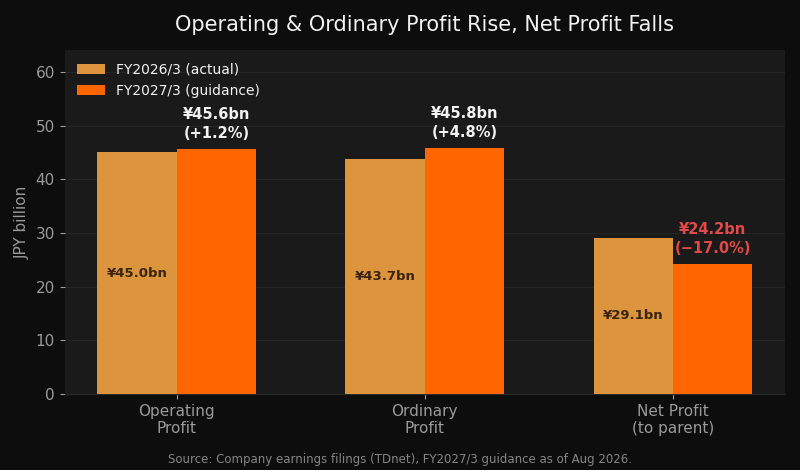 Figure 1: FY2026/3 actual vs. FY2027/3 guidance — operating and ordinary profit both grow while net profit alone declines
The answer lies in last year’s unusually low effective tax rate. In FY2026/3, pre-tax profit was ¥43.4 billion, but total tax expense was just ¥5.7 billion — an effective rate of roughly 13%, well under Japan’s typical corporate rate of around 30%. The gap came from a large deferred-tax benefit (¥3.5 billion) tied to net operating loss carryforwards at certain subsidiaries. The company states plainly in its filing that this benefit is expected to shrink next year, raising the tax burden. Apply a normal ~30% effective rate to the ¥45.8 billion ordinary profit guidance, and the resulting net profit lands right around the guided ¥24.2 billion.
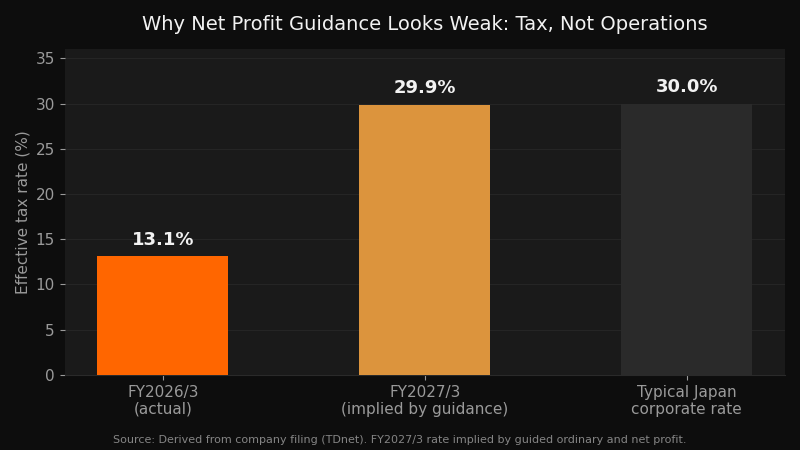 Figure 2: Effective tax rate — an unusually low ~13% last year, reverting toward a normal level in guidance
In other words, the “-17%” headline says nothing about the underlying business weakening. Q1 itself tells the opposite story: Haneda passenger traffic grew (domestic +2%, international +4%), and duty-free sales at Haneda hit a quarterly record, driven by the weak yen and secured inventory of popular brands. The impact from reduced Chinese travel to Japan was described by the company as “minor.”
One caveat worth flagging: the new Terminal 1 North Satellite facility (six gates, Haneda’s first wood-steel hybrid structure), due to open September 1, is not a near-term revenue driver despite the timing coinciding with this earnings cycle. The company’s own guidance explicitly frames it as a cost item — higher depreciation expense — and it sits roughly a kilometer from the main terminal, remote enough that Japan Airlines has warned passengers to allow extra time. Any boost to duty-free exposure from the new gates looks limited for now; this reads more as long-term capacity investment for future flight growth than an immediate sales catalyst.
For investors reading only the headline net profit number, this is a textbook example of a Japanese earnings quirk that can mislead: a tax-driven swing dressed up as an operating one. The underlying business — Haneda’s inbound tourism and duty-free exposure — is performing exactly as the weak-yen narrative would suggest.
Source: Original filing (TDnet) | IR | 日本語版
Disclaimer | This article is for informational purposes only and does not constitute investment advice.