params: ticker: “TSE:2590” reviewed: “edit” image: “/images/analysis/dydo-japan-turkey-two-playbooks/thumb.png”
DyDo Group Holdings (2590) posted a striking first half for fiscal year ending January 2027: operating profit up 388.2% year-on-year, and net profit swinging from a loss of ¥1.36 billion to a profit of ¥2.80 billion. But the two forces driving that result are almost nothing alike. At home, cost inflation forced a “select and concentrate” restructuring. In Turkey, Middle East geopolitics handed the business an unexpected tailwind. Two very different stories, landing in the same quarter, at the same company.
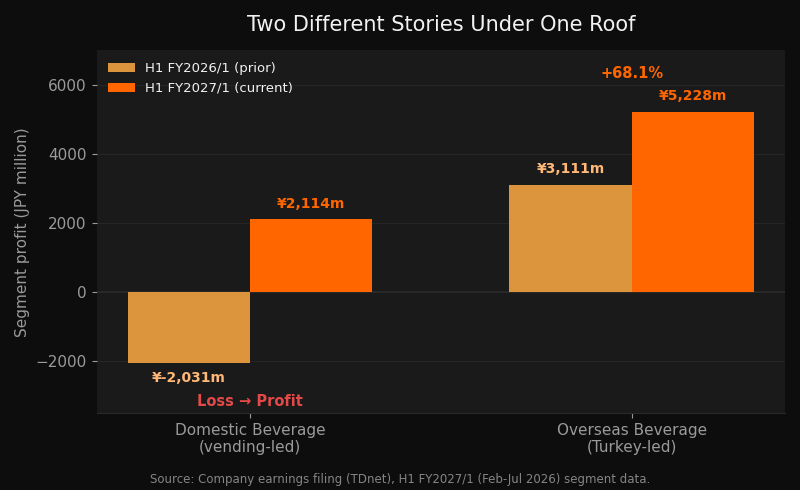 Figure 1: Domestic and overseas beverage segment profit, year-on-year, H1 FY2027
At home: cost inflation forced a concentrated bet on vending machines
DyDo’s domestic beverage business draws roughly 93% of its sales from vending machines — a degree of concentration unmatched among major Japanese beverage makers. Compare that to rival Ito En, whose channel mix is the near-opposite: supermarkets account for 47% of sales, vending machines just 5%. The all-in vending bet itself dates back to the 1990s, but what’s driving this quarter’s numbers is much more recent: rising material and energy costs, price hikes reducing purchase frequency, and a widening price gap versus other retail channels have forced “select and concentrate” restructuring across the entire vending industry.
Domestic beverage revenue fell again this half, to ¥67.6 billion (-5.5%), but by pruning unprofitable locations and squeezing efficiency through its proprietary “Smart Operation” program, segment profit swung from a ¥2.03 billion loss to a ¥2.11 billion profit. This is a defensive strategy, born of cost pressure: trading volume for quality.
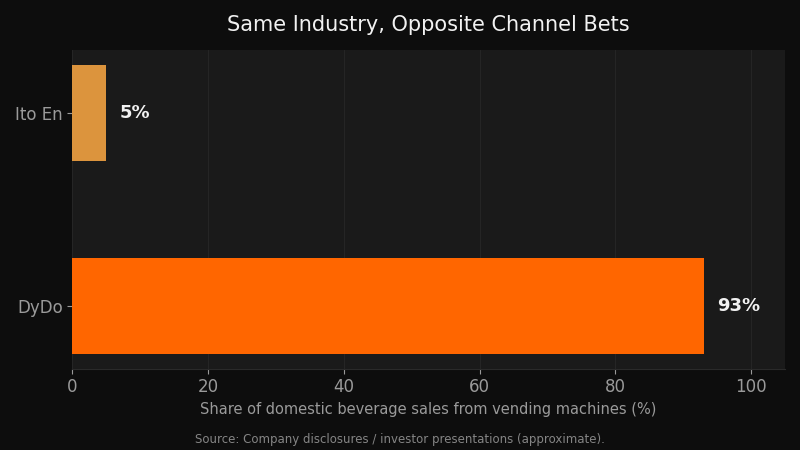 Figure 2: Domestic beverage channel mix, DyDo vs. Ito En
In Turkey: an unexpected tailwind from Middle East geopolitics
The overseas beverage segment (revenue ¥36.0 billion, +25.3%; segment profit ¥5.2 billion, +68.1%) — anchored by Turkey — is being driven by geopolitics, not cost. In 2016, DyDo acquired three beverage manufacturing subsidiaries from Yıldız Holding, Turkey’s largest food conglomerate, for roughly ¥13.3 billion, gaining the heritage local cola brand Cola Turka and sparkling water brand Çamlıca. Amid Middle East tensions, a boycott of American brands has spread across Turkey since around October 2025, hitting Coca-Cola particularly hard while orders for the homegrown Cola Turka have surged. A geopolitical risk turned directly into a tailwind, simply because the brand DyDo happened to own a decade ago is authentically Turkish.
Not a “refuge,” and not pure luck either
One thing worth being precise about: the Turkish business isn’t a hedge DyDo deliberately built to escape Japan’s vending crisis. The 2016 acquisition predates the vending industry’s structural troubles by years; the original rationale was almost certainly ordinary international expansion. But calling it pure luck isn’t right either — what DyDo bought back then wasn’t some obscure, unproven asset, it was an already-established, well-regarded local brand with real brand equity and distribution. That was a sound decision on its own merits. The seed just happens to be catching a geopolitical tailwind nobody could have forecast; the quality of the original decision and the scale of today’s payoff are two separate things worth judging separately.
Put together, this is a genuinely asymmetric picture: at home, an external force (cost inflation) is compelling defensive concentration; abroad, a past diversification bet is being amplified by an unrelated external force (geopolitics). For investors, the takeaway is that treating DyDo as a simple “domestic vending machine stock” misses the picture. This half’s earnings beat combines a highly repeatable domestic restructuring effect with a Turkish tailwind that has no guaranteed repeatability — and the latter could fade as suddenly as it appeared.
Whether the shock comes from cost inflation or geopolitics, the companies worth watching aren’t the ones that simply absorb the hit — they’re the ones that swallow it whole and come out the other side more profitable. This quarter, DyDo looked like exactly that kind of company.
What to Watch:
- Whether the domestic turnaround sticks: Once the loss-to-profit comparison base effect fades, can the segment sustain this profitability level?
- Durability of the Turkish boycott tailwind: This is a geopolitically contingent driver, not a structural one, and could reverse.
- Turkish lira and hyperinflation accounting effects: IAS 29 hyperinflation adjustments for the Turkish subsidiary swing meaningfully each period — check the notes before reading headline growth rates at face value.
Source: Original filing (TDnet) | IR | DyDo acquires three Turkish beverage subsidiaries (Nikkei) | 日本語版
Disclaimer | This article is for informational purposes only and does not constitute investment advice.