This is the third article in our Section 301 series. Read the first — The Fentanyl Factor (June 3, 2026) — and the second — Japan’s 12.5%: The Cost of Having No Conviction on Human Rights (July 24, 2026) — for the legal and political background.
The 12.5% Section 301 tariff on Japan took effect on July 24. In our previous analysis, we explained why Japan pays 2.5% more than the EU, UK, and Canada: those economies enacted legal prohibitions on forced-labor imports; Japan issued a voluntary guideline instead. The gap was self-inflicted by a decade of political deference to Beijing.
That argument is about why Japan as a country was rated 12.5%. This article asks a different question: within that 12.5%, who actually pays it, and does the rationale hold up when you look at the individual companies?
The short answer is no. The logic does not hold up. And the companies bearing the largest absolute burden are, in many cases, the ones with the least connection to the problem the tariff was designed to address.
The ¥300 Billion Shared Invoice
Japan exports approximately ¥12–13 trillion in goods to the United States annually. At 2.5% above the EU baseline, the premium amounts to roughly ¥300 billion per year spread across all Japanese exporters. That figure does not arrive as one invoice — it diffuses across thousands of shipments, customs declarations, and margin lines. It compounds quietly.
The logic behind Section 301’s forced labor framework is traceable: economies that enable or tolerate forced labor in their supply chains should face higher import costs than economies that have legislated against it. If a country’s manufacturers source from Xinjiang, avoid beneficial ownership disclosure, or lack the legal infrastructure to certify supply chain cleanliness, the 12.5% rate reflects genuine risk.
That logic applies to some Japanese companies. It does not apply to all of them. Yet all of them pay.
Group 1: The Collateral Damage
The following companies export substantial volumes of Japan-manufactured goods to the United States. Their manufacturing is almost entirely domestic. Their supply chains do not run through China. The Section 301 forced labor rationale — Xinjiang cotton, undisclosed beneficial ownership, Chinese-origin components — describes none of them.
Shin-Etsu Chemical (TSE: 4063) manufactures semiconductor-grade silicon wafers at facilities in Annaka (Gunma) and Shirakawa (Fukushima), among others. Its semiconductor silicon wafer operations — with roughly 30% global share — ship directly from Japanese plants to US chip manufacturers. Estimated Japan→US revenue in scope: ¥640 billion. Estimated 2.5% premium: ¥16 billion per year. The company has no meaningful Xinjiang supply chain exposure. It competes directly against Korean and European wafer makers, who face their own Section 301 rates — but Japan’s 12.5% sits above Germany and the Netherlands at 10%.
Keyence (TSE: 6861) operates a fabless model: it designs sensors, PLCs, and measurement instruments in Japan, outsources production to domestic contract manufacturers, and sells globally through a direct-sales force. China does not feature in its manufacturing supply chain. Estimated US sales from Japan-origin inventory: ¥170 billion. Estimated annual premium: ¥4.3 billion.
Fanuc (TSE: 6954) is perhaps the clearest illustration. Its CNC systems, servo motors, and robots are designed, manufactured, and assembled at Oshino village in Yamanashi prefecture — the same location it has used for decades, a mountain campus with its own mountain. The “Made in Japan” claim on Fanuc product is not a marketing strategy; it is a literal description. Fanuc sells extensively to US automotive and aerospace manufacturers. Estimated US exposure: ¥130 billion. Annual premium: ¥3.3 billion.
Hamamatsu Photonics (TSE: 6965) makes photomultiplier tubes, image sensors, and laser diodes used in medical imaging, particle physics, and semiconductor inspection. Its entire production is in Hamamatsu, Shizuoka. Its client list includes CERN, hospital equipment makers, and US defense contractors. Estimated US revenue: ¥46 billion. Annual premium: ¥1.2 billion.
Tokyo Electron (TSE: 8035) manufactures semiconductor deposition and etch equipment at Japanese facilities. Its customers are TSMC, Samsung, and Intel — the same customers that benefit from CHIPS Act subsidies to build US capacity. TEL is selling to America’s most strategically important semiconductor build-out while paying a 2.5% premium that its Dutch peer ASML does not.
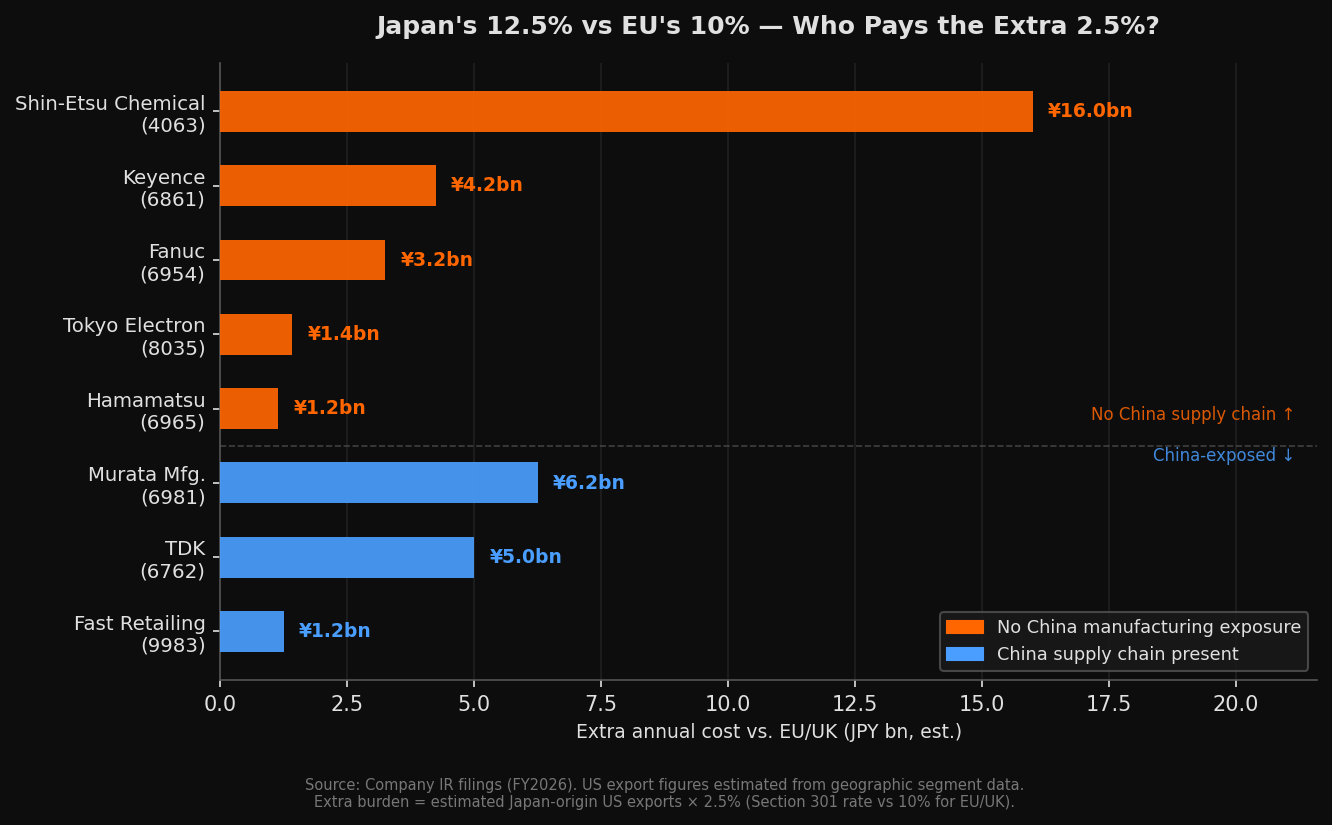 Figure 1: Estimated extra annual cost (Japan→US exports × 2.5%) by company. Orange = no China manufacturing exposure. Blue = China supply chain present. Source: Company IR filings (FY2026 estimates).
Group 2: The Intended Targets
Not all Japanese exporters are in the same position. Some companies do have meaningful China supply chain exposure — and for them, the Section 301 logic is at least coherent, even if their Japan-origin exports are caught in the same net.
Fast Retailing / Uniqlo (TSE: 9983) sources approximately 40% of its products from Chinese manufacturers. Its US stores stock garments made in China and in Southeast Asian factories that use Chinese-origin fabrics and yarn. The “Substantial Transformation Test” that US Customs applies means that Vietnamese assembly of Chinese-origin fabric may still carry Chinese-origin classification. Uniqlo’s situation is exactly what Section 301 was designed for: a supply chain that runs through the People’s Republic, through factories where labor conditions are opaque, into the US market. The 12.5% on Fast Retailing’s Japan-origin apparel is a separate stream from its China/Southeast Asia exposure — but the company’s overall profile is the one the tariff architects had in mind.
TDK (TSE: 6762) operates major manufacturing facilities in China, producing passive electronic components — capacitors, inductors, filters — at scale. Roughly 55% of its production capacity is China-based. Its China-manufactured products flowing directly to the US face 25%+ Chinese tariffs under separate Section 301 schedules. Its Japan-manufactured products face 12.5%. TDK is paying forced labor risk tariffs on two tracks simultaneously — one of which is proportionate to its actual China exposure, the other of which it shares with Fanuc and Hamamatsu.
Murata Manufacturing (TSE: 6981) has approximately 20% of its production in China (down from higher levels as it has actively diversified since 2018). Its Japan-origin ceramic capacitors and communications modules going to US customers face 12.5%.
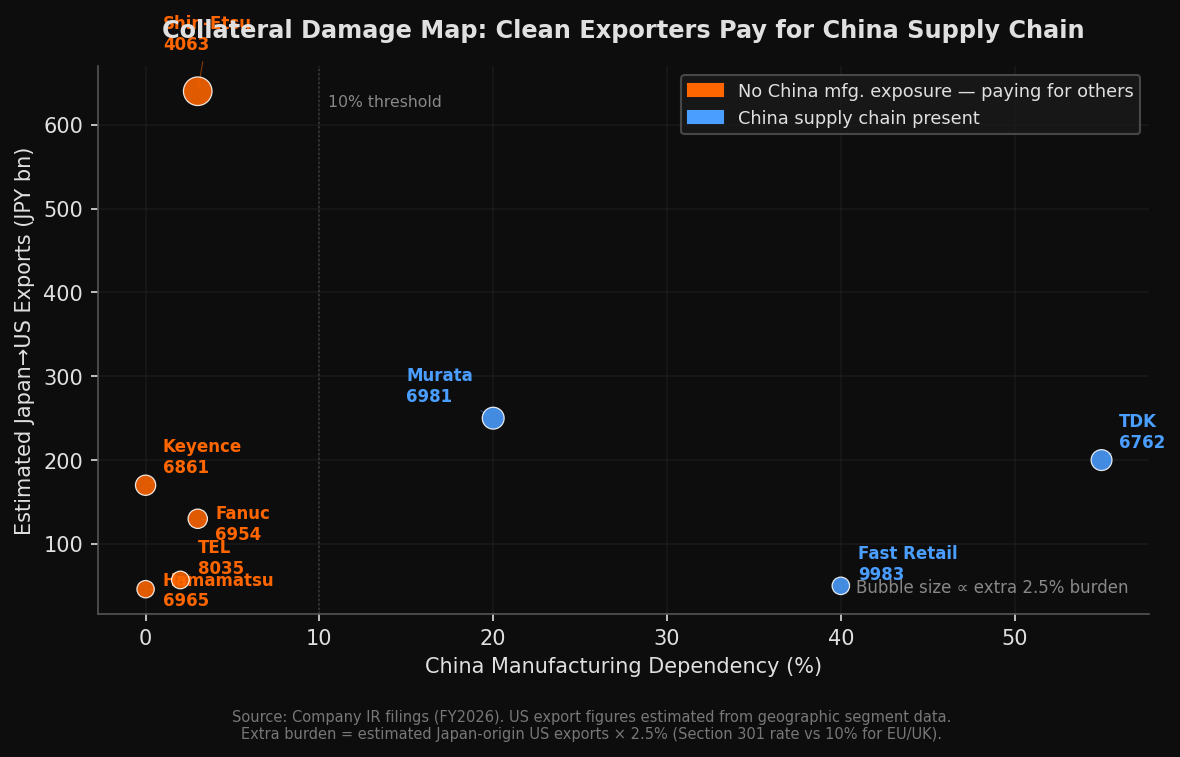 Figure 2: Scatter plot of China manufacturing dependency vs. estimated Japan→US export volume. Bubble size proportional to estimated 2.5% extra burden. Source: Company IR filings (FY2026 estimates).
The Decoupling Backdrop
There is a larger structural story visible in these two groups, and it runs in the wrong direction for Japan’s tariff policy.
The world economy has been systematically reducing its exposure to Chinese supply chains. CHIPS Act manufacturing incentives pull semiconductor production toward the US, Japan, and Europe. UFLPA creates legal penalties for Chinese-origin forced labor goods. Corporate “China+1” strategies have moved assembly lines to Vietnam, Thailand, and Mexico. The EU’s Carbon Border Adjustment Mechanism targets Chinese industrial goods on environmental grounds. US institutional investors run China-exposure screens. Japan’s own government has subsidized supply chain repatriation through economic security legislation.
The direction of travel is clear: Chinese supply chain exposure is being repriced as risk, and companies that have avoided it are being rewarded by the market — lower geopolitical risk premia, cleaner UFLPA certification, easier ESG scores.
Fanuc, Hamamatsu, Shin-Etsu, and Keyence are exactly the type of companies that should benefit from this repricing. Their Japan-exclusive supply chains are a structural advantage in a world moving away from China. They are the poster children for what post-decoupling manufacturing looks like.
And they are paying the same Section 301 rate as companies that built their business model on Chinese labor.
The EU’s Fanuc equivalent — Kuka, acquired by Midea (Chinese) and thus genuinely China-linked — pays 10%. The German precision instrument makers that sell to US defense and medical customers pay 10%. Shin-Etsu’s silicon wafer competitors in Germany pay 10%.
The irony is that Japan’s clean manufacturers are being penalized for a political failure committed by a different constituency: the importers, retailers, and component buyers who chose low-cost Chinese supply chains over transparent ones. The 2.5% premium is a collective tax, but the votes that created it were cast by a different group of companies entirely.
Investment Implications
Margin compression is real and uneven. At the operating profit level, a ¥16 billion annual extra cost for Shin-Etsu — a company with approximately ¥600 billion in operating profit (FY2026) — is about 2.7% of earnings. For Fanuc, the ¥3.3 billion figure against operating profit of roughly ¥120 billion is 2.8%. These are manageable but not trivial, and they are permanent under current law. EU and Korean competitors have a structural cost advantage in US contract negotiations.
The pricing power question. Can Japanese manufacturers pass the 2.5% through to US customers? For companies like Fanuc and TEL, where products are differentiated, delivery times matter, and switching costs are high, pass-through is more feasible. For commodity-like components (passive electronics, wafers at the lower end), the market is more competitive and pass-through becomes harder.
Capital allocation and US localization. The persistent 2.5% premium creates a long-term incentive for Japanese manufacturers to move production to the US — qualifying product for “Made in USA” treatment. Shin-Etsu already has US PVC operations. Whether the math works for silicon wafers depends on scale and capital economics. Fanuc has US assembly operations but core manufacturing remains in Japan. Watch for medium-term capex allocation signals from these companies indicating whether they intend to absorb the tariff or eventually eliminate it through US localization.
The clean supply chain premium is still real. Even paying 12.5%, a Japanese manufacturer with a certified Xinjiang-free, China-free supply chain faces lower UFLPA compliance risk, lower ESG friction with US institutional investors, and lower geopolitical risk premium in its share price. The tariff disadvantage is 2.5 percentage points. The supply chain risk premium for a Chinese-exposed competitor can be multiple turns of P/E. The math still favors the clean manufacturers — the tariff is a headwind, not a reversal of the structural advantage.
The Accounting Question Nobody Is Asking
The Section 301 forced labor framework works as intended when the tariff rate reflects the supply chain risk of the paying entity. Japan got 12.5% because Japan, as a country, lacked forced labor legislation. That national-level judgment collapsed an entire spectrum of company-level supply chain practices into a single rate.
Fanuc does not source from Xinjiang. Hamamatsu does not have undisclosed Chinese beneficial owners. Shin-Etsu’s silicon wafer supply chain begins and ends in Japan. These companies are paying a forced labor risk premium for a forced labor risk that their own supply chains do not carry.
The bill arrived. It is shared equally among the guilty and the innocent. And it will not be renegotiated.
Source: USTR – Section 301 Forced Labor Action | Previous: The Cost of Having No Conviction (July 24) | The Fentanyl Factor (June 3) | 日本語版
Disclaimer | This article is for informational purposes only and does not constitute investment advice.