Capcom (TSE:9697) reported Q1 FY2027 results on July 28 that, on first read, look like an outlier: revenue ¥70.4bn (+54.7%), operating profit ¥41.1bn (+66.9%), and an operating margin of 58.3%. For context, most video game publishers globally operate at 15–25% margins. A 58% margin on ¥70 billion in quarterly revenue is not an industry norm — it is a number that requires explanation.
Three things produced it. Understanding each is important for judging how much of this quarter’s result is structural versus one-time.
What Drove the Quarter
1. Resident Evil Requiem: The Engine That Kept Running
The largest single contributor was Resident Evil Requiem (RE9), released February 27, 2026. By the end of Q1 — just four months into its commercial life — the title had reached cumulative sales of 8 million copies.
Eight million copies in four months is a strong result by any standard. What makes it strategically significant for Capcom is that RE Requiem was not a pure Q1 story — it was a carry-forward from February, still pulling sales three months after launch. This pattern is characteristic of Capcom’s best-performing titles: Resident Evil Village crossed 10 million copies two years after launch; RE2 Remake has sold over 14 million copies across seven years of ongoing availability.
The digital-first distribution model amplifies this. A game released digitally on PlayStation 5, Xbox Series X|S, and PC has no inventory constraint — it sells indefinitely at full margin as long as demand exists. Capcom’s aggressive price promotion strategy (discounting catalog titles to create new entry points) consistently extends the commercial life of its IP beyond initial launch windows.
2. Pragmata: A New IP That Delivered
Capcom’s most watched announcement was Pragmata — a completely original IP, a sci-fi action-adventure with a hacking mechanic set in near-future Earth-Luna space. New IPs in gaming are high-variance bets. Most fail to reach critical mass; a small number define franchises.
Pragmata sold 2.5 million copies in its first quarter of availability (launched April 2026 on PS5, Xbox Series X|S, PC, and Nintendo Switch 2). For a new IP with no existing fanbase, 2.5 million units at premium price points represents a successful debut by industry standards. The combination of Capcom’s global distribution infrastructure (256 titles sold in 236 countries and regions as of Q1), its established marketing engine, and favorable review reception appears to have driven meaningful day-one and week-one uptake.
Whether Pragmata becomes a multi-title franchise depends on Q2 and Q3 momentum and management’s willingness to greenlight a sequel. The initial signal is positive.
3. The Expo Bill That Disappeared
The most important line item for understanding year-on-year comparisons is buried in the financial statement footnotes.
In Q1 FY2026 (April–June 2025), Capcom recorded ¥1,216M in Osaka-Kansai World Expo 2025 related expenses under “social contribution costs” — a non-operating charge. As a major Osaka-based company and official Expo participant, Capcom bore sponsorship and infrastructure costs concentrated in Q1, the Expo’s opening quarter. The Expo ran from April to October 2025.
In Q1 FY2027, those costs are zero. The non-operating expense line collapsed from ¥2,019M to ¥160M as a result — and operating-to-ordinary income conversion improved dramatically. This is the principal explanation for why ordinary income grew +81.1% while operating profit grew +66.9%. The gap between those two growth rates (roughly ¥1.2bn) is entirely attributable to the Expo cost evaporation.
Segment Breakdown: One Segment Running Everything
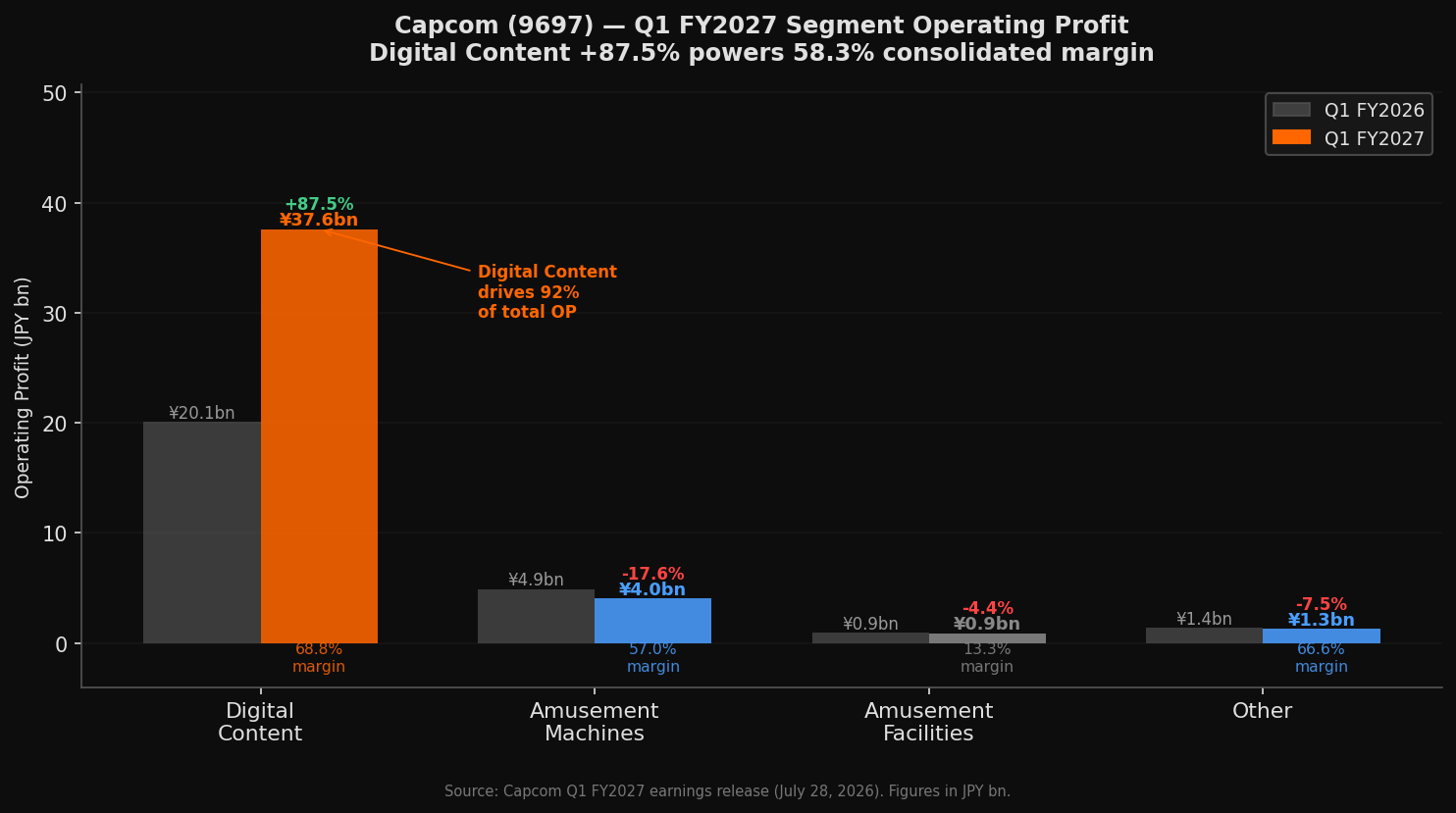 Figure 1: Segment operating profit, Q1 FY2026 vs Q1 FY2027. Digital Content at ¥37.6bn (+87.5%) drives 92% of total consolidated operating profit. Source: Capcom Q1 FY2027 earnings, July 28, 2026.
The segment data reveals a highly concentrated profit structure:
Digital Content (console, PC, and mobile game sales): ¥54.6bn revenue (+83.0%), ¥37.6bn operating profit (+87.5%), 68.8% operating margin. This segment sold 23.81 million units across 256 titles in 236 countries — up from 14.16 million units a year earlier. It represents 78% of consolidated revenue and 92% of consolidated operating profit.
Amusement Machines (pachislot hardware): ¥7.1bn revenue (-9.1%), ¥4.0bn operating profit (-17.6%), 57.0% margin. The segment sold approximately 17,000 units of Biohazard RE:3 pachislot machines in Q1. The revenue decline reflects lighter Q1 machine release scheduling; the 57% margin remains structurally high because Capcom’s IP-branded hardware commands premium pricing in Japan’s gaming machine market.
Amusement Facilities (64 arcade and entertainment stores, including CAPCOM STORE TAIPEI opened March 2026): ¥6.8bn revenue (+20.6%), ¥0.9bn operating profit (-4.4%). The revenue growth reflects new store openings and higher footfall; the slight profit decline reflects pre-opening and ramp-up costs for newer locations.
Other (video content, eSports, character licensing): ¥1.9bn revenue (-14.6%), ¥1.3bn operating profit (-7.5%). This segment includes the Netflix Devil May Cry Season 2 global distribution (launched May 2026 following Season 1 in 2025) and eSports revenues from CAPCOM Pro Tour 2026. The live-action Street Fighter: The Movie (worldwide October 2026 release) is generating pre-release marketing spend that flows through this segment.
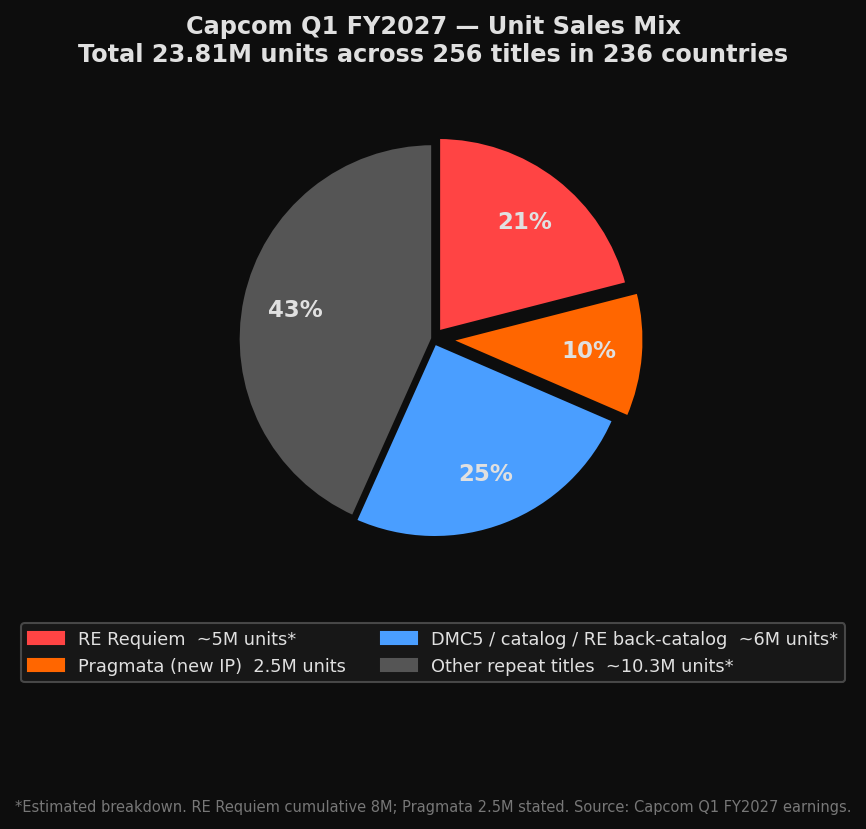 Figure 2: Estimated unit sales mix for Q1 FY2027. RE Requiem and back-catalog Resident Evil titles combined with DMC and Monster Hunter catalog drove the majority of 23.81 million units. Pragmata contributed ~2.5M as a stated figure. Breakdown is estimated; exact title-level data is not disclosed. Source: Capcom earnings; Japan Earnings Insights estimates.
The Balance Sheet: A Software Business Generating Cash
The financial position warrants attention independent of the Q1 income statement.
| Item | March 2026 | June 2026 | Change |
|---|---|---|---|
| Cash & deposits | ¥148.0bn | ¥161.2bn | +¥13.2bn |
| Game software WIP | ¥54.6bn | ¥56.5bn | +¥1.9bn |
| Equity ratio | 78.8% | 83.9% | +5.1pp |
| Net assets | ¥267.7bn | ¥286.9bn | +¥19.2bn |
| Deferred revenue | ¥9,065M | ¥598M | -¥8,467M |
Cash increased by ¥13.2 billion in a single quarter despite ¥10.7bn in dividend payments. Game software work-in-progress (representing current development spending) stands at ¥56.5bn — a proxy for the development pipeline depth. At 83.9% equity ratio with ¥161bn in cash, the balance sheet has essentially no financial risk.
The deferred revenue collapse from ¥9,065M to ¥598M is an accounting story worth understanding: Capcom recognized approximately ¥8.5bn of previously deferred digital subscription and DLC revenue in Q1, pulling forward income that had been held on the balance sheet. This contributed to the revenue surge in the quarter beyond what pure unit sales would imply.
Why Guidance Looks Conservative — and What Could Change It
Full-year FY2027 guidance remains unchanged from May: revenue ¥210.0bn (+7.5%), operating profit ¥83.0bn (+10.2%). After a Q1 that delivered ¥41.1bn in operating profit — 49.5% of the full-year target in a single quarter — the guidance implies roughly flat H2 performance relative to Q1 pace.
Capcom’s reasoning is defensible. Video game revenue is extremely lumpy. A quarter with two major simultaneous tailwinds (RE Requiem carrying forward + Pragmata launch) will not repeat by definition. Management is not projecting the absence of new hits — it is declining to count on them until they materialize.
The variable that could change the calculus is Monster Hunter Wilds: Ascendance — a “super-expansion” to Monster Hunter Wilds (released February 2025, which became Capcom’s fastest-selling title ever). The Ascendance release was announced during Q1 for a FY2027 launch, meaning it falls within the current fiscal year. Monster Hunter Wilds launched to 10 million copies in its first three days. An expansion of that franchise released into an active installed base of tens of millions of players would be a material revenue event — and it is not in the guidance.
The IP Flywheel in Practice
Capcom’s moat is not primarily technical — it is intellectual property with decades of established fandom. The Q1 results illustrate the flywheel in action:
- Devil May Cry 5 (released 2019) sold enough units this quarter to cross the 14 million cumulative copies milestone, driven by a Netflix anime series (Season 2 launched May 2026) creating new fan entry points
- Resident Evil RE:4 and RE:2 Remake (released 2023 and 2019 respectively) continued selling on the back of RE Requiem’s promotional halo
- Street Fighter 6 maintains audience engagement through CAPCOM Pro Tour eSports circuit, building the installed base ahead of the live-action film release in October 2026
The economic model: Capcom spends ¥56.5bn developing games that, when they hit, generate 68.8% operating margins on digital distribution. Old titles keep selling for years, generating high-margin revenue with minimal incremental cost. New media (anime, film) creates discovery moments that re-monetize the back catalog.
What to Watch
Pragmata sequel signal. If management announces a sequel or expansion for Pragmata in the next two quarters, it signals confidence that the new IP has demonstrated sufficient commercial viability. A repeat title version of Pragmata would extend the quarter’s gains into future periods.
Monster Hunter Wilds: Ascendance timing. The announced FY2027 window is wide. A Q3 (October–December 2026) launch before the holiday season would have a different impact than a Q4 (January–March 2027) launch. Any timing disclosure will move the consensus estimate on full-year guidance significantly.
Street Fighter: The Movie (October 2026). Live-action film releases have historically generated discovery-driven catalog sales for Capcom. If the film performs well, Street Fighter 6 and back-catalog SF titles benefit. The prior SF film (1994) is cult history; the new production has material production values and a global release.
Source: Capcom Q1 FY2027 Earnings (TDnet) | 日本語版
Disclaimer | This article is for informational purposes only and does not constitute investment advice. Unit sales estimates by title are Japan Earnings Insights estimates based on disclosed segment totals; Capcom does not disclose per-title quarterly data.