Thine Electronics Co., Ltd. (TSE:6769) reported a sharp upward revision to its FY2026 net profit forecast on July 21, lifting the figure from JPY 3M to JPY 107M on the back of special gains. The market barely noticed. And that tells you something important about this company.
The numbers on the surface are puzzling. Annual revenue of ¥6.7bn, operating profit of ¥13M — a margin of 0.2%. Yet the balance sheet holds ¥6.95bn in cash, more than a full year of sales. And the company spent ¥410M on R&D in a single quarter, running at ¥1.6bn per year — more than 100 times its annual operating profit.
Standard financial analysis breaks down here. To understand Thine, you need a different framework.
Two Businesses, Two Fates
Thine operates two segments that are heading in opposite directions.
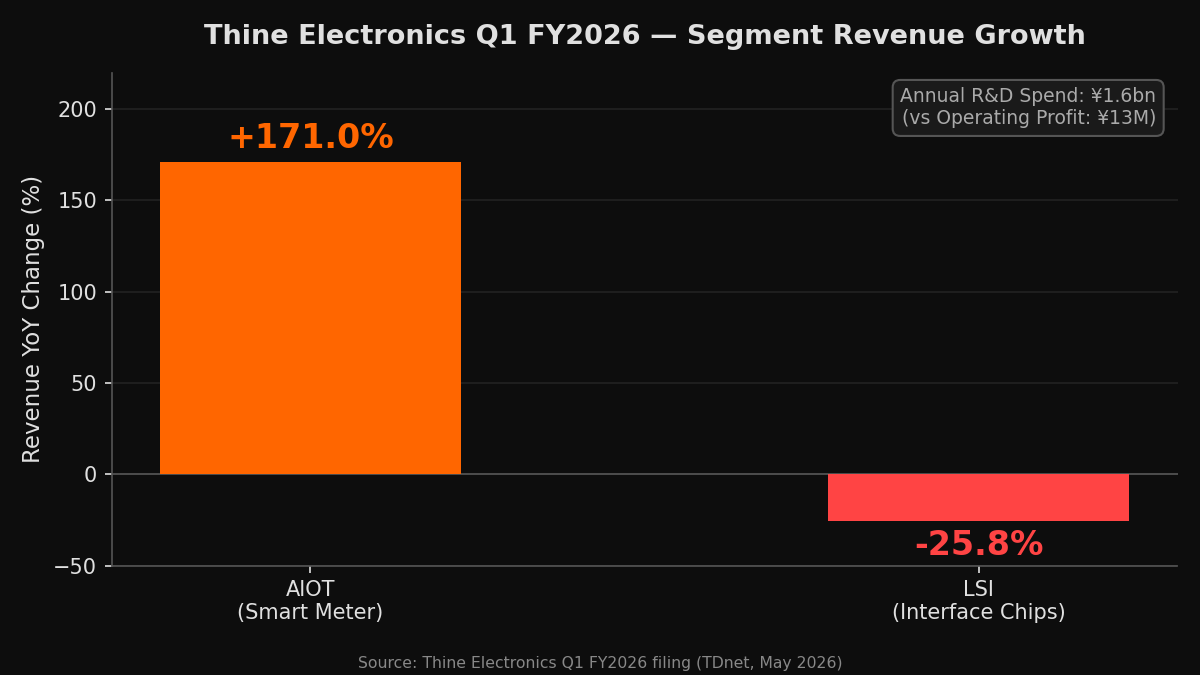 Figure 1: AIOT Segment Revenue +171% YoY vs LSI Segment -25.8% (Q1 FY2026)
The LSI business — high-speed interface chips sold to industrial equipment, automotive displays, and consumer electronics — declined 25.8% in Q1. Its proprietary V-by-One®HS standard, used in EV dashboard panels and industrial monitors, faces headwinds from sluggish domestic OA equipment demand and inventory adjustments in amusement machine clients. This business is shrinking.
The AIOT business — IoT modules for smart meters — grew 171% in Q1, with communications module revenue up 273%. This is not a technology story. Japan’s government mandated the nationwide replacement of analog electricity meters with smart meters under its energy liberalization policy. Thine supplies the embedded communications modules. The customer is effectively the Japanese state, acting through power utilities.
The AIOT business is what it is: a government-mandated infrastructure rollout, providing predictable, high-volume demand for as long as the installation program runs. It explains the cash accumulation. When your customer is a public utility executing a legal mandate, payments are reliable.
The Cash Question
With ¥6.95bn in cash against ¥6.7bn in annual revenue, the obvious question is: why?
The company’s official answer — disclosed in its Q1 filing — is that it maintains liquidity “to secure flexible R&D resources and respond swiftly to M&A opportunities.” M&A has not materialized. Capital expenditures in Q1 were ¥8M — negligible for a company of this size.
The real answer is that the cash is runway. Specifically, runway for the R&D program that the LSI division is running: the development of DSP-less optical semiconductor chipsets compliant with PCI Express 6.0 (targeted for mass production in 2027) and PCI Express 7.0 (2028).
At the current R&D burn rate of ¥1.6bn per year, the company has roughly four years of development funding without touching revenue. That is the design.
The Optical Semiconductor Bet — Or Is It?
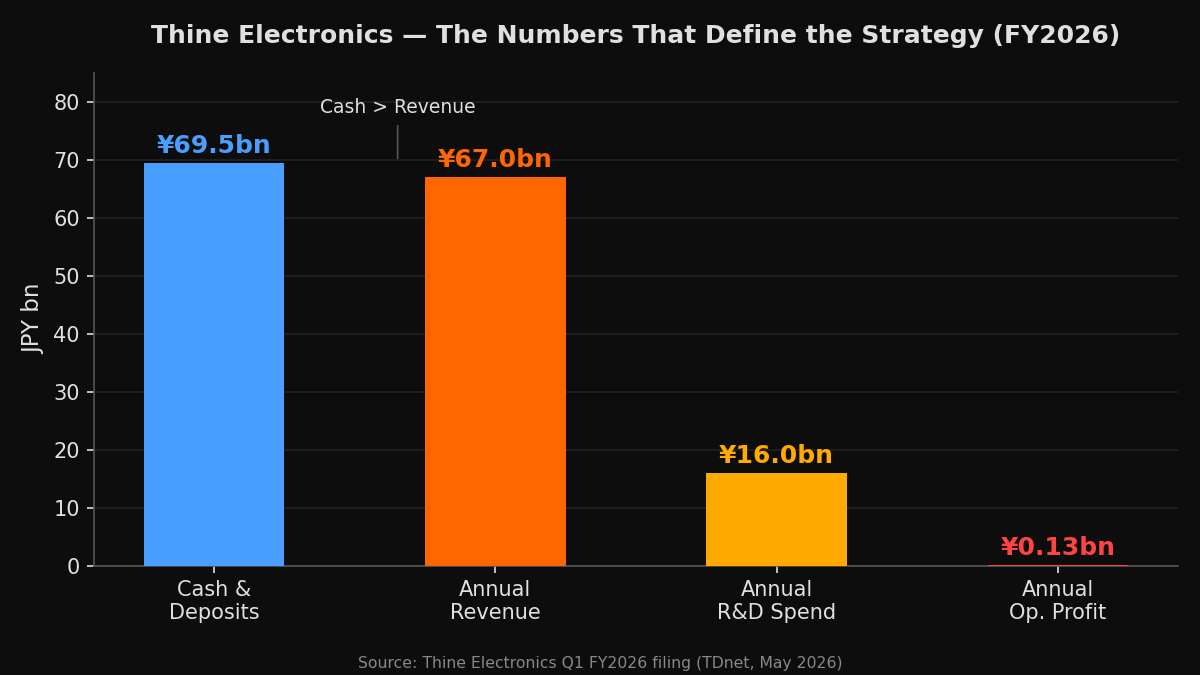 Figure 2: Cash Holdings, Annual Revenue, and R&D Spend — the numbers that define Thine’s strategy
The optical semiconductor program is described internally as a race to develop “the world’s first DSP-less low-power, low-latency optical semiconductor technology for AI server next-generation computing.” In March 2026, Thine exhibited its solution at OFC2026 in Los Angeles — the world’s largest optical communications conference — and received significant interest.
The technology addresses a real bottleneck. As AI server clusters scale to thousands of GPUs, the copper interconnects between chips become a constraint: bandwidth-limited, distance-limited, heat-generating. Optical interconnects solve all three problems, but traditional implementations require Digital Signal Processors that add latency and power draw. Thine’s DSP-less approach eliminates that overhead.
This sounds like a competitive technology bet. But context changes the picture considerably.
The development is funded in part by NICT — the National Institute of Information and Communications Technology, a government research organization under Japan’s Ministry of Internal Affairs and Communications. NICT does not fund speculative commercial ventures. It funds technology development aligned with national priorities.
And Japan’s national priority in this area is explicit. NTT’s IOWN (Innovative Optical and Wireless Network) initiative — backed by the government and NTT, with Intel and Sony as partners — targets the replacement of electrical processing with optical processing by 2030. The technology Thine is building maps directly onto what IOWN requires.
Under Japan’s Economic Security Promotion Act (2022), semiconductors are designated as “specified critical materials” requiring domestic supply chains. For AI server optical interconnects, Thine is currently the only Japanese company developing this specific chipset technology.
The Reserved Seat Framework
The standard lens for evaluating a technology company asks: can it win in the market? For Thine, the more relevant question is: has the seat already been reserved?
The NICT funding signals that the answer to the second question is yes — the government has already identified Thine as the designated domestic developer of this technology. The ¥1.6bn annual R&D spend is not a bet on market competition. It is the technical homework required to occupy a position that has already been arranged through Japan’s government-industry ecosystem.
The CEO, Yoichiro Minami, joined Thine in 2019 specifically to build the AIOT (smart meter) business — after a career at NEC that included heading the mobile terminal division and running NEC’s China communications subsidiary. NEC’s government division relationships run deep into Japan’s ministries. The NICT funding and the smart meter supply position did not materialize by accident.
What This Means for Investors
Thine is not a company that will disrupt the optical semiconductor market. It will not compete with Broadcom or Intel Silicon Photonics for hyperscaler contracts globally. It will supply NTT and Japan’s national AI infrastructure — a smaller, more certain, and structurally protected market.
The stock trades at a significant discount to book value precisely because the market cannot easily price this dynamic. Cash-rich but operationally thin. High R&D burn with no near-term earnings visibility. A 2027 revenue target of ¥10bn (“Innovate100”) that implies only modest growth from current levels.
The bull case is simple: if the optical semiconductor program delivers on schedule and NTT-IOWN adopts it, Thine becomes the sole domestic supplier of a critical component in Japan’s AI infrastructure — with pricing power and government backing. The cash provides the runway to get there.
The risk is equally simple: if the technical delivery slips past 2027-2028, competitors from Taiwan or the US enter the IOWN supply chain before Thine can establish its position. At that point, the cash erodes and the thesis breaks.
For now, Thine is quietly completing its homework. The seat, by all appearances, is already reserved.
Source: Original filing — FY2026 Earnings Revision (TDnet) | Q1 FY2026 Quarterly Filing (TDnet) | 日本語版
Disclaimer | This article is for informational purposes only and does not constitute investment advice. Analysis reflects publicly available information only.