A 10.9% Adjusted EBITA margin on ¥2.7 trillion in quarterly revenue. For context, most diversified industrial conglomerates — Siemens, GE, Honeywell — operate in the 8–12% range and consider that a good year. Hitachi (TSE:6501) delivered that in a single quarter, on revenue that grew 20% year-on-year, for a company that was assembling refrigerators and televisions not long ago.
The Q1 FY2027 result — revenue ¥2,709.6bn (+20.0%), adjusted operating profit ¥294.3bn (+39.5%), Adjusted EBITA ¥323.5bn (+36.2%) — is a case study in what happens when a conglomerate spends fifteen years selling the wrong businesses and keeping the right ones, then finds itself positioned directly in front of two of the decade’s biggest infrastructure investment waves.
The Segment That Actually Drove the Quarter
The narrative around Hitachi tends to center on Lumada, its IoT/AI platform for enterprise digital transformation. Lumada is real and important. But Lumada did not drive Q1 FY2027.
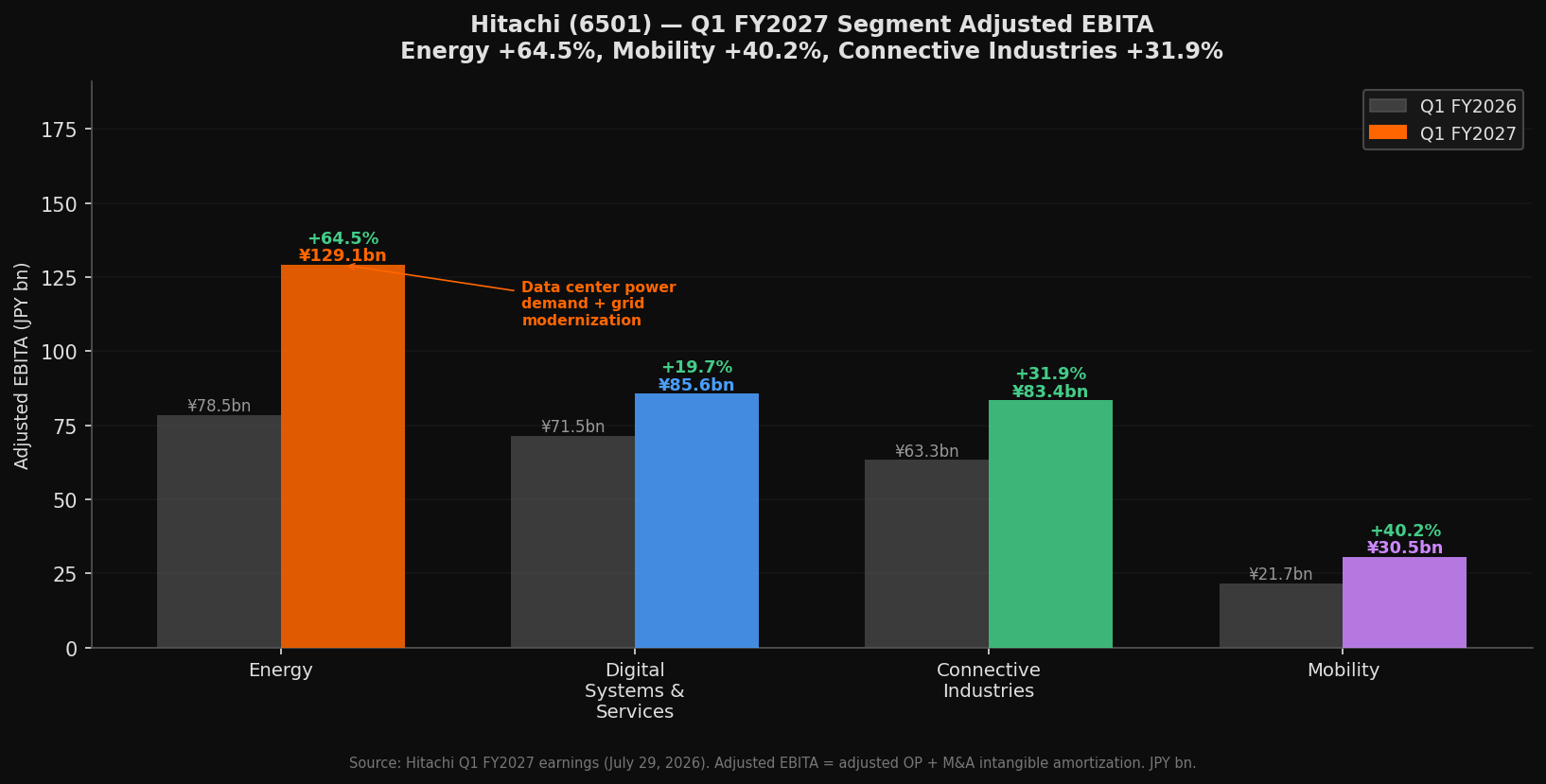 Figure 1: Segment Adjusted EBITA, Q1 FY2026 vs Q1 FY2027. The Energy segment drove approximately 59% of the total year-on-year increase, reaching ¥129.1bn (+64.5%). Source: Hitachi Q1 FY2027 earnings, July 29, 2026.
The Energy segment posted Adjusted EBITA of ¥129.1bn — up 64.5% year-on-year on revenue of ¥908.2bn (+36.7%). This single segment contributed approximately ¥50.6bn of the ¥86bn total EBITA increase. Put differently: six out of every ten yen of incremental earnings this quarter came from power grids and energy infrastructure.
What drove Energy? Two forces are running simultaneously. The first is the global buildout of AI data center infrastructure. A hyperscale data center consumes 100–500MW of power. Building one requires not just the server racks inside but the transformer stations, grid connections, and power management systems outside — equipment Hitachi Energy (the renamed successor to the ABB Power Grids business acquired in 2020) specializes in. Microsoft, Google, Amazon, and their Asian equivalents are building at historic pace; every new campus generates a procurement cycle for Hitachi.
The second force is grid modernization in North America and Europe. Aging transmission infrastructure, accelerating renewable energy integration, and energy independence mandates following the 2022 supply shock have created a sustained multi-year capital program at major utilities. HVDC (high-voltage direct current) transmission, transformer replacement, and grid stabilization equipment are all in shortage globally. Order backlogs at Hitachi Energy have extended accordingly.
The remaining segments each contributed:
- Digital Systems & Services: ¥85.6bn (+19.7%) — system integration, cloud services, IT products, and consulting. This segment absorbed the industrial SI business previously housed in Connective Industries, making direct year-on-year comparison approximate.
- Connective Industries: ¥83.4bn (+31.9%) — measurement and analysis systems for semiconductor manufacturing, building systems (elevators, escalators), and home appliances. Semiconductor equipment demand is the growth driver here, on the same AI infrastructure tailwind as Energy.
- Mobility: ¥30.5bn (+40.2%) — railway systems globally, under the Hitachi Rail brand. The segment closed the Clever Devices acquisition ($302M, a U.S. intelligent transportation systems company) on July 1, adding a capability in real-time transit management software.
Why Doesn’t a Startup Displace This?
The natural question for investors encountering Hitachi’s margins is: why can’t a more agile, software-native competitor take market share?
The answer differs by segment but follows a common logic: in regulated infrastructure, the barrier to entry is not technology — it is certification, liability, and institutional trust accumulated over decades.
A nuclear plant control system requires safety certification that takes five to ten years and must survive regulatory audits by national atomic energy agencies. A railway signaling system must be certified against collision scenarios before a single train runs on it. A power grid transformer installation requires engineering sign-off from the transmission system operator, performance guarantees against grid failure, and warranty commitments measured in decades, not product cycles.
AWS can provide excellent compute infrastructure. It cannot sign a thirty-year availability guarantee on a substation in rural Germany. Hitachi can, because it has been doing so — and absorbing the liability — since before most software companies existed.
This is the structural moat that financial models struggle to capture: the willingness and capability to accept long-duration infrastructure liability at industrial scale, backed by balance sheet strength (Hitachi’s equity ratio is 43.7%, net cash position solid) and a track record that regulators and utilities are trained to verify.
What Hitachi Is Not Anymore
It is equally important to understand what drove the margin improvement structurally over the past decade.
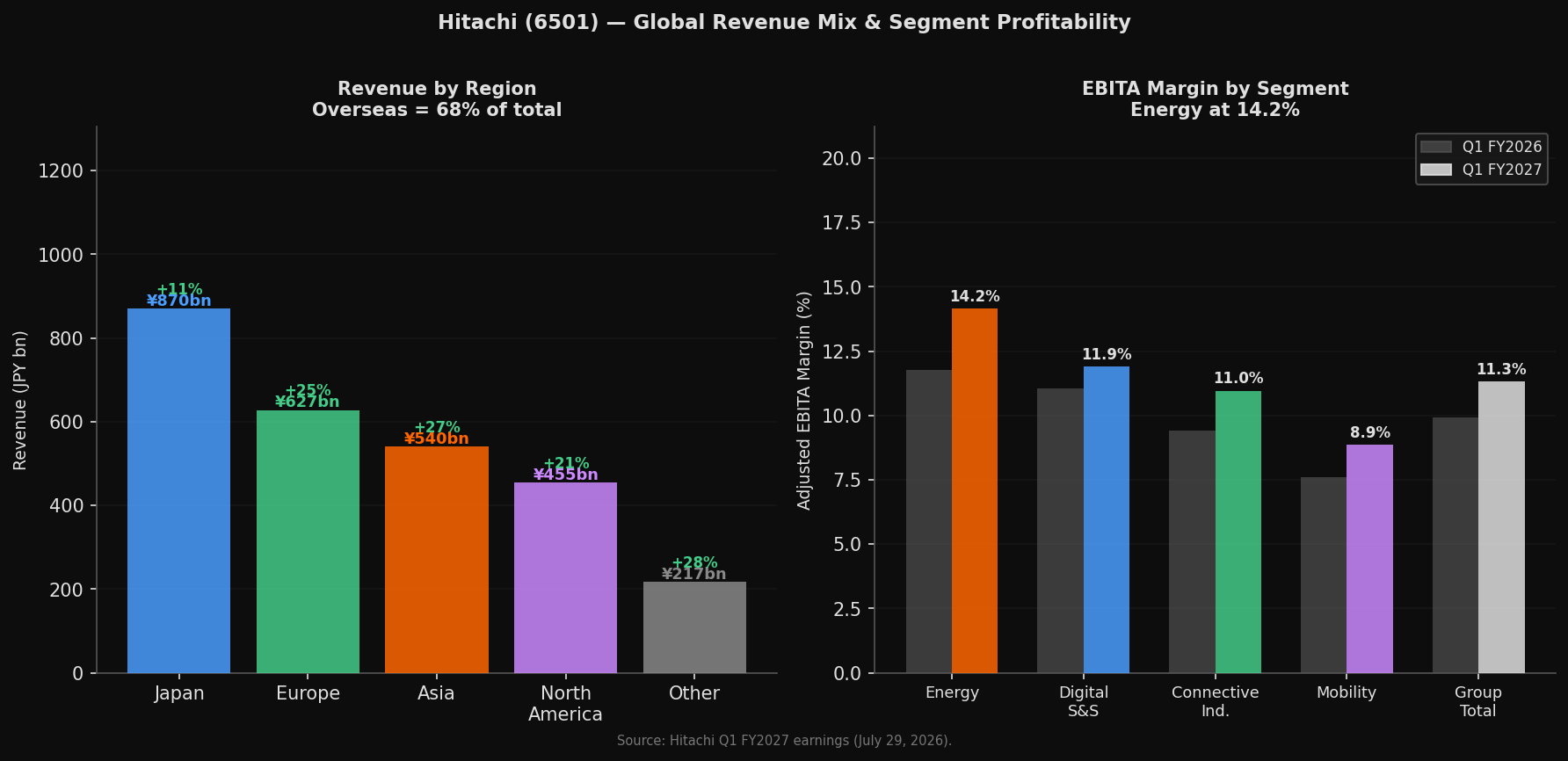 Figure 2: Left — Q1 FY2027 revenue by region (overseas = 68% of total, all regions growing 20%+). Right — Adjusted EBITA margin by segment, Q1 FY2026 vs Q1 FY2027. Energy leads at 14.2%. Source: Hitachi Q1 FY2027 earnings.
Hitachi divested Hitachi Chemical (now Resonac/Showa Denko Materials), Hitachi Metals (now Proterial), Hitachi Capital, Hitachi Transport System, and reduced its stake in Hitachi Construction Machinery — businesses that collectively represented hundreds of billions of yen in revenue but operated at structurally lower margins in cyclical or commoditized markets.
What remained was a deliberate portfolio: power grids (high-margin, long-cycle capital equipment), railways (long-cycle, sticky service contracts), digital transformation services (recurring, sticky once embedded), and measurement/industrial technology (high-value, low-substitutability).
The conglomerate discount that traditionally applied to Hitachi — the assumption that cross-subsidization and management complexity erodes value — has diminished because the portfolio complexity itself diminished. Four focused segments with shared OT/IT capabilities is a different structure than fifteen businesses ranging from nuclear to refrigerators.
The OT+IT Combination and Lumada
Lumada is Hitachi’s data platform and solution framework that runs across segments — collecting operational data from power grids, rail systems, and factory equipment, and applying analytics and AI to improve efficiency and predict failures. As of the most recent annual disclosure, Lumada-related revenue represented approximately ¥1.4 trillion annualized, growing at roughly 20% per year.
The strategic value of Lumada is not the platform itself but what it creates over time: customer data lock-in. A utility running its grid management on Lumada generates years of operational data that trains predictive models unique to that grid. Migrating away means losing that model — and accepting a performance regression during the re-training period. For critical infrastructure, that is an unacceptable operational risk.
This is the software layer on top of the physical infrastructure moat: the physical equipment is hard to displace because of certification and liability; the software on top is hard to displace because of data accumulation and integration depth.
Full-Year Guidance and What to Watch
Full-year FY2027 guidance: revenue ¥11,700bn (+10.5%), adjusted operating profit ¥1,408bn (+17.4%), net profit ¥900bn (+12.2%). After Q1 delivered ¥294.3bn in adjusted operating profit — 20.9% of the full-year target — the guidance implies meaningful deceleration in Q2–Q4.
This reflects standard Hitachi conservatism: infrastructure project revenue is lumpy, recognition depends on milestone completions, and the Energy order book (not disclosed at the quarterly level) may contain projects with multi-quarter revenue recognition. Management does not extrapolate quarterly run rates into guidance.
Energy order book. The most important unknown. Hitachi Energy’s backlogs have been running at record levels per public communications; if that order book converts to revenue in Q2–Q4 above the implicit guidance rate, energy-driven upside is material.
Clever Devices integration. A $302M acquisition of a U.S. ITS company into the Mobility segment. The strategic rationale — adding real-time transit management software to Hitachi Rail’s hardware offering — is coherent. Integration execution and whether the capability can be cross-sold into Hitachi Rail’s existing European and Asian customer base are the variables to monitor.
Lumada revenue trajectory. Only disclosed annually in detail; quarterly results give limited visibility. Watch the FY2027 full-year disclosure for evidence that the platform is accelerating or plateauing.
Source: Hitachi Q1 FY2027 Earnings (TDnet) | 日本語版
Disclaimer | This article is for informational purposes only and does not constitute investment advice.