Insource Co., Ltd. (TSE:6200) is invisible to most consumers. The company does not sell products in stores, does not run consumer apps, and does not advertise on prime-time television. Yet it serves 52,118 client organizations across Japan, earns a 38.4% operating margin — comparable to leading software companies — and just announced plans to cancel 4.7% of its outstanding shares.
Q3 FY2026 results (cumulative October 2025 through June 2026) show revenue of ¥11.6bn (+8.9% YoY) and operating profit of ¥4.45bn (+3.7%). Gross margin was 76.3%. These are not the numbers of a company that rents conference rooms and sends out speakers. They are the numbers of a company that has quietly built one of Japan’s most durable business moats — in an industry most investors never think about.
Not a Training Company. A Compliance Infrastructure Provider.
The standard framing — “corporate training company” — misses what Insource actually does. To understand the business, start with the question every Japanese HR manager asks when a new law passes: who do we call?
Japan’s regulatory environment has produced a relentless stream of mandatory training obligations. Workplace harassment prevention became legally required for large companies in 2020, extended to small companies in 2022. The Personal Information Protection Act was comprehensively revised in 2022. Stress checks became mandatory in 2015. Cybersecurity guidelines are updated annually. And since 2023, generative AI utilization guidelines have created an entirely new category of compliance training demand.
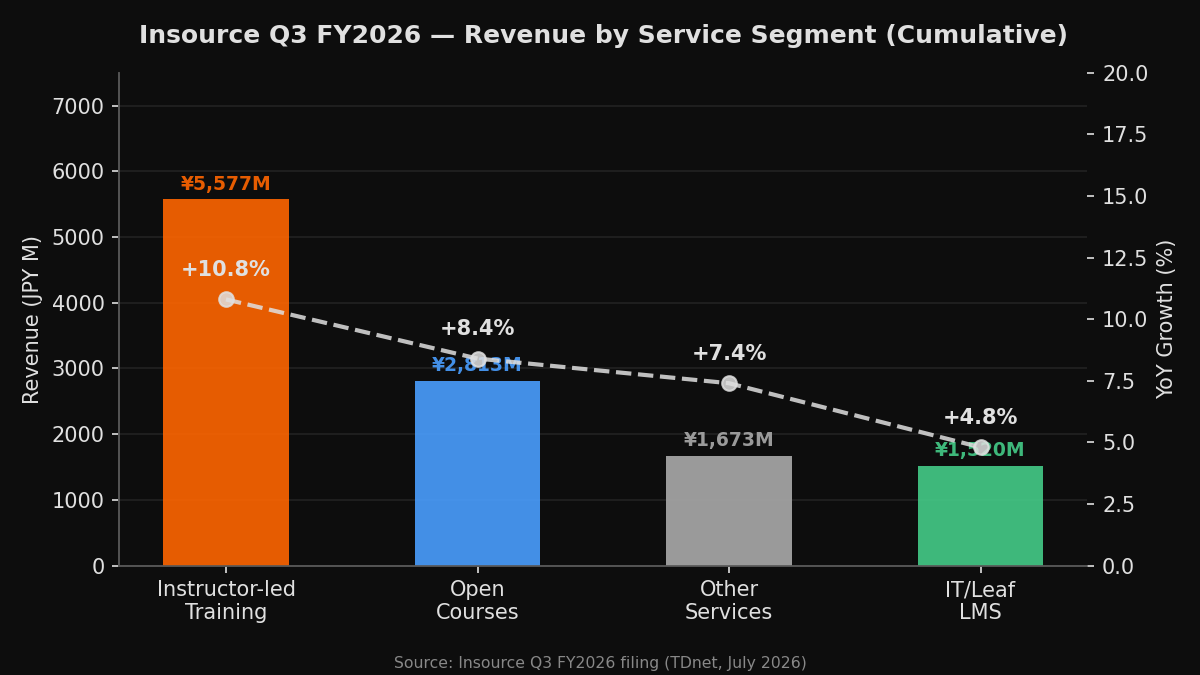 Figure 1: Insource Q3 FY2026 revenue by service segment (cumulative, JPY M) with YoY growth rates
Each regulatory update is, for Insource, effectively a sales event. The company already holds more than 3,500 training programs in its library. When a law changes, Insource updates the relevant content — supervised by legal experts and, where required, specialists with ministry connections — and re-sells it to its existing customer base. The marginal cost of content delivery across thousands of organizations is minimal. The gross margin of 76.3% reflects this structure precisely.
The Three Layers of the Moat
What makes this business difficult to disrupt comes down to three interlocking barriers.
First: content credibility requires regulatory access. A company cannot simply write a harassment prevention training module and sell it to government agencies. The content must reflect the accurate legal interpretation of the relevant ordinance or ministerial guideline — and that interpretation is not always obvious from reading the official text alone. Established providers maintain relationships with supervising academics, former officials, and specialist attorneys who validate content accuracy. A new entrant faces years of relationship-building before it can credibly claim the same authority.
Second: scale creates a price floor competitors cannot undercut. Insource’s content library was built over more than two decades. For a new entrant to compete, it must build comparable content from scratch — a capital-intensive process — while bidding against an incumbent whose fixed costs are already fully amortized. Government procurement (competitive tender) across Japan’s 1,741 municipalities generates approximately 900 successful bids for Insource annually. These are not relationship-dependent contracts; they are price-competitive. Insource wins on price because it already has the content.
Third: Leaf LMS converts training into sticky infrastructure. Insource’s learning management system “Leaf” has reached ¥1.475bn in ARR, with 5.46 million active users (+19.3% YoY) across 919 paying organizations (+10.2%). Leaf is marketed as an e-learning platform, but its core value to corporate buyers is different: it generates auditable completion records. When regulators or internal auditors ask whether employees completed mandatory harassment training, the answer must come with documentation. Leaf provides that documentation. Canceling Leaf means losing the paper trail — which is not a risk most compliance officers are willing to take.
The P&L Structure
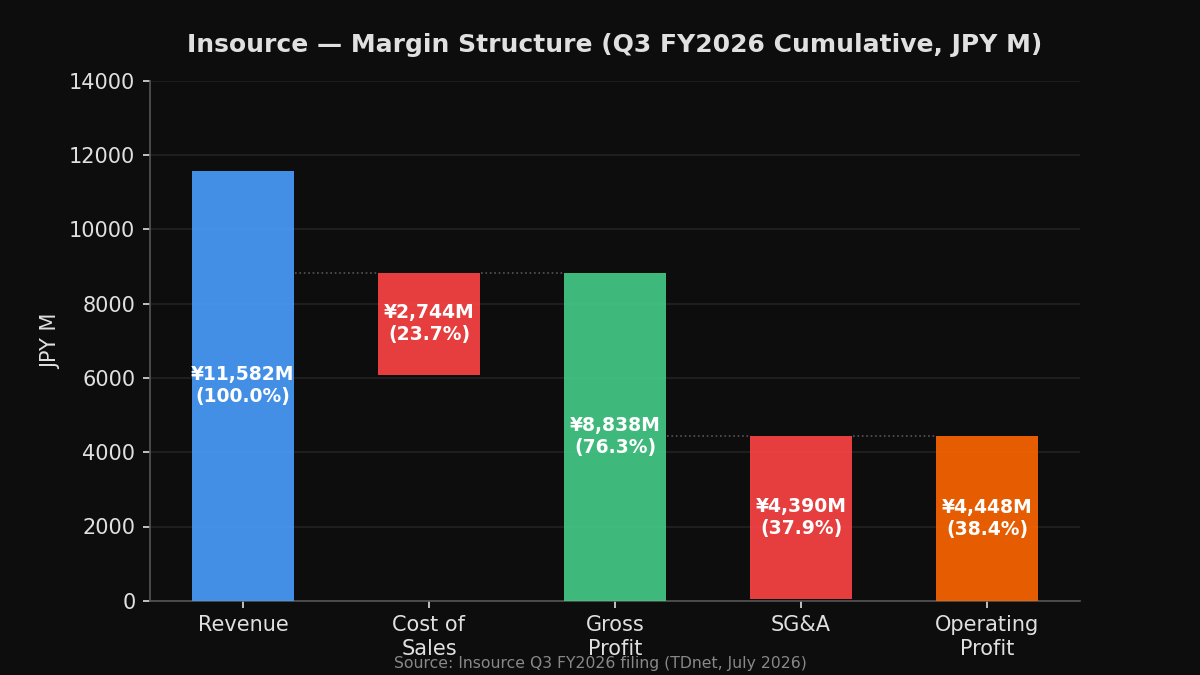 Figure 2: Insource P&L structure — from revenue to operating profit (Q3 FY2026 cumulative, JPY M)
The financial structure makes the moat concrete. Revenue of ¥11,582M less cost of sales of ¥2,744M yields a gross profit of ¥8,838M — a 76.3% gross margin. The majority of cost of sales represents external instructors deployed for on-site training; the marginal cost of Leaf-delivered digital content is effectively zero. Selling, general and administrative expenses of ¥4,390M leave operating profit of ¥4,448M, a 38.4% margin.
The fastest-growing customer segment this quarter is public sector (+15.7% YoY), which accounts for 19.8% of revenue and 1,791 client organizations. The Ministry of Health, Labour and Welfare is the single largest government client by contract volume — the ministry most directly responsible for writing the harassment and occupational health laws that generate Insource’s training demand.
Full-year guidance projects revenue of ¥16.0bn (+10.3%) and operating profit of ¥6.38bn (+6.7%), implying a Q4 that sustains current trajectory.
Shareholder Returns Signal Confidence
On July 21, 2026, Insource’s board authorized a share buyback of up to 3 million shares (approximately 3.5% of issued shares) and up to ¥2 billion, to be conducted through September 30. On the same date, the company announced cancellation of 4 million shares — including both newly repurchased shares and existing treasury stock — on September 30. This represents 4.7% of outstanding shares being permanently retired.
Combined with a dividend of ¥35 per share (up from ¥25 the prior year, a 40% increase including a ¥5.5 commemorative dividend), the total shareholder return signal is unambiguous: management views the current price as undervalued relative to the business’s earning power.
What Could Go Wrong
The regulatory moat has one structural vulnerability: it depends on the continued production of new regulations. Japan has shown no sign of reversing this trend — if anything, the Human Capital Management disclosure requirements introduced for listed companies in recent years suggest the compliance training market will continue expanding. But a shift toward simpler, less prescriptive regulation would reduce the content credibility barrier and open the market to lower-cost alternatives.
A second risk is commoditization of Leaf. As LMS technology becomes standardized, the switching cost advantage may erode. Competitors that offer equivalent documentation functionality at lower price points could pressure Leaf’s ARR growth.
Neither risk appears imminent. Japan’s regulatory trajectory is toward more disclosure, more mandatory training, and more documentation requirements — not fewer.
The Hidden Giant
Insource occupies a structural position that most market participants overlook because the company’s customers — HR managers, compliance officers, and procurement officials at 52,000 organizations — are not visible to ordinary observers. The business is not glamorous. But the economics are among the most durable in Japan’s service sector.
Every new law is a sales opportunity. Every compliance deadline is a retention mechanism. And every employee who needs to prove they completed their annual harassment training is a recurring unit of revenue.
The company has been building this position since 2002. It has now reached the scale at which the position reinforces itself.
Source: Q3 FY2026 Financial Filing (TDnet) | Q3 FY2026 Presentation (TDnet) | 日本語版
Disclaimer | This article is for informational purposes only and does not constitute investment advice. Analysis reflects publicly available information only.