Daido Special Steel (TSE:5471) posted Q1 FY2027 results that look, on first read, like a straightforward beat: revenue ¥163.5bn (+14.9%), reported operating profit ¥13.1bn (+51.4%). But the headline number requires interpretation — and the interpretation reveals something more interesting than a single strong quarter.
The company produces specialty steels, functional and magnetic materials, precision-forged parts, and engineering systems. Its customers span automotive, semiconductor manufacturing, aerospace, marine, energy, and medical sectors. That customer base is, right now, subject to one of the more unusual demand configurations in recent memory: automotive is weak, semiconductor is surging, and China’s export controls have quietly made Daido’s magnet products strategically irreplaceable.
The Two Numbers That Tell the Real Story
Daido reports two operating profit figures: a reported number (IFRS), and an adjusted number that strips out inventory valuation gains and losses, foreign exchange, environmental provisions, and other one-time items. The gap between them in Q1 FY2027 is the most important data point in the release.
| Q1 FY2026 | Q1 FY2027 | YoY | |
|---|---|---|---|
| Reported OP | ¥8.66bn | ¥13.11bn | +51.4% |
| Adjusted OP | ¥9.17bn | ¥11.49bn | +25.4% |
The ¥1.6bn difference between reported and adjusted in Q1 FY2027 is almost entirely inventory valuation gain: iron scrap prices surged sharply from March 2026. Under IFRS, raw materials are carried at cost; when prices rise, companies holding lower-cost inventory gain a margin advantage in the current period — but face the reverse when that high-cost inventory flows through to cost of goods sold in later quarters. This is a timing effect, not a structural one.
The adjusted figure of +25.4% is the more durable signal. It is still a strong result — but it needs to be read differently from the headline.
What Actually Drove the Quarter: Two Structural Themes
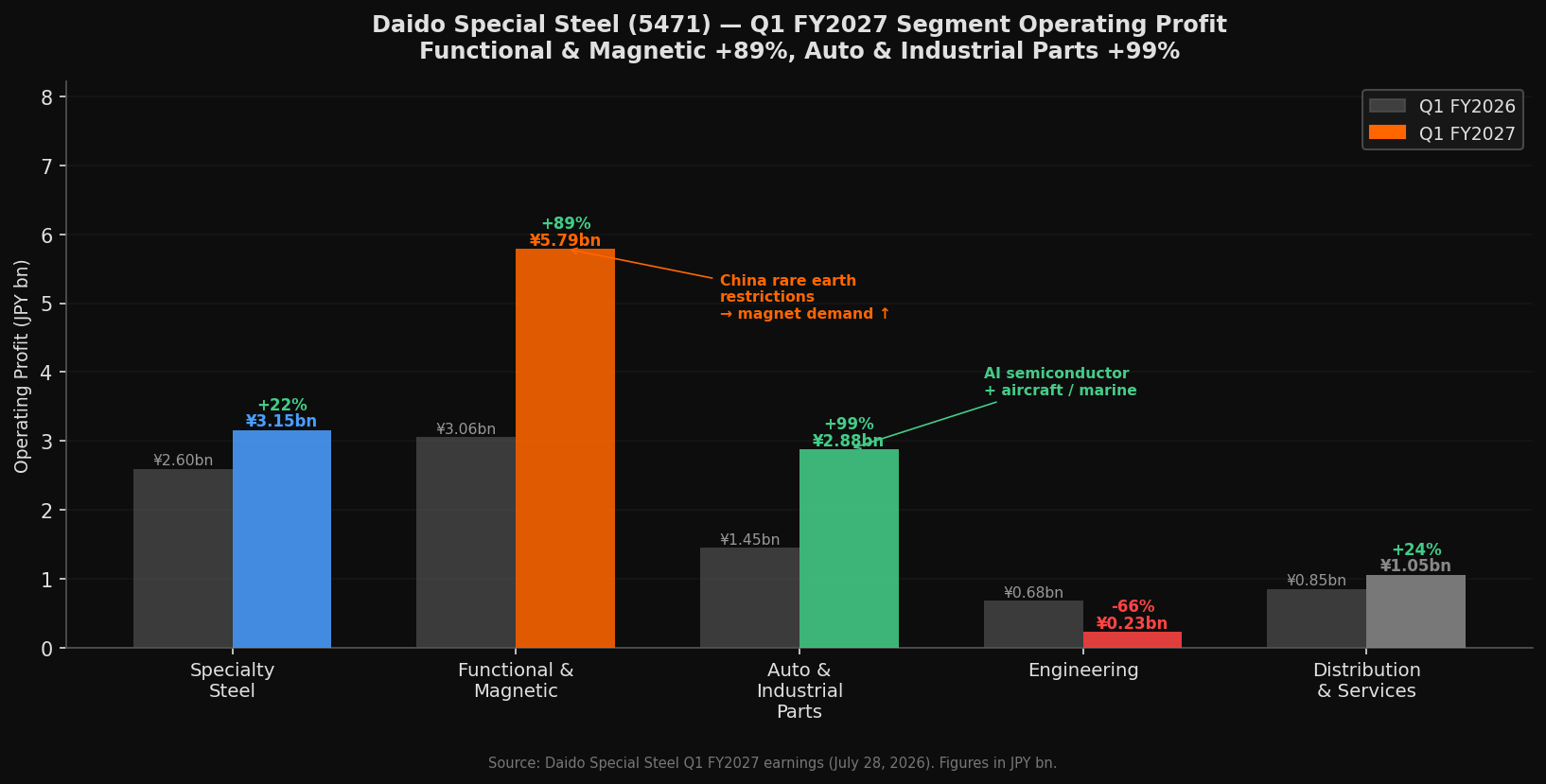 Figure 1: Segment operating profit, Q1 FY2026 vs Q1 FY2027. Functional & Magnetic Materials and Auto & Industrial Parts drove the vast majority of the OP increase. Source: Daido Special Steel Q1 FY2027 earnings, July 28, 2026.
Theme 1: China’s Rare Earth Crackdown Is Daido’s Windfall
The Functional & Magnetic Materials segment posted operating profit of ¥5.79bn — up 89.4% year-on-year. This is the segment that contains Daido’s magnet products, and the driver is geopolitical.
China controls approximately 85–90% of global rare earth refining capacity. In recent months, Beijing tightened export restrictions on heavy rare earth elements — specifically dysprosium (Dy) and terbium (Tb), which are critical inputs for high-performance permanent magnets used in EV drive motors, industrial robots, and wind turbines. The restrictions have created supply uncertainty for manufacturers that depend on Chinese rare earth inputs.
Daido’s magnets are engineered to be heavy rare earth-free — a deliberate technical strategy that dates back years. Without requiring Dy or Tb, Daido’s magnets are immune to the Chinese supply restriction that is disrupting competitors. The earnings release states directly: “demand for our magnets, which are characterized by being free of heavy rare earths such as Dy and Tb, is trending upward.” In April 2026, Daido installed a new manufacturing line for electric vehicle drive motor magnets — capacity that is now absorbing the demand surge.
The China risk here cuts in an unusual direction: the risk is not that China restricts rare earths and hurts Daido — it is that China removes the restrictions. If Beijing reverses course and floods the market with Dy and Tb, the competitive advantage of Daido’s heavy rare earth-free magnets shrinks. This is the structural uncertainty that management is likely factoring into its conservative full-year guidance.
Also within this segment: stainless steel for semiconductor-related applications grew strongly, driven by demand from semiconductor manufacturing equipment makers aligned with AI infrastructure buildout. Daido commissioned two vacuum arc remelting (VAR) furnaces at its Chita No.2 Plant in 2024 specifically to address this demand. The capex is now generating returns.
Theme 2: AI Semiconductor + Aerospace + Marine Is Rescuing the Auto Parts Business
The Auto & Industrial Parts segment posted operating profit of ¥2.88bn — up 99.0% year-on-year on revenue of +8.0%. The margin nearly doubled.
The segment name is somewhat misleading: while it includes automotive parts (engine valves, precision castings), the growth driver this quarter was everything except automotive. Engine valve demand in North America increased. Free-forged products for aerospace, marine ship engines, and heavy electrical equipment maintained high order levels. Semiconductor-related free forgings saw “sharply accelerating” order intake.
The automotive side — particularly Japanese auto manufacturers in China and ASEAN — remains weak. Japan’s traditional automakers are losing market share to Chinese EV competitors in their most important growth markets. Daido’s engine valve business serves ICE powertrains, which is a structural headwind over the multi-year horizon.
The current quarter’s strength is that semiconductor, aerospace, and marine demand is large enough to more than compensate. Management notes that aircraft, marine, and heavy electrical orders “remain at high levels” — language suggesting these are not one-quarter phenomena.
The Reported vs. Adjusted Gap — and What Full-Year Guidance Is Actually Saying
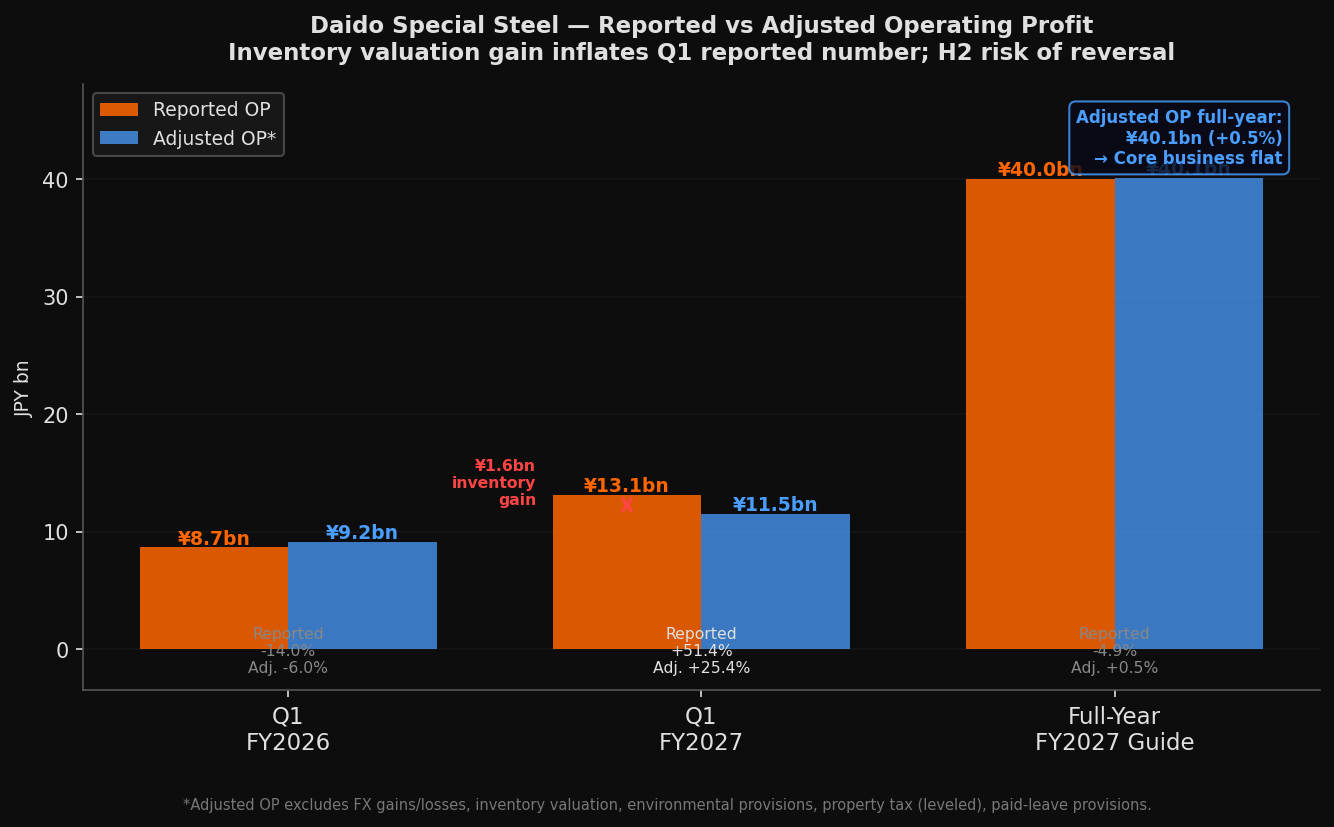 Figure 2: Reported vs. adjusted operating profit. The ¥1.6bn gap in Q1 FY2027 reflects inventory valuation gains from scrap iron price surge (March 2026 onward). Full-year adjusted OP guidance is essentially flat (+0.5%), suggesting management views the core business as stable — not declining. Source: Daido Special Steel Q1 FY2027 earnings.
Full-year FY2027 guidance: reported OP ¥40.0bn (-4.9%), adjusted OP ¥40.1bn (+0.5%).
The divergence between these two numbers is the key to reading the guidance correctly. Management is not forecasting that the business deteriorates — it is forecasting that the inventory valuation tailwind reverses. Iron scrap prices that surged in March and created Q1 gains will, as high-cost inventory enters production and flows to cost of goods sold, create headwinds in H2. The adjusted OP guidance at +0.5% says: strip away timing effects, and the underlying business is roughly flat year-on-year.
There is a second layer: the comparison base. Q2–Q4 FY2026 generated approximately ¥33.4bn in operating profit (FY2026 full-year was ~¥42.1bn; Q1 FY2026 was ¥8.66bn). The current guidance implies Q2–Q4 FY2027 at approximately ¥26.9bn — a meaningful step-down from the prior-year comparable period. The prior-year H2 benefited from its own favorable conditions; the guidance is conservatively assuming those don’t repeat at the same magnitude.
The China Risk: Structural Tailwind With a Single-Point Failure
Daido’s rare earth-free magnet position is genuine, technically difficult to replicate, and currently in strong demand. But it carries a specific risk that most operational risks don’t: it can be neutralized by a single policy decision in Beijing.
If China lifts or substantially eases heavy rare earth export controls, the competitive advantage of Daido’s Dy/Tb-free magnets shrinks immediately. Customers currently paying a premium for supply-chain security would have less reason to do so. The demand surge that drove 89% operating profit growth in the Functional & Magnetic Materials segment would moderate.
This is not a reason to dismiss the business — the technical capability Daido has built in rare earth-free magnets is valuable regardless of China’s policy stance. But it explains why management is not extrapolating Q1’s Functional & Magnetic segment performance into full-year guidance at the same run rate.
The ¥36 Billion Investment Story
An important long-term signal in the earnings release: Daido is executing a ¥36 billion “high-alloy process reform project” targeting aerospace and energy sectors. This is a multi-year capital program aimed at repositioning the company’s manufacturing capacity toward higher-value products with more durable demand characteristics than traditional automotive steel.
The investment rationale: aerospace, marine, and energy-related forged products are growing their share of Daido’s order book. These end markets have different cyclical characteristics from automotive — aerospace in particular has order backlogs that extend years, not quarters. The capital program is management’s signal that it views the current demand composition as more durable than the headline guidance numbers might suggest.
What to Watch
China rare earth policy. Any relaxation of Dy/Tb export restrictions would be the most significant single risk to the Functional & Magnetic segment. Monthly monitoring of China’s rare earth export data is the best early warning signal.
Scrap iron price trend. If iron scrap prices moderate or decline from current elevated levels in H2, the inventory valuation headwind management has built into guidance may prove less severe than assumed — creating room for upside to the reported OP figure.
H3 rocket launch schedule and defense-related aerospace demand. Japan’s sovereign aerospace and defense procurement, accelerating under the government’s defense build-up, represents a growing customer base for Daido’s free-forged products. Any news on H3 manifest expansion or domestic defense orders is a positive read-through.
Source: Daido Special Steel Q1 FY2027 Earnings (TDnet) | 日本語版
Disclaimer | This article is for informational purposes only and does not constitute investment advice.