Shin-Etsu Chemical Co., Ltd. (TSE: 4063) opened its fiscal year 2027 with a first quarter that confirms what long-term holders already knew: this is a company where exceptional profitability is structural, not cyclical.
Revenue of ¥662.4bn (+5.4% YoY) and operating profit of ¥173.8bn (+4.2% YoY) are solid numbers. But the number that commands attention is the operating margin: 26.2%. For a chemical company operating in commodity-adjacent markets, sustaining that margin through a quarter of moderate macro uncertainty is the real achievement.
More telling is the full-year guidance. Management projects operating profit of ¥700bn — growth of +10.2% on revenue guidance of +4.9%. Profit growing at more than twice the rate of revenue is not a conservative forecast. It is a statement of confidence in operational leverage.
The Numbers Behind the Margin
The 26.2% operating margin does not emerge from a single business unit. It is the product of two dominant positions, each protected by scale and technology that competitors have spent decades failing to replicate.
Silicon Wafers: ~30% Global Market Share
Shin-Etsu holds the largest share in the global semiconductor silicon wafer market. Its wafers — from 200mm legacy nodes to 300mm advanced logic — supply every major chipmaker. TSMC, Samsung, Intel, SK Hynix, and the growing roster of US-fab-expansion beneficiaries (TSMC Arizona, Intel Ohio, Samsung Taylor) all require silicon wafers, and Shin-Etsu is a primary source.
The wafer business earns premium margins because quality tolerances are extreme. A single defect on a 300mm wafer can render millions of yen of downstream chips unusable. Qualifying a new wafer supplier takes two to three years of process validation. Shin-Etsu’s customers do not switch lightly.
The current environment is favorable. AI infrastructure investment is driving extraordinary semiconductor capital expenditure. CHIPS Act subsidies are accelerating US fab construction. These fabs need silicon wafers before they can make chips. Shin-Etsu sits at the front of the supply chain for the most strategically prioritized industrial buildout of this decade.
PVC: The Cash Machine Nobody Talks About
Shin-Etsu Chemical is also the largest PVC manufacturer in North America, operating through its US subsidiary Shintech. PVC demand tracks US construction activity — housing, infrastructure, pipe, and cable conduit. Shintech’s low-cost Gulf Coast chlorine operations give it a structural cost advantage over competitors.
The PVC segment is less glamorous than silicon wafers but generates consistent cash flow that funds the balance sheet. The equity ratio of 79.0% in Q1 FY2027 is the direct product of PVC-generated cash accumulation over decades.
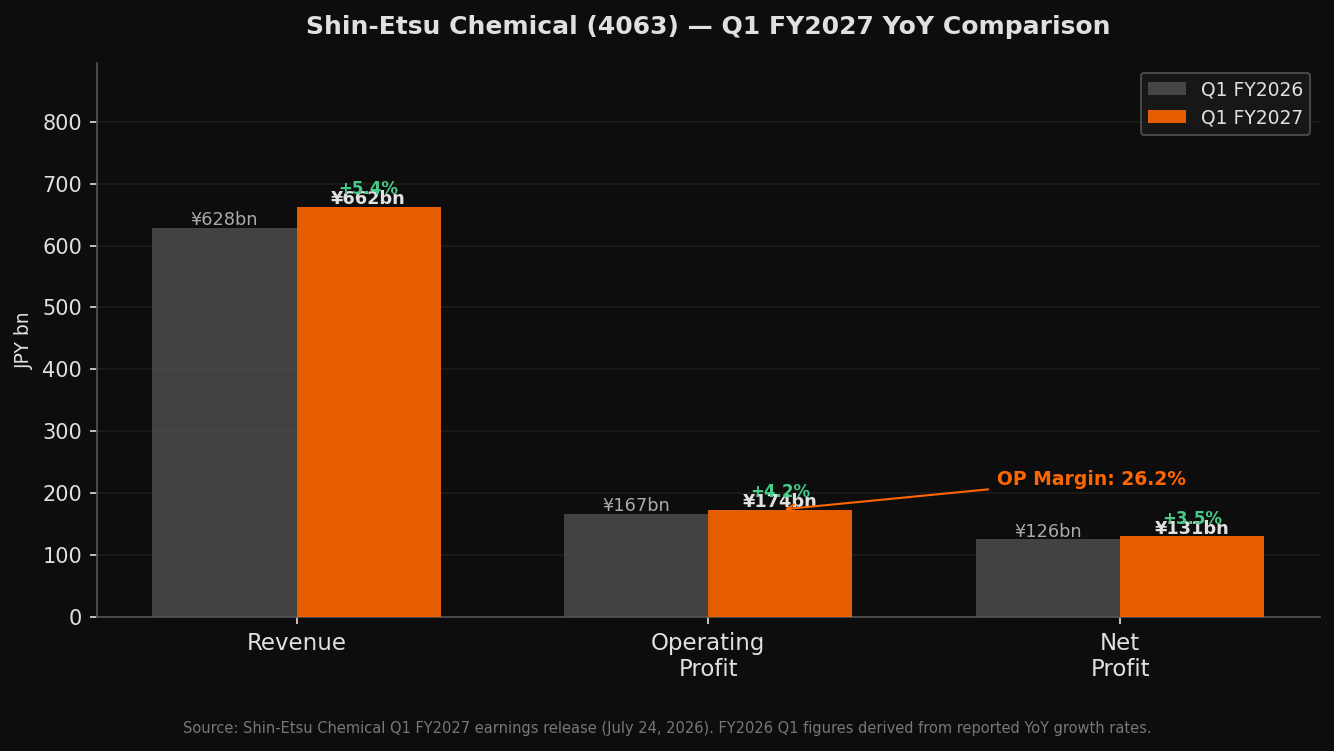 Figure 1: Shin-Etsu Chemical Q1 FY2027 vs Q1 FY2026. YoY growth rates shown in green. Source: Company earnings release, July 24, 2026.
Why Profit Grows Faster Than Revenue
The full-year guidance implies a margin of approximately 25.9% on the revenue target of ¥2,700bn. That is slightly below Q1’s 26.2% — which means Q1 came in ahead of the full-year trajectory. Management’s full-year projection already embeds meaningful margin expansion from FY2026 levels (approximately 24.7%).
The mechanisms for this expansion are straightforward:
Fixed cost absorption. Shin-Etsu’s production facilities — wafer polishing lines, PVC chlor-alkali plants — carry high fixed costs. When volume grows even modestly, incremental revenue flows to profit at a much higher rate than the blended average. A +5% revenue increase does not require a +5% increase in plant overhead.
Product mix. Within the silicon wafer segment, leading-edge 300mm wafers command higher prices than legacy 200mm. As advanced logic and HBM memory demand grows, the mix shifts toward higher-ASP products. Shin-Etsu’s wafer revenue per unit improves without requiring volume gains.
Raw material stabilization. Chlorine and polysilicon input costs have moderated from peak levels. Lower input costs, combined with firm product pricing, directly expand gross margin.
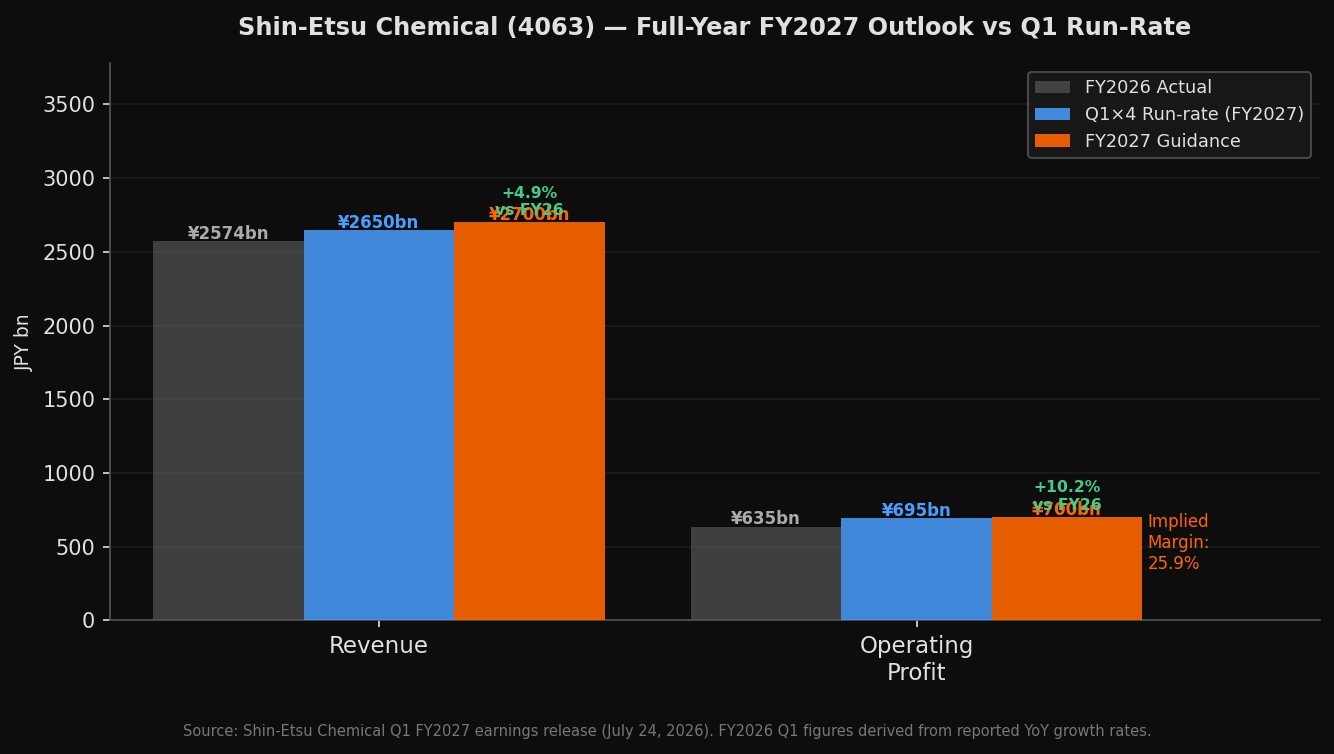 Figure 2: FY2027 full-year guidance vs annualized Q1 run-rate and FY2026 actual. The Q1 annualized OP run-rate (¥695bn) tracks within 1% of the ¥700bn full-year target. Implied FY2027 margin: 25.9%. Source: Company earnings release.
AI Tailwind: Real, but Already Priced In?
Shin-Etsu’s management commentary explicitly cited AI data center investment as a demand driver. This is accurate. But investors should contextualize it.
The silicon wafer market is not a direct proxy for AI spending. Data centers buy chips; chips consume wafers; wafers require 18–24 months of lead time from wafer production to chip completion. The wafer demand currently arriving at Shin-Etsu’s fabs was contracted 18 months ago. The current AI infrastructure boom will manifest in wafer orders over the next 12–18 months.
This creates a pipeline dynamic: the Q1 FY2027 wafer results reflect investment decisions made in early calendar 2025. The next wave of AI-driven demand — linked to Blackwell, Rubin, and their successors — is still converting from chip orders to wafer purchase agreements. Shin-Etsu’s wafer backlog is filling with future AI capacity; it has not yet fully appeared in reported results.
For investors, this means the AI tailwind is structural over a 3–5 year horizon rather than fully reflected in the current quarter’s numbers. The guidance for +10.2% operating profit growth implies management sees this pipeline as largely committed.
The Section 301 Headwind: Real but Manageable
Today’s activation of the 12.5% Section 301 tariff on Japan creates a permanent cost item for Shin-Etsu’s US-destined exports from Japan. We estimated the additional annual burden at approximately ¥16 billion per year — the largest absolute number among Japan’s clean exporters, by virtue of Shin-Etsu’s scale.
At a ¥700bn operating profit run-rate, ¥16bn represents 2.3% of earnings. That is not trivial, but it is not a strategic threat either. For context:
- EU silicon wafer competitors (primarily Siltronic of Germany, operating at lower margins) pay 10%. The 2.5% gap creates pricing advantage headroom for European competitors in US contracts.
- Shin-Etsu’s wafer customers face extremely high switching costs. The 2.5% tariff creates pricing pressure, but it does not make Siltronic or SK Siltron an immediate substitute.
- Shintech (Shin-Etsu’s US PVC subsidiary) manufactures in the US, so its output is not subject to import tariffs. The tariff burden falls primarily on wafer and specialty chemical exports from Japan.
The long-term question is whether Shin-Etsu accelerates investment in US wafer manufacturing capacity to reduce its tariff exposure. The company has historically preferred Japanese manufacturing for quality control reasons. At ¥16bn/year, the economic incentive to shift production is modest but growing.
Balance Sheet: The Unlocked Asset
A 79% equity ratio in a capital-intensive business is extraordinary. Shin-Etsu carries essentially no leverage. Its net cash position is substantial.
Japanese chemical companies with strong balance sheets have historically been criticized for hoarding cash rather than deploying it. Shin-Etsu has maintained this posture across cycles — investing steadily in capacity but rarely making large acquisitions or aggressively returning capital.
The question for FY2027: with AI-driven wafer demand creating a multi-year growth window, will management accelerate capex? Or does the balance sheet continue to grow while shareholders wait? The company has increased dividends gradually, but the yield remains modest relative to the cash accumulation rate.
For investors who can tolerate a long holding period, the balance sheet represents stored optionality: Shin-Etsu can respond to any competitor move, technology shift, or M&A opportunity from a position of complete financial freedom. The cost of that optionality is the return forgone on deployed capital.
What This Quarter Signals
A 26.2% operating margin, flat against a prior-year period that was itself at elevated margins, tells investors that Shin-Etsu’s profitability is not mean-reverting. The company is not in a peak-cycle quarter that will normalize lower. The full-year guidance embeds further expansion.
The near-term risks are currency (yen appreciation compresses yen-denominated revenue from overseas operations) and wafer cycle timing (an AI investment pause would hit wafer orders with an 18-month lag). The structural risks are modest: no competitor is close to replicating Shin-Etsu’s wafer manufacturing scale, and PVC’s North American moat is similarly durable.
For investors tracking Japan’s high-quality industrial complex, Shin-Etsu Chemical is the benchmark. The question is never whether the business is exceptional — it is whether the price already reflects it.
Source: Shin-Etsu Chemical Q1 FY2027 Earnings Release (TDnet) | Section 301 Collateral Damage Analysis | 日本語版
Disclaimer | This article is for informational purposes only and does not constitute investment advice.