Our previous piece argued the BOJ’s June 16 hike to 1.00% was solving the wrong problem. Since then, two things happened: the hike’s own governance turned out to be stranger than the headline suggested, and 30 years of data confirmed the yen-defense logic behind it doesn’t hold up.
A Hike Decided Without the Governor
Governor Kazuo Ueda was hospitalized on June 9 for a liver cyst infection and missed the June 15–16 policy meeting entirely — the first time a sitting BOJ governor has missed a regular policy meeting since the current Bank of Japan Act took effect in 1998. Deputy Governor Ryozo Himino chaired in his absence; Deputy Governor Shinichi Uchida handled the press conference and explicitly denied speculation about Ueda’s health, calling the absence “lonely.”
More notable than the absence itself: reporting on the meeting indicates the BOJ’s executive wing — the governor and deputy governors — had favored holding rates, while external policy board members pushed for the hike on grounds that inflation was running ahead of the bank’s response. The proposal on the table is reported to have been switched from “hold” to “hike” specifically to avoid the optics of the chair’s own motion being voted down. This was, by most reconstructions, a hike driven by the board’s external members over the executive’s preference — not the other way around.
Those external members are not “bank representatives” in the way that framing might suggest. Of the six, one (Naoki Tamura) is a former Sumitomo Mitsui Banking Corporation executive and the board’s most consistent hawk; the rest come from asset management, securities-house economics, international academia, and trading-company industry backgrounds. The board is, if anything, becoming less hawkish going forward — both incoming replacements for departing members are reflation-leaning economists expected to favor caution on further hikes.
What “2.8%” Actually Measures
The BOJ’s April 2026 Outlook Report raised its FY2026 forecast for “CPI excluding fresh food” — Japan’s official “core” — to 2.8%, up sharply from January. The report’s own language attributes this almost entirely to Middle East-driven crude oil prices pushing up energy and goods prices.
That matters because Japan’s official “core” still includes energy. The measure the US, UK, and Australia call “core” — excluding both fresh food and energy — is what Japan calls “core-core,” and it ran at 1.9% in April, below the US (2.9%) and Eurozone (2.2–2.5%) equivalents. The Fed’s preferred gauge, core PCE, deliberately strips out food and energy for the same reason central banks elsewhere look through these prints: oil shocks aren’t something a domestic rate hike can fix. The 2.8% figure cited as part of the case for hiking is carrying an imported, supply-side shock that Tokyo’s policy rate has no leverage over.
30 Years of Data Say the Yen-Defense Channel Just Broke
We pulled monthly BOJ monetary base data, the BOJ policy/call rate, the US-Japan rate differential, and USD/JPY back to 1996 to test the textbook claim directly: do rate hikes and a narrowing rate differential actually correlate with a stronger yen?
| Relationship | 30-year correlation (1996–2026) | 2024–2026 hiking/QT cycle |
|---|---|---|
| US–Japan rate differential vs. USD/JPY | +0.57 | −0.29 |
| BOJ monetary base vs. USD/JPY | +0.48 | −0.47 |
Over three decades, both relationships run in the textbook direction: a wider US rate advantage and a larger monetary base both track with a weaker yen, and their opposites with a stronger one. That’s the basis for “hike rates, shrink the balance sheet, defend the yen.”
In the actual 2024–2026 episode, both signs flipped. The rate differential narrowed from 5.34 points to 2.90 as the BOJ hiked and the Fed held — narrowing differentials are supposed to support the yen — and the monetary base shrank 14%, from ¥668.0tn to ¥575.8tn, as the BOJ ran quantitative tightening alongside the hikes. Both moves point the textbook way toward a stronger yen. USD/JPY went from ¥146.3 to ¥158.2 instead.
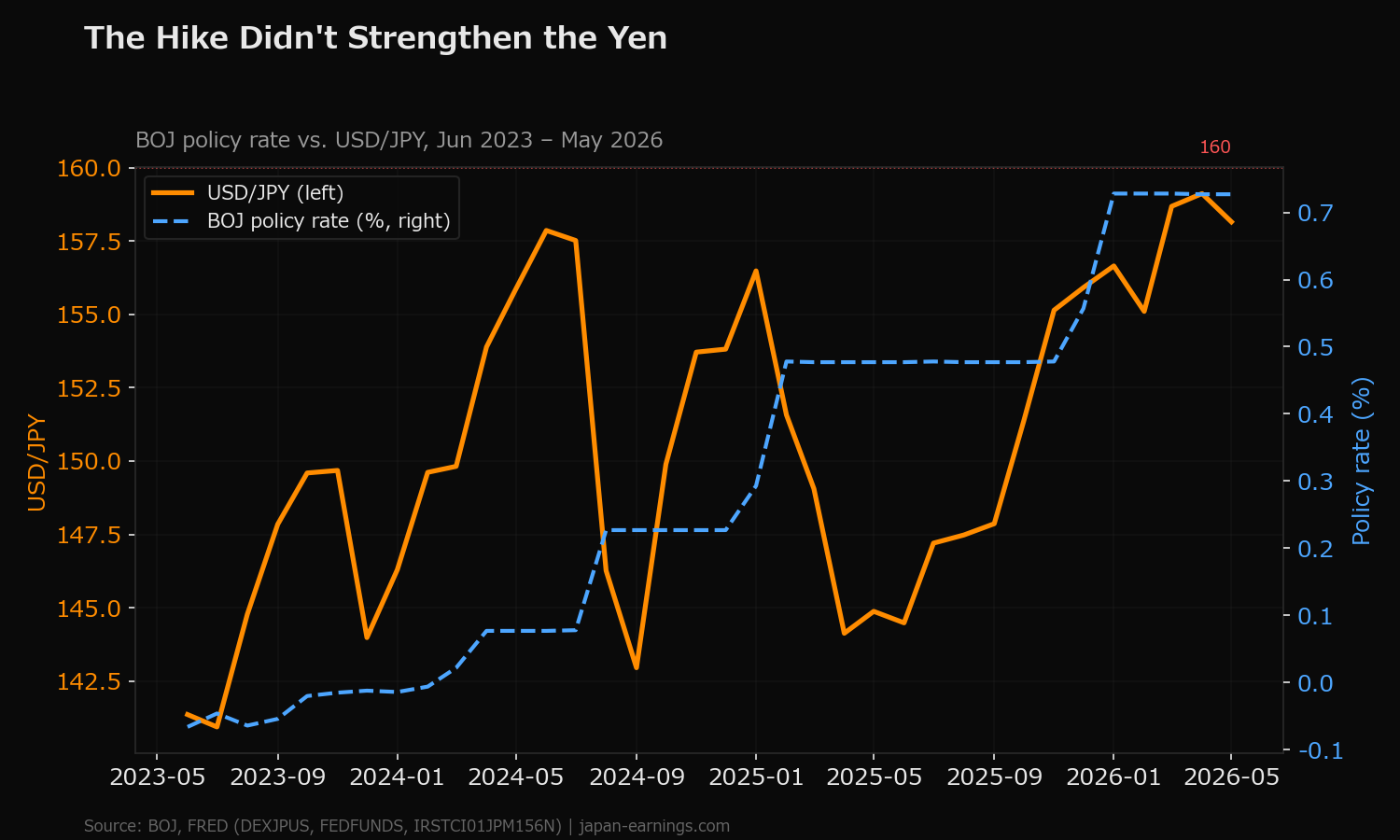
This is a 29-month sample, not a structural break proof, and correlation isn’t causation — something else (oil prices, dollar risk demand, capital flows) is plainly doing more work on the yen right now than BOJ policy. But that is itself the point: if Tokyo’s own policy variables aren’t what’s moving the exchange rate, raising rates to “defend the yen” is pulling a lever that isn’t connected to the machine.
Who Actually Captures the Yen Weakness
This is where the story closes a loop. A weak yen that monetary tightening can’t fix still has winners — Japanese exporters booking higher yen-translated profits — and losers, concentrated in households and import-dependent firms paying more for energy and food with wages that haven’t kept pace.
The national accounts have a name for this: the gap between real GDP and real GNI, driven by terms-of-trade deterioration. When import prices rise faster than export prices — exactly what a weak yen plus an oil shock produces — Japan as a whole transfers real purchasing power abroad even as headline output and corporate profit figures look strong. Mizuho Securities estimates the H2 2026 import price surge alone at a roughly ¥3.8tn additional income outflow.
Put together: a hike whose own yen-defense rationale doesn’t survive contact with 30 years of its own data, decided in the governor’s absence by a board whose executive wing wanted to hold, justified partly by an inflation figure that’s mostly an oil shock — while the real economic transfer underway is from household purchasing power to exporter profit margins, with no rate decision in Tokyo currently capable of reversing it.
Can the Government Step In Before This Breaks Something?
A structure where households and import-dependent SMEs are quietly subsidizing exporter profit margins is not one the public will tolerate indefinitely once it’s visible in real wages rather than buried in trade statistics. That makes the open question not “will the BOJ hike again” but “does the government have a circuit breaker before that patience runs out.”
What’s actually on the table is indirect. The government is leaning on wage-increase tax credits and pre-shunto tripartite talks between government, business, and labor to pressure companies into passing profits through to pay — not a mechanism that claws back exporter windfalls directly. It’s also promoting SME and agricultural exports and inbound tourism as alternative income channels that benefit from the same weak yen. Japan’s FY2026 official wage-price math threads the needle on paper: nominal pay up roughly 2.8%, inflation cooling toward 2%, a modest positive real wage. But the channel itself is structurally weaker than it was in the 1985–2000s era this playbook was designed for — with roughly 30–40% of manufacturing output now produced overseas, a larger share of weak-yen profit shows up as repatriated earnings at the parent company rather than domestic output that pulls up local wages directly.
The government is betting that voluntary pass-through arrives before the public accounting does. Whether it does is the actual test here — not the next BOJ statement.
Source: BOJ Outlook Report, April 2026 | Nikkei: BOJ hikes with Governor absent | 日本語版
Disclaimer | This article is for informational purposes only and does not constitute investment advice.